

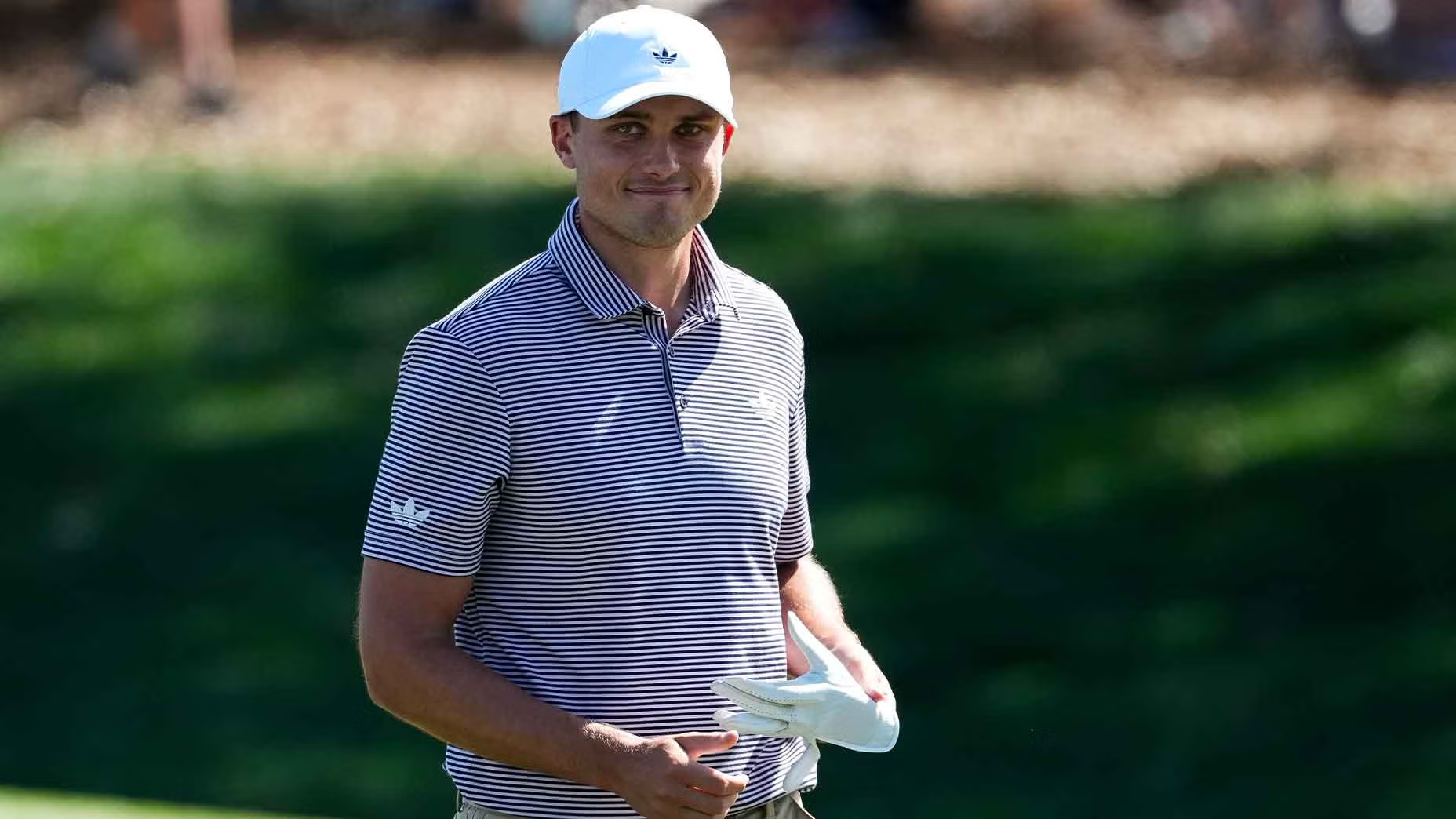

When the Tour’s Best Aren’t Best: What Aberg’s Dominance Says About Professional Golf Right Now
I’ve been covering professional golf for 35 years, and I’ve learned to trust one thing above all else: the leaderboard doesn’t lie. So when Scottie Scheffler—a man who’s won five times already this season and is playing at a level we haven’t seen since Tiger’s prime—finds himself 13 shots off the lead after 36 holes at the Players Championship, you pay attention. When Rory McIlroy, still one of the best ball-strikers on the planet, can’t crack even par, something significant is happening.
What’s happening, friends, is that the Players Championship leaderboard is telling us a story that extends far beyond Ponte Vedra Beach. It’s a story about depth, about the democratization of elite professional golf, and about a Swedish kid who’s reminding us all why we fell in love with this game in the first place.
The Scheffler Problem That Isn’t Actually a Problem
Let me be clear: Scottie Scheffler made the cut. He’s still in the tournament. But here’s what strikes me about his 1-over performance through two rounds—his driver, which has been an absolute weapon all season, abandoned him on one of the game’s most unforgiving courses. That’s not a weakness in Scheffler; that’s just golf. And frankly, it’s healthy for the Tour.
Having caddied for Tom Lehman back in the ’90s, I saw firsthand what happens when one player gets too far ahead of the field: the casual fan stops caring. Major championships become coronations. The narrative gets stale. What we’re witnessing at TPC Sawgrass is a course and a setup that refuses to be conquered by superior talent alone. You have to execute. You have to be sharp. You have to want it.
Ludvig Aberg clearly wants it.
The Aberg Moment We’ve Been Waiting For
Let’s talk about that 63. On Friday afternoon. In firming conditions. On a golf course that was playing significantly harder than it did Thursday. That’s not just a good round; that’s a statement. At 12-under par and a two-shot lead heading into the weekend, Aberg has positioned himself exactly where a rising star should be at the year’s most prestigious non-major.
“It’s no secret that I’m a fast player and I like it fast,” Aberg said after enduring a 20-minute wait on the 7th tee box.
There’s something I appreciate about that comment—it shows self-awareness and a healthy sense of humor about the grind. But it also reveals something deeper: Aberg’s mentality. He’s impatient in the best possible way. He doesn’t overthink. He executes.
What strikes me most about Aberg’s position here is the historical weight of it. This is a 24-year-old Swede who’s already established himself as a legitimate tour player, and now he has a genuine chance to announce himself as something more—a player capable of winning the events that define careers. In my 15 trips to the Masters, I’ve watched enough young champions’ trajectories to know: this moment matters.
The Leaderboard’s Real Story
Here’s where the article gets interesting beyond the obvious narrative. Of the six players within five shots of the lead heading into the weekend, four are major-less professionals (Aberg, Cameron Young, Corey Conners, and Sepp Straka). That’s not a fluke. That’s not a quirk of one week’s golf. That’s a statement about the current Tour landscape.
“This Tour is not easy to survive every year. It was a huge win,” Si Woo Kim reflected, recalling his 2017 Players Championship victory as a 21-year-old.
Kim knows something about breakthrough moments. He knows they’re rare. He also knows they’re career-altering. Since his win seven years ago, Kim has become a fixture on Tour, a player with staying power. That’s what a Players Championship victory does—it changes the trajectory.
What fascinates me about this particular leaderboard is how it contradicts the narrative that’s dominated professional golf for the past 18 months: that only Scheffler and McIlroy matter. That narrative sells, but it sells short. The Tour is deeper than it’s been in years. The talent pipeline is unclogged. And a golf course like TPC Sawgrass—a course that demands precision and respect—has a way of exposing which players are truly elite and which are simply playing well that week.
The Brian Rolapp Factor
I’ll be honest: I was skeptical about some of the Tour’s recent organizational shifts. But here’s something the new PGA Tour CEO understands that some of his predecessors didn’t—a Players Championship won by Ludvig Aberg or Cameron Young or Xander Schauffele (trying to reverse a quiet 12 months) is infinitely more valuable than another coronation by the usual suspects.
“Advantage or not, there’s little question that Aberg is the favorite,” the article notes. “Aberg is loath to address the kind of rampant speculation that fills a Friday evening with a two-shot lead at the biggest non-major of the golf season.”
Smart man. Let the golf do the talking.
What This Means for the Weekend (and Beyond)
The beauty of TPC Sawgrass is that it doesn’t reward complacency. Aberg’s two-shot lead is substantial but not insurmountable. The island green on 17 has ended dreams before. The brutal finishing stretch has humbled everyone from Nicklaus to Norman.
If I had to bet on who wins this thing, I’m taking Aberg. But if I had to predict who wins the next three Players Championships? I’m not confident about anything. And that’s actually wonderful news for professional golf. The field is closing. Opportunities are expanding. And young players with talent and hunger are finally getting their moments in the sun.
That’s the real story at Ponte Vedra Beach this week—not that Scheffler stumbled, but that golf itself is thriving.
