

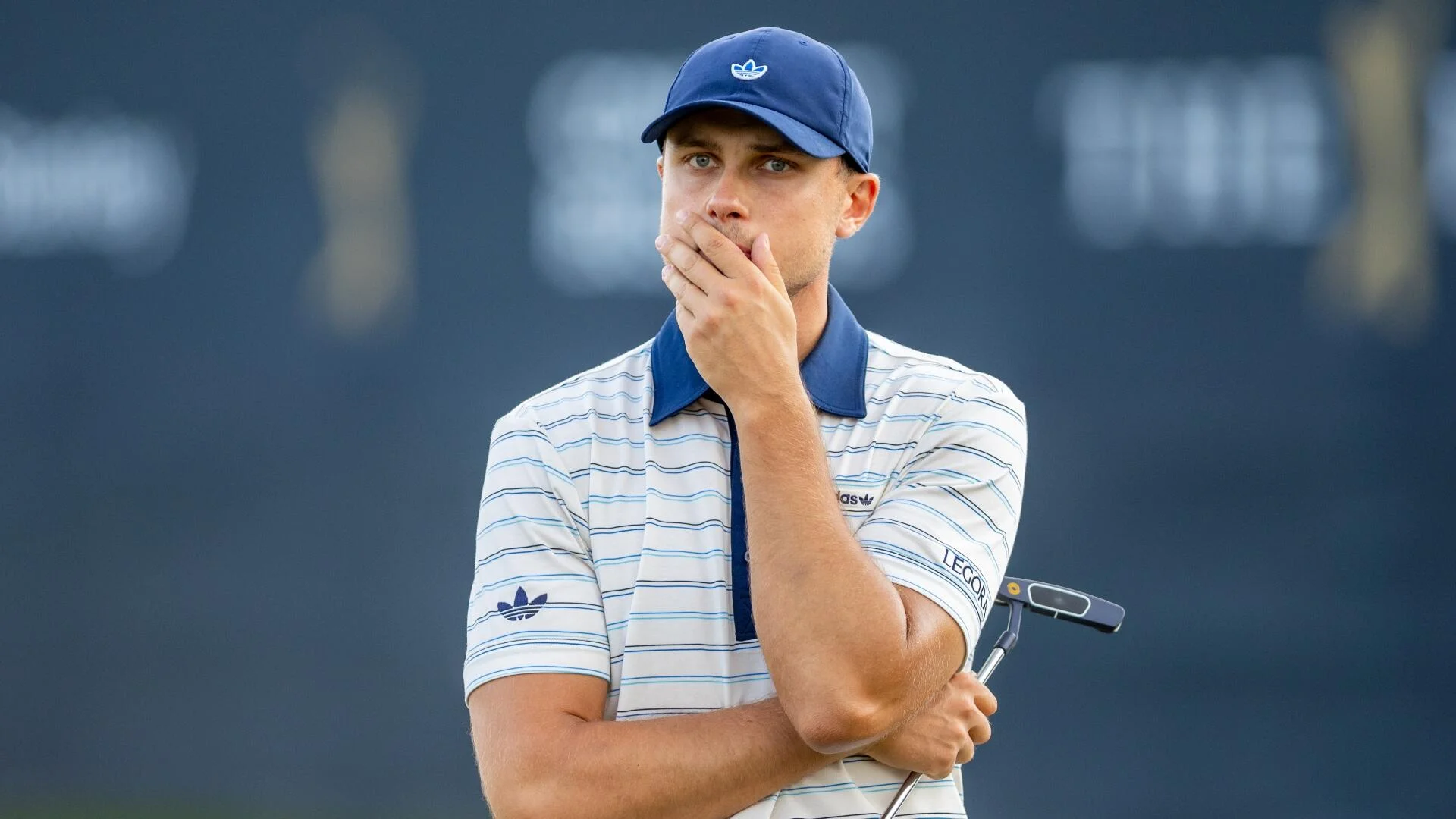

The Ludvig Conundrum: Talent Meets Temperament at The Players
I’ve watched a lot of talented young players come through the PGA Tour over my 35 years in this business, and I can tell you with certainty: raw ability and major championship pedigree don’t guarantee anything if you can’t manage the mental side of a four-round grind. What happened to Ludvig Åberg at TPC Sawgrass on Sunday wasn’t a fluke or a bad break. It was a masterclass in self-sabotage delivered by a player who knows exactly what his problem is—and still can’t seem to stop himself from walking straight into it.
Let me be clear: Åberg is phenomenally talented. That swing is a thing of beauty—smooth, repeatable, efficient. I’ve caddied for players with less talent who’ve won majors, and I’ve covered enough golf to know that technical ability is just the starting line. What separates winners from contenders is what happens between the ears when pressure cranks up. On Sunday at The Players, we got another painful illustration of where Åberg currently sits on that spectrum.
Knowing the Problem and Solving It Are Two Different Things
Here’s what struck me most about this collapse: Åberg articulated his exact weakness after Saturday’s round. “Whenever I get in a stressful situation, I have to slow myself down because I get really fast,” he said. “I start talking fast, I start breathing fast, and I kind of get, like, a little worked up like that. So, I just have to really calm myself down, try to walk slow, talk slow, make everything just a little bit slower, which is a challenge.”
That’s genuine self-awareness. That’s also cold comfort when you’re watching him pull driver on the 12th hole—a hole where he knew he shouldn’t be aggressive—and snap a hook into the water. The distance between intellectual understanding and execution under pressure might be the widest gap in professional golf.
The sequence on 11 and 12 was particularly revealing. On 11, a reachable par 5 where he should’ve had an advantage, he found the center of the fairway and then served up a slicing 7-wood that sailed into the pond. That one stings because it was a reasonable aggressive play—find the green and you’re almost certainly getting a birdie to extend the lead. But the subsequent bogey, combined with a Fitzpatrick birdie, suddenly erased his comfortable cushion.
Instead of taking the gut punch, processing it, and moving on with a patient approach, Åberg let the situation accelerate him. Twelve holes into that back nine, and he was already three shots down. The youthful aggression that makes him so dangerous when things are rolling had become a liability the moment the script flipped.
The Putting Elephant in the Room
But here’s what I think gets overlooked in these post-mortems: Åberg’s putting statistics tell a story that goes deeper than Sunday’s collapse. He’s 76th in strokes gained putting this season after finishing 67th and 86th in 2024 and 2025 respectively. That’s not variance. That’s a pattern.
When players don’t trust their putter, they compensate with aggression off the tee. They hunt for birdie opportunities because they don’t believe they’ll convert the makeable putts that come from conservative positioning. I’ve seen this countless times. It’s a vicious cycle: lack of confidence breeds aggressive decision-making, which breeds worse scoring, which confirms the lack of confidence.
Cameron Young’s trajectory is instructive here. Young was worse than 145th in strokes gained putting in 2023 and 2024 before flipping the script entirely, finishing 7th in 2025—and guess what? That‘s when he finally broke through for a win. Young’s 10-footer on 17 to tie the lead wasn’t luck. It was the byproduct of months spent in putting labs and practice ranges, building something he could lean on in the moment that mattered.
The Path Forward Exists—But It Requires Work
I don’t want to be unfair to Åberg. He’s in just his third year on the PGA Tour. He’s already played in two Ryder Cups for winning European sides. He’s contended in majors. The foundation is there. But there’s a learning curve, and we’re watching his happen in real time—sometimes painfully so.
The solution isn’t rocket science: improve the putter, build confidence on the greens, and suddenly you can afford to play the conservative aggression that separates five-time major champions from talented also-rans. It’s a well-worn path. Jordan Spieth had to take it. Rory McIlroy had to take it. Even Brooks Koepka, who acknowledged his putting struggles early this year, is starting to climb back by addressing that specific weakness.
What gives me confidence about Åberg’s eventual breakthrough is precisely what made Sunday so frustrating: he knows what he needs to fix. He’s self-aware enough to identify it and honest enough to admit it. Some players never get there. They blame the course, the breaks, the equipment. Åberg owns his stuff. That’s a hallmark of players who eventually do the work and break through.
Could it happen in a few weeks? Absolutely. Could it take another year or two? Sure. But as inevitable as his Sunday struggles felt this week, so is the feeling that when it all clicks—when that putter starts behaving and that aggressive instinct gets properly calibrated—Åberg is going to pile up some serious wins on this tour.
Until then, though, he and all of us watching are going to have to exercise something Ludvig’s still learning: patience.
