


Augusta’s Iron Grip: What the Kenny Mayne Ban Reveals About Golf’s Most Powerful Institution
I’ve been covering professional golf for 35 years, and I’ve learned that Augusta National Golf Club operates by a set of rules that would make a Swiss watchmaker look casual. But Kenny Mayne’s revelation about his lifetime ban from the grounds tells us something far more interesting than just another story about the club’s famous rigidity—it reveals how the sport’s most influential institution still grapples with its complicated past, even as it tries to move forward.
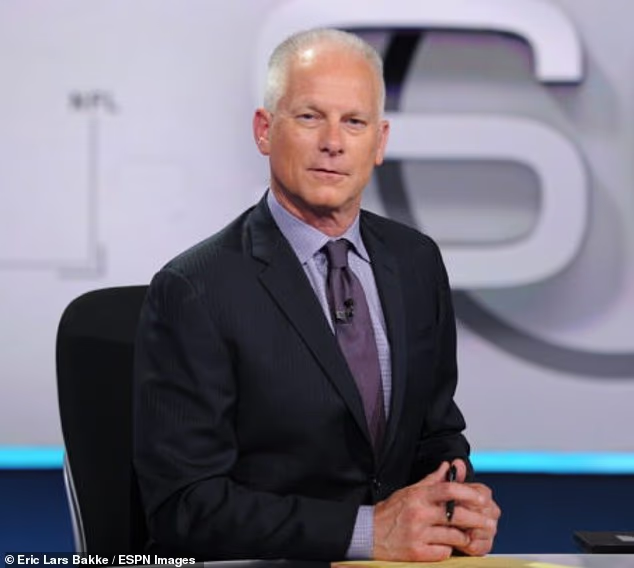
For those who’ve been living under a divot, Mayne—the veteran ESPN broadcaster who covered golf for years alongside legends like Van Pelt and Andy North—revealed recently that he believes he’s been banned for life from Augusta National over a joke he made about bringing women to play the course. The timing of this comment, made during an appearance on the “God Bless Football” podcast with Jon Weiner, is particularly illuminating given where we stand in 2026.
Context Matters—And So Does History
Here’s where I think people miss the real story. Yes, Augusta National is famous for micromanaging broadcast language—insisting on “patrons” instead of “fans,” the “second cut” instead of the “rough.” That’s old news, and frankly, it’s part of the club’s eccentric charm at this point. But what Mayne’s ban really underscores is that Augusta still operates from a defensive crouch when it comes to gender issues, even after admitting Condoleeza Rice and Darla Moore to membership back in 2012.
Think about that timeline for a moment. The club finally broke its all-male tradition just 14 years ago—not in response to principle, but after decades of relentless pressure from women’s rights groups and cultural evolution that simply left them behind. And even now, according to Mayne’s account, a casual joke about women playing golf was treated like a Five-Star violation.
“I used to cover golf, I used to do the TPC Sawgrass, and I did the U.S. Open every year for, I don’t know, seven or eight years. It was me, Van Pelt, Andy North, the whole gang… [Augusta National] called into the ESPN truck, like we’re still on the air, and the people in Augusta are literally, they somehow have the inside number to the truck. And they were like, ‘He is not coming!'”
What strikes me most about this account is the immediacy and the power. Mayne wasn’t fired by ESPN. The club itself interceded directly into the broadcast truck—mid-production—to ensure his banishment. That’s not just enforcing standards; that’s flexing institutional muscle in a way that feels almost out of proportion to the offense.
The Contradiction at the Heart of Augusta
In my three decades covering the tour, I’ve watched Augusta National navigate an impossible tension: it wants to be seen as an institution of tradition and excellence, yet it’s also fundamentally a private club that has had to reckon with being on the wrong side of history. The club’s approach has always been to control the narrative with an iron fist—and control it they do, from the color of the carpets in the clubhouse to which pronouns broadcasters use.
But here’s what’s genuinely troubling about the Mayne situation: it suggests that even a joke perceived as supportive of women’s golf access was treated as an existential threat. That’s not enforcing standards—that’s governing from fear. And when an institution that powerful governs from fear, it tends to make decisions that age poorly.
Having caddied in the ’90s, I remember what Augusta felt like to those of us on the inside. It was sacred, yes, but it was also suffocating. The club’s reaction to Mayne’s comment feels like it’s coming from that same playbook—the one that said women didn’t belong there, and jokes about women belonging there were somehow worse than the exclusion itself.
The Broader Picture
It’s worth noting that Mayne left ESPN in May 2021 after 27 years, reportedly declining a 60-plus percent pay cut. The man had credentials, tenure, and respect. He wasn’t some provocateur looking to stir the pot. He was a golf journalist doing his job, and a casual quip—one that, by today’s standards, seems almost quaint in its mildness—cost him access to the most prestigious golf course in the world.
What I find encouraging, though, is that Mayne felt comfortable enough to publicly discuss this ban. That suggests the institutional fear Augusta cultivated for so long is beginning to lose its stranglehold. In my experience, when insiders start talking, it’s because the rules have changed enough that the cost of silence exceeds the cost of speaking.
Augusta National will always be Augusta National—a law unto itself, answerable to no one. That’s part of what makes the Masters what it is. But the Mayne situation reminds us that even the most powerful institutions in golf are wrestling with questions about inclusion and progress. The fact that they’re still handling those questions so defensively, in 2026, tells you something important about how much work remains to be done.
The course itself—Amen Corner, Magnolia Lane, that perfect green—remains perfect. The people running the place, though? They’re still learning how to be.
