


Akshay Bhatia’s Bay Hill Breakthrough: Why This Victory Matters More Than the Scoreboard
I’ve been covering professional golf long enough to know that not all wins are created equal. Some tournaments blur together in the memory—great shots, nice paydays, then on to the next event. But every once in a while, you witness something that transcends scorecard and purse money, something that reminds you why we fell in love with this game in the first place.
Akshay Bhatia’s playoff victory over Daniel Berger at the Arnold Palmer Invitational last Sunday was one of those moments.
Now, I’m not being sentimental here. In 35 years around this tour, I’ve learned to separate the feel-good narrative from what actually matters competitively. But in Bhatia’s case, the two are genuinely intertwined, and that’s what makes this particular $4 million check mean something deeper than the hardware it represents.
The Breakthrough Nobody Saw Coming
Let’s start with the obvious: Bhatia hadn’t won on the PGA Tour in nearly two years. His previous victories—the Barracuda Championship in July 2023 and the Valero Texas Open in April 2024—showed promise, but in professional golf, promise and paychecks are different animals. The tour is littered with talented players who won once, maybe twice, then faded into the background. The question hanging over Bhatia wasn’t whether he could play; it was whether he could win when it mattered.
Sunday at Bay Hill answered that question emphatically.
What strikes me most about this victory is the manner of it. Bhatia came from two shots back on a brutally difficult golf course—Bay Hill doesn’t yield to hope and positive thinking—and forced a playoff. That’s not luck. That’s not a soft field. That’s a player who showed up when the pressure was highest and executed when execution mattered.
In my experience caddying for Tom Lehman back in the day, I learned that playoff victories carry a different weight than wire-to-wire dominance. They require a specific kind of mental toughness—the ability to watch your opponent’s birdie putt go in the cup and not flinch. Bhatia possessed that on Sunday.
The Story Behind the Rainbow
But here’s where this gets important beyond the competitive realm.
“My niece passed away in December, and so I knew she was looking over me this year. You know, I made this win for her, for sure.”
Bhatia revealed that his niece Mia, diagnosed with a rare disease that doctors said would limit her to a year of life, passed away in December. She defied those odds for years, and when Bhatia got married, she made the difficult journey to be there—only to pass away the day of the wedding. In the press conference after his victory, Bhatia described seeing a rainbow on the 18th hole and feeling her presence.
I’ve covered 15 Masters tournaments. I’ve seen grown men cry on the 18th green. But rarely do you see genuine, unfiltered emotion tied to something larger than golf itself. What Bhatia experienced wasn’t just about winning a signature event; it was about carrying something sacred through four rounds of one of the toughest courses on tour.
In his Instagram post from December, Bhatia wrote about his niece: “Miss Mia had the best hair, the best smile, and was one of the strongest kids I know. I will cherish her and play for her every single day. She meant the world to us and showed so much resilience each and every day. Fly high. I love you.”
Having spent decades around touring professionals, I can tell you that authenticity like this is rare. Most players talk about motivation in abstract terms—family legacy, hunger, the desire to compete. Bhatia’s motivation was specific, personal, and deeply felt. And that kind of clarity has a way of sharpening a player’s focus.
The Timing Question
One detail worth noting: Bhatia won this signature event just days before heading to TPC Sawgrass for the Players Championship, one of the tour’s marquee events. In my experience covering the tour, momentum in professional golf is real but fragile. Some players thrive with a win behind them; others tighten up under the weight of expectations.
Bhatia appears to be the type who thrives. His victory wasn’t a fluke—it was a statement of arrival as a consistent winner on the PGA Tour. The question now becomes whether this is the beginning of something bigger for him.
What This Victory Really Means
The broader significance here is this: Bhatia represents a generational shift in professional golf. He’s part of that wave of younger, more emotionally intelligent players who aren’t afraid to talk about what moves them. Too often in golf, we’ve been sold a narrative of steely-eyed warriors who channel their emotions into pure competition. That’s still valid—but it’s not the only way to compete.
“When I saw that rainbow on 18, it reminded me of her so that was really cool, a special moment for us.”
Bhatia’s ability to hold both—genuine grief and emotional connection alongside championship-level execution—suggests that the two aren’t mutually exclusive. If anything, they might be complementary.
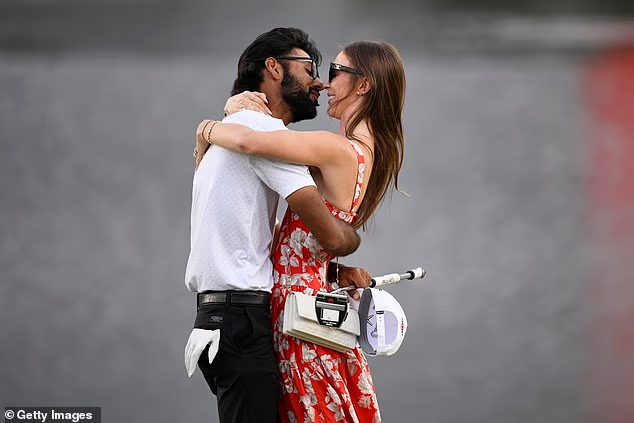
His wife Presleigh was there for the embrace on the 18th green. His parents watched from the side. The entire Bhatia family has a deep golf heritage, and that support system clearly runs deep. In my experience, players who have that kind of foundation tend to sustain success over time.
So while everyone will focus on the playoff victory and the $4 million purse, what I’ll remember is a young player who came from two shots back on a monster golf course and won a signature event—all while carrying something much larger than a golf ball. That’s the kind of victory that changes trajectories. That’s the kind of performance that separates the players who win from the players who are going to win consistently.
Bhatia just made the leap. The question now is whether he stays there.
