

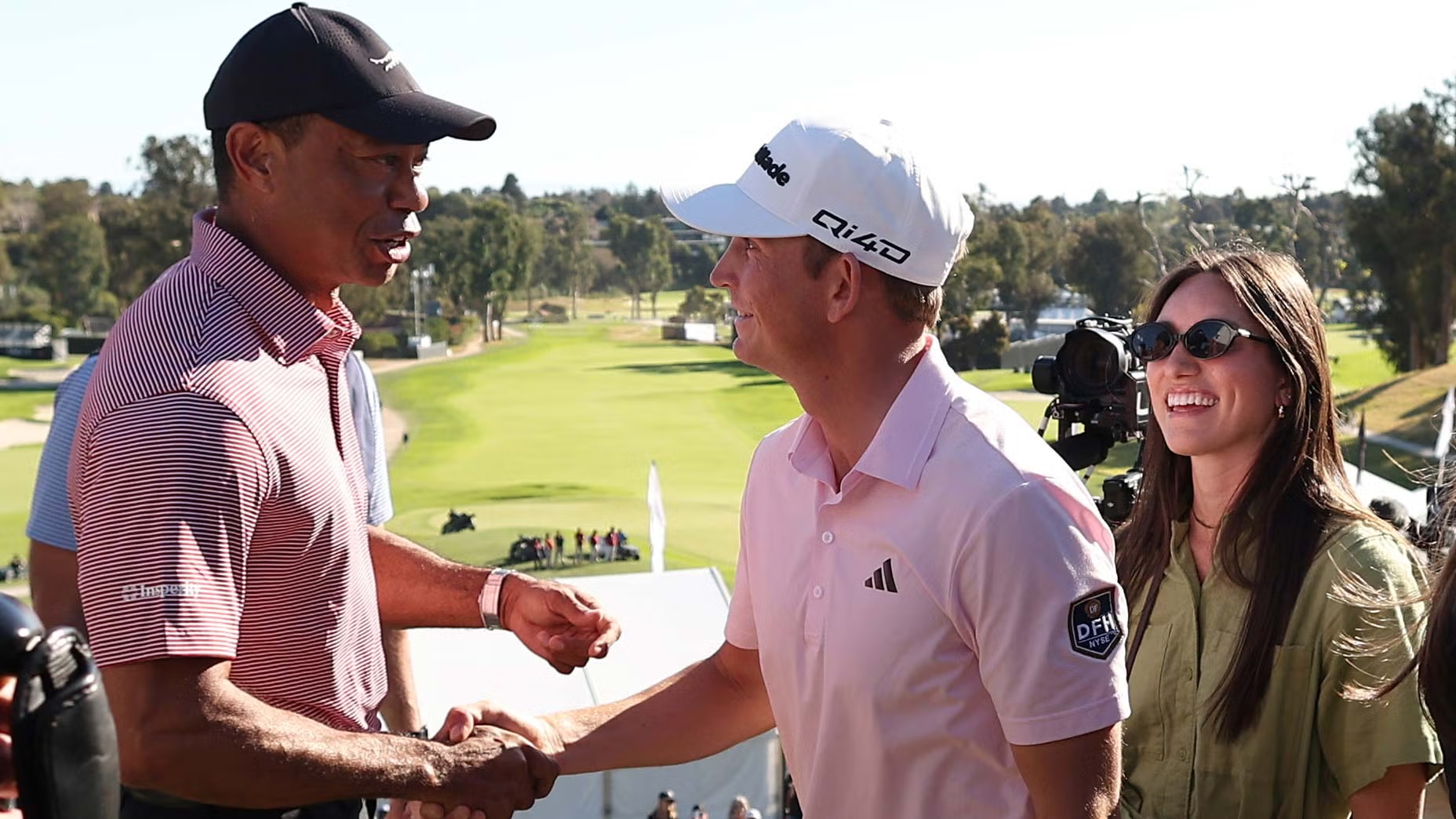

Jacob Bridgeman’s Genesis Win Reveals a Tour Truth We Often Forget
I’ve spent 35 years watching golfers navigate the space between ambition and execution, and I can tell you with absolute certainty: that three-and-a-half-foot putt Jacob Bridgeman faced on the 18th green at Riviera on Sunday tells you more about modern professional golf than any stat sheet ever could.
Not because it was a difficult putt—though Lord knows it was, with a six-stroke lead evaporated and Kurt Kitayama posting 17-under par waiting in the clubhouse. What strikes me about Bridgeman’s moment isn’t the pressure or the stakes. It’s what happened when the pressure became so intense that his nervous system essentially checked out.
“I couldn’t even feel my hands on the last couple greens, I just hit the putt hoping it would get somewhere near the hole.”
That’s not weakness. That’s actually something closer to a superpower, and I wish more young players understood it.
The Autopilot Advantage
Having caddied for Tom Lehman back in the ’90s, I watched him navigate similar moments—the kind where your conscious mind becomes your worst enemy. What Bridgeman discovered on the back nine of the Genesis Invitational is something tour veterans spend years learning: sometimes the best thing your hands can do is stop listening to your brain.
Bridgeman described it perfectly. After losing feeling in his fingers, he said he felt like he was
“just kind of in robot mode and autopilot, I could just swing the club and it would do exactly what it’s supposed to do.”
He wasn’t being poetic. He was describing the neurological shift that separates winners from those who accumulate near-misses. In my three decades covering the tour, I’ve noticed the players who win majors and tour events under genuine pressure aren’t the ones who think their way through the moment. They’re the ones who’ve practiced so thoroughly that their bodies can execute without their minds interfering.
Bridgeman’s first PGA Tour victory wasn’t decided by superior golf through 72 holes—though his three-round position certainly mattered. It was decided by a 29-year-old who understood that sometimes the most important thing you can do is get out of your own way.
A Steady Rise, Finally Rewarded
What impressed me most about Bridgeman’s week wasn’t the final dramatic moment. It was the consistency that got him there. The guy has been on a genuine upward trajectory for multiple seasons. He’s not a flash-in-the-pan story. He’s a deliberate builder, the kind of player you notice when you’re paying attention to the Korn Ferry Tour results and wondering who’s next to make noise on the big stage.
Consider his support system. His caddie, G.W. Cable, took a pay cut to join him on the Korn Ferry Tour. His swing coach, Scott Hamilton, helped transform a player who “didn’t hit the ball straight, didn’t hit it high, didn’t have a lot of control with my irons” into someone capable of executing under the most intense circumstances imaginable. In my experience, that kind of loyalty in your corner—the people willing to bet on you before you’ve made it—often matters more than raw talent.
Last season, Bridgeman earned $4.4 million. He was playing for a $4 million winner’s check on Sunday. That’s meaningful money, sure, but what I noticed was that he seemed less focused on the paycheck and more focused on proving something to himself. That distinction matters more than people realize.
The Tour’s Pressure Cooker Still Works
I’ll be honest—there are moments when I wonder if professional golf has become too easy in some ways. Courses are softer. Equipment is more forgiving. The tour is more global and perhaps slightly less cutthroat than it was in the ’90s and 2000s.
Then something like Sunday at Riviera happens, and I remember: the pressure is still real. Maybe it hits differently now. Maybe it’s compressed into fewer moments. But when it arrives, it’s as unforgiving as ever.
Bridgeman started with a six-shot lead. By the time he reached the 18th tee, Kurt Kitayama had posted 17-under par, Adam Scott had strung together eight straight birdies with zero bogeys for 16-under, and Rory McIlroy had made that highlight-reel bunker shot to suddenly make things interesting. A lead that felt insurmountable at lunch had become a three-way playoff scenario if Bridgeman missed.
That’s still the tour. That’s still the game.
The Real Story
What will stick with me from this week isn’t Bridgeman’s victory—though it’s certainly deserved. It’s his honesty about the moment. When he recounted watching Chris Gotterup win at the WM Phoenix Open, seeing Gotterup described as hitting his putt so hard he couldn’t feel his hands, Bridgeman thought he was “kind of crazy until I got to this moment.”
That’s the real story. It’s not the win. It’s the moment when a player finally understands what the veterans have been trying to tell him: the game at the highest level isn’t about feeling. It’s about trusting what you’ve built, what you’ve practiced, and who you’ve surrounded yourself with.
Jacob Bridgeman won his first PGA Tour event on Sunday. But more importantly, he learned how to win. And that’s the story that matters.
