

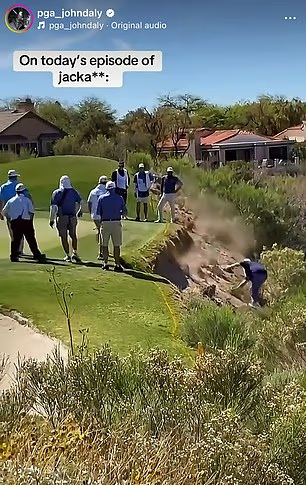

John Daly’s Desert Tumble Reveals the Grit—and the Gamble—of Competitive Golf After 60
There’s a moment in every aging athlete’s career when you stop asking “Can I still compete?” and start asking “Should I still compete?” John Daly’s belly-flop into the Arizona dirt at the Colourguard Classic this week isn’t just a funny viral moment—though his social media caption certainly played it that way. It’s a window into something deeper: the complicated calculus of staying in the game when your body has already told you to sit down.
I’ve been around professional golf long enough to know that Daly’s fall matters less than what comes after it. And what came after it—his caddie John Cooley literally sliding in to catch him—tells me something important about why Daly keeps showing up to tournaments despite 16 surgeries in four years.
The Setup: A Champion Who Won’t Quit
Let’s be clear about who we’re talking about here. John Daly won the Open Championship in 1995. He’s a legitimate major champion who punched his ticket to golf immortality decades ago. He doesn’t need to prove anything to anyone. And yet, there he was in Tucson last week, chasing a top-10 finish on the Champions Tour—his first in three years.
In my thirty-five years covering this tour, I’ve learned that competitive fire doesn’t just switch off when you turn 50 or 60. If anything, it burns hotter because the window gets narrower. Daly wasn’t out there on some ego trip. He was genuinely in contention through ten holes at four-under par. That’s not a victory lap; that’s competing.
The video shared to his 1.1 million followers captured the moment perfectly—not as a cautionary tale, but as a snapshot of resilience:
“On today’s episode of Jacka**. Bellyfloppin’ in the desert. True buddy sliding in to save.”
That’s a champion’s sense of humor. Daly could’ve played it safe, avoided the emotional roller coaster, let the surgeries be his excuse. Instead, he’s out there taking risks, eating dirt, and laughing about it on social media.
What the Numbers Tell Us—and Don’t
Here’s where I think the narrative gets interesting. Daly finished the Colourguard Classic tied for 29th at six-under par, nine strokes behind winner Steve Alker. On the surface, that looks like a disappointing result. But context matters, and here’s what matters: he was in the mix. He was playing well enough to contend. The only thing that stopped him was literally tumbling down a hill.
Before that erratic 508-yard drive sent him into the penalty area, Daly was having the kind of round that keeps a competitor coming back. For a player dealing with tangled tendons in his hands—the kind of injury that would permanently sideline most recreational golfers—being four-under after ten holes is significant.
What strikes me most is what didn’t happen. Daly didn’t get hurt. His caddie—a singer-songwriter by trade, which tells you something about the eclectic family that orbits professional golf—saw the situation and reacted. They emerged arm in arm, no injuries reported. Crisis averted. Round continued.
The Bigger Picture: Courage and Common Sense
Having caddied for Tom Lehman back in the ’90s, I watched firsthand how players manage pain, injury, and the simple wear and tear that comes from a lifetime in the game. The conversation in the locker room isn’t really “Should I retire?” It’s more like “Can I get another good year out of this? Can I still compete at a level that matters?”
Daly’s surgery count—16 operations in four years—is genuinely sobering. That’s not normal aging. That’s serious medical intervention. But here’s what I’ve observed in three decades of covering this sport: surgeries aren’t always endings. Sometimes they’re pit stops. The question isn’t whether your body is perfect; it’s whether you’re willing to keep fighting to make it work.
The Champions Tour itself has become more compelling precisely because of players like Daly who refuse to fade quietly. Steve Alker winning the Colourguard Classic at a younger age within that over-50s bracket represents the depth of talent still competing at that level. But Daly being in the tournament, being competitive, being in the conversation—that’s equally important to the narrative.
Looking Forward
Daly has the Hoag Classic in California in two weeks, then the Masters. Yes, the Masters. At 59 years old, after 16 surgeries, he’s still chasing opportunities to compete at golf’s most storied event. That’s not the action of someone just collecting paychecks. That’s a competitor.
I think what we witnessed in Tucson—the fall, the catch, the laugh, the continued fight—is actually golf at its most honest. It’s not the highlight reel or the victory speech. It’s the moment when a player faces a literal obstacle, gets helped up, and keeps going. That’s the real story of professional golf after 60. It’s not about perfection. It’s about perseverance.
Daly’s social media moment went viral because it was funny and dramatic. But the real victory was already there before the fall: a former Open champion still believing he belonged in the competition. Everything else was just details.
