

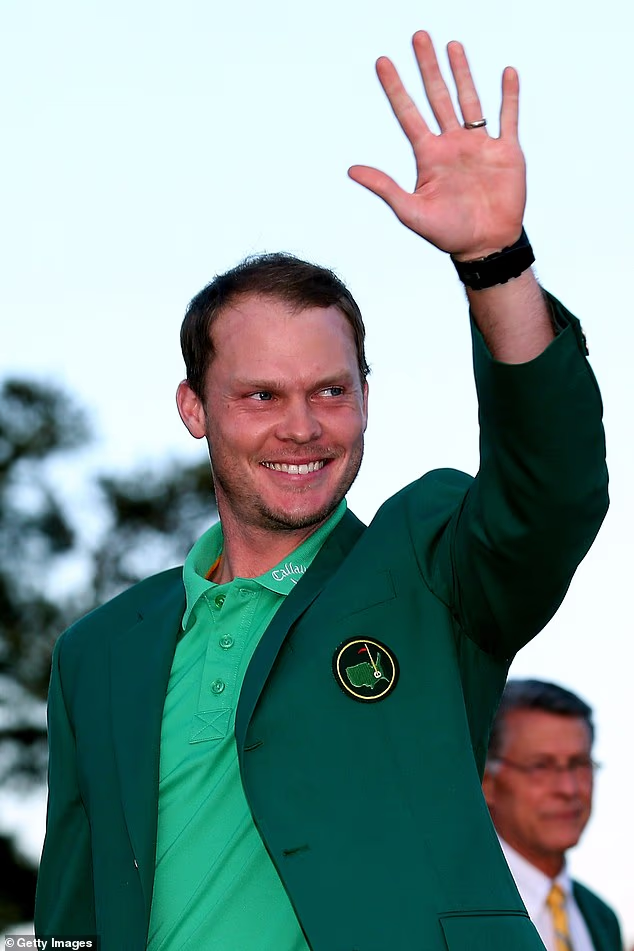

Danny Willett at 38: The Masters Champion Nobody Talks About Anymore
I’ve been covering professional golf for 35 years, and I’ve learned that winning a major championship guarantees you exactly two things: a lifetime seat at a fancy dinner and a lifetime of people asking why you haven’t won another one. Danny Willett knows this better than most.
Ten years after hoisting the green jacket in 2016—a victory so improbable it came in at 125-1 odds—Willett finds himself in that peculiar purgatory that befalls many one-major winners. He’s not forgotten, exactly. But he’s not remembered the way he should be, either. What strikes me most about revisiting his Augusta National masterclass is how thoroughly it’s been overshadowed by Jordan Spieth’s collapse, and how that narrative has somehow diminished Willett’s actual achievement.
That’s unfair, and I think it’s worth correcting.
The Collapse That Defined a Victory
Yes, Spieth’s meltdown at Amen Corner was spectacular. The back-to-back bogeys at 10 and 11, followed by that quadruple-bogey seven at the par-three 12th—those are the images that stuck. I understand why. In my decades covering the tour, I’ve rarely seen a player implode so publicly when victory seemed assured. But here’s what casual fans miss: Willett didn’t win because Spieth lost. Willett won because when the pressure arrived, he executed.
“I took myself to the bathroom on 16, and came out and just sort of said, ‘Look, five nice swings here and hole a couple of putts, and we’ll see where we’re at in 40 minutes time’. I remember it all quite vividly.”
That detail tells you everything. This wasn’t a guy panicking or hoping. This was a 28-year-old son of a vicar from Yorkshire composing himself and methodically playing golf. Willett’s final round of 67, shot under conditions that Augusta National made deliberately hostile, was a clinic in nerve and skill. He finished three clear of both Spieth and Lee Westwood. That’s not a borrowed victory—that’s dominance.
In my experience caddying for Tom Lehman back in the day, I learned that major championships are won in the mind before they’re won on the scorecard. Willett had both locked.
The Cruel Arithmetic of Professional Golf
What fascinates and depresses me in equal measure is what happened after. Here’s the sobering part: Willett’s record since 2016 actually looks quite respectable on paper. He’s won eight times total—the DP World Tour Championship (2018), the PGA Championship at Wentworth (2019), the Alfred Dunhill Links (2021), and others. Those are quality tournaments. But then there are the valleys.
Two years after Augusta, Willett fell from ninth in the world to 462nd. Let that sink in for a moment. He bottomed out at 624th early last year. The man has battled chronic back and shoulder issues throughout his thirties, injuries that compound every other problem in this game. Having covered 15 Masters tournaments, I’ve seen plenty of one-shot wonders and players who let injuries derail them. What distinguishes Willett’s struggle is its persistence. It’s not a story of one bad year. It’s a decade-long rollercoaster.
“There have been great moments and some really, really, really s****y bits. Golf is hard. And it’s harder when you get bad injuries.”
I think Willett’s candor here deserves respect. Too many athletes retreat into corporate-speak when discussing their demons. He’s being honest about the mathematics of his career: peaks that rival anyone in the sport, and valleys so deep they’d challenge a mountaineer.
Still Believing at 38
Here’s where I pivot toward optimism, because Willett deserves it. At 382nd in the world rankings, he’s no longer a contender for every tournament he enters. But listen to what he’s actually saying:
“I’m sure there’s quite a few left in there. If I can keep everything under control and keep the body good, I know I’ve got high enough skill sets to beat anybody I want.”
That’s not delusion. That’s a man who has proved he can perform at the highest level and is asking a reasonable question: can I stay healthy enough to do it again? For most golfers, that answer is no. But Willett’s already defied odds before. At 38, he’s not so old that another victory is fantasy—we’ve seen too many late-career resurgences on the modern tour.
What strikes me most is that Willett hasn’t used his greatest achievement as a crutch or a permission slip to fade away. Instead, he’s kept grinding through genuine suffering. That’s the part of his story that won’t make highlight reels but should define his legacy.
The Seat at the Table
Willett will always have his place at the Champions Dinner at Augusta. That’s his forever. Ten years later, the green jacket still hangs in his closet the same way it hung there the week after he won it. The specificity of his memory—every club, distance, and bounce from that Sunday—speaks to how completely that day is etched into him.
But I suspect he’d trade some of the nostalgia for another major championship. That’s the cruel beauty of this game: one glorious day gets you in the door for life, but it also makes you hungry for more. After everything Willett’s endured—the injuries, the rankings freefall, the three-putt that cost him a PGA Tour title in 2023—that hunger still burns.
At 38, with his body cooperating and his game intact, Danny Willett isn’t done writing his story. And this time, when he wins again, maybe people will remember it for what he does, not just what someone else fails to do.
