


Ah, the Golden Age of golf course architecture! Roughly 1915-1935, by many scholarly accounts, though some clever minds stretch it to 1910-1940. It was a time when visionaries like Donald Ross, A.W. Tillinghast, and Alister MacKenzie were sketching their masterpieces onto the American landscape. They sculpted courses that felt inherent to the land, strategic puzzles that, even a century later, still challenge and delight. While many of these hallowed grounds remain the exclusive domain of private clubs, a select few beckon the golfing public, offering a rare glimpse into the genius of a bygone era. Today, I want to take you on a journey to one such gem, a course that proves public golf can stand shoulder-to-shoulder with the game’s most revered layouts: Bethpage Black.
Perched on Long Island, a mere hour’s drive from the concrete canyons of New York City, Bethpage Black isn’t just a golf course; it’s an experience, a pilgrimage for those who truly love the game. Its very existence is a testament to an audacious vision forged in the depths of the Great Depression. The State of New York, with remarkable foresight, decided that the public deserved its own U.S. Open-worthy arena. And deliver, A.W. Tillinghast did, with an assist from Joseph Purbeck.
I’ve walked the fairways of many of Tillinghast’s creations, from Winged Foot to Baltusrol, and there’s a particular blend of strategic brilliance and raw challenge that distinguishes his work. Bethpage Black embodies this ethos perfectly. It’s not a gentle walk in the park; it’s a rigorous test of nerve, skill, and patience. The famed warning sign at the first tee —
“Warning—The Black Course is an extremely difficult course which we recommend only for highly skilled golfers.”
— isn’t hyperbole; it’s a solemn truth. I can attest, having seen many a confident golfer humbled by its demands.

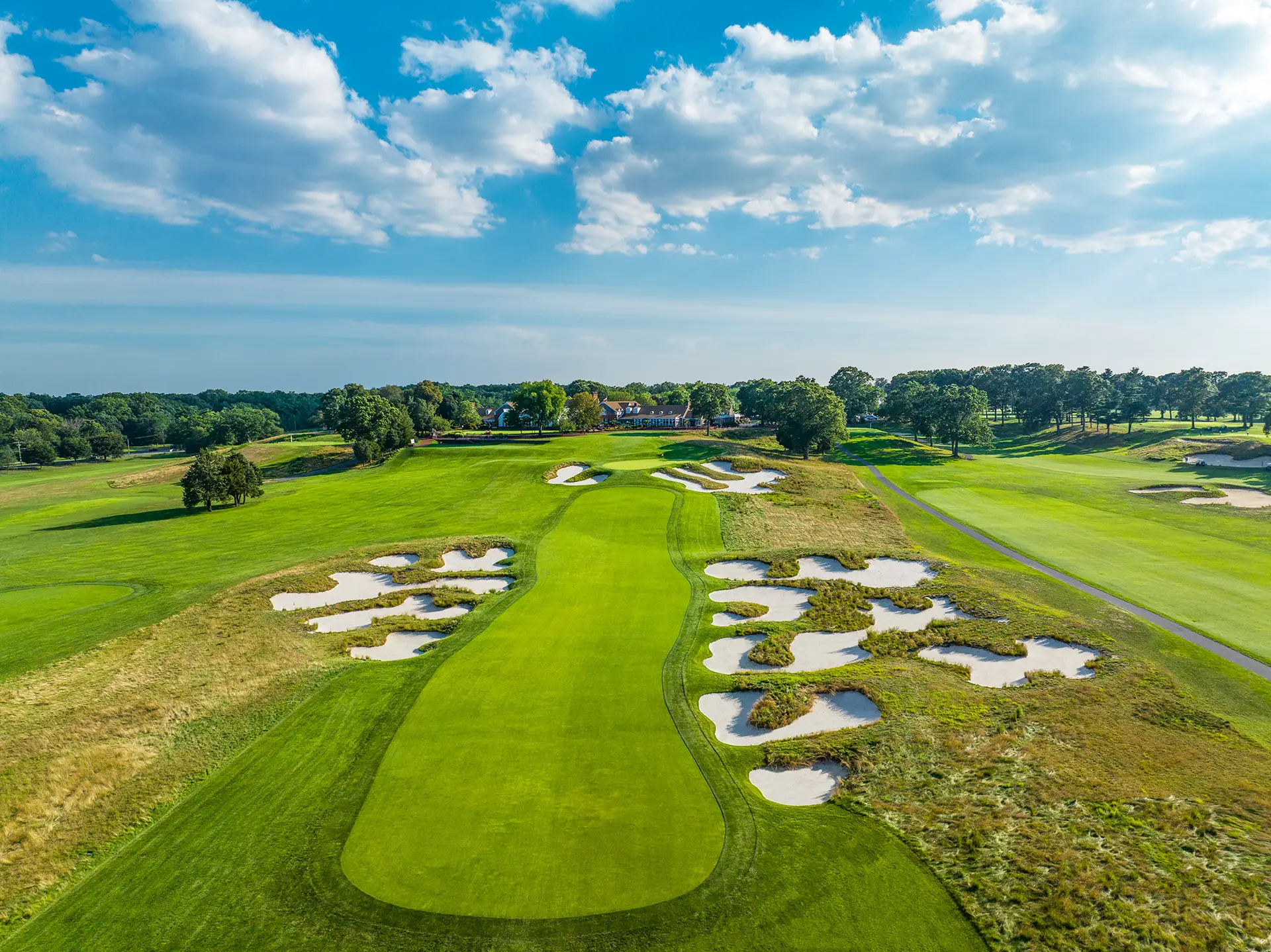
What makes the Black so formidable? Tillinghast masterfully created a relentless march through dense fescue, carving out fairways that demand precision, not just power. The bunkering is truly a sight to behold—gigantic, sculpted hazards that loom at every turn, ready to swallow errant shots. And the greens, oh, the greens! They are large, undulating, and often set high, requiring aerial approaches and deft touch. Landing short means a long, uphill chip from thick rough; flying it too far leaves you scrambling from even deeper trouble. It’s a constant mental battle, a strategic dance where every shot carries consequences.
The pacing of Bethpage Black is crucial to its genius. There are no easy holes. The par-fours, in particular, are brutal, often playing uphill and demanding two perfectly struck shots to reach the green. You’ll find yourself hitting long irons and even fairway woods into greens that, by modern standards, might seem short but play incredibly long. The routing snakes through natural elevations, offering breathtaking vistas and a sense of isolation despite its proximity to a major metropolitan area. This walking-only course feels pure, a throwback to how the game was meant to be played.
Its championship pedigree speaks for itself. Tiger Woods famously won the 2002 U.S. Open here, battling through torrential rain and a truly diabolical setup. Lucas Glover and Brooks Koepka have also hoisted major trophies on these hallowed grounds. These champions, among the game’s elite, have been thoroughly tested by Tillinghast’s enduring design. They’ve navigated the unforgiving rough, the cavernous bunkers, and the slick, sloping greens.
“Gigantic bunkers, thick rough, glassy greens, and uphill climbs combine to send scores soaring, especially on the set of brutish par fours.”
This isn’t just about length; it’s about decision-making, about finding the right angles, and executing under immense pressure.
For the golf architecture enthusiast, Bethpage Black is a masterclass in strategic design. It’s a course that forces you to think, to plan, and to accept the challenge. Tillinghast wasn’t interested in making it easy; he was interested in making it great. And in doing so, he cemented Bethpage Black’s place not just as a revered public course, but as one of the best Golden Age designs accessible to anyone willing to brave its formidable charms.
“Bethpage Black is lasting proof that public golf courses needn’t be dumbed down merely to move players through.”
Indeed, it stands as a monument to that very principle. If you’re planning a golf trip to the Northeast, and you relish a true test of your game, Bethpage Black is an absolute must-play. Just be sure to bring your A-game, and perhaps a few extra balls – you’ll need them.
