


The Golf World’s Hardest Shot: Finding Common Ground on Eligibility
I’ve been covering professional golf for 35 years—long enough to see the sport navigate its share of controversies. I’ve watched tours expand, contracts explode, and standards evolve. But I’ll be honest: the Hailey Davidson lawsuit landing in a New Jersey courtroom this week represents something I haven’t quite seen before in my time around the game. It’s complicated. It’s emotional. And it demands more nuance than either side of this debate seems willing to offer right now.
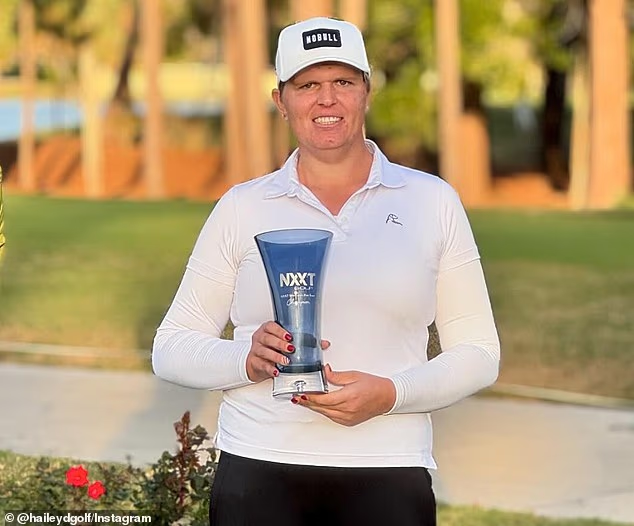
For those just tuning in, Davidson, a 33-year-old transgender golfer, is suing the LPGA, the USGA, and Hackensack Golf Club after being barred from competing in a US Women’s Open qualifier. The policy change came down hard and fast: as of 2025, players must either be assigned female at birth or have transitioned before male puberty to compete in women’s events. Davidson didn’t transition until her early 20s, though she completed gender-affirming surgery in 2021 and hasn’t competed as a male golfer since 2015.
What Happened—And When
Here’s the timeline that matters. Davidson competed in LPGA Qualifying School and a US Open qualifier in 2024 under the old policy. She fell short in both attempts, but she was legally in the field. Then the rules changed mid-game. In March 2024, a smaller tour (the NXXT) reversed its policy, citing biological sex at birth as the eligibility threshold. The LPGA followed suit in December 2024, effective immediately for 2025 and beyond.
The new LPGA standard is specific: players assigned male at birth must prove they “have not experienced any part of puberty beyond the first stage or after age 12, whichever comes first” and meet testosterone limitations. It’s a bright-line rule, which I understand the appeal of—clarity matters in sport. But for Davidson, it’s a door that closed while she was walking through it.
The Expert Consensus Question
What strikes me after three decades in this business is how both organizations are leaning hard on the phrase “expert-informed process.” The LPGA’s statement reads:
“The LPGA’s gender policy was developed through a thoughtful, expert-informed process and is grounded in protecting the competitive integrity of elite women’s golf.”
That’s not wrong—they did consult experts. The competitive advantage question in golf is real. Bone density, muscle mass, lung capacity—male puberty confers measurable athletic advantages. I’ve covered enough PGA Tour events to know that even marginal physical differences matter at the elite level. Whether those advantages persist after 8+ years of hormone therapy is the actual science that matters, and that’s genuinely complicated.
But here’s what bothers me: Davidson wasn’t in the room.
She wrote on Instagram Stories after the ban:
“For the record, I was not involved nor asked to be involved in any of the ‘studies’ that any golf organization has just used to ban me, the only active golfer who is actually affected by these policy changes.”
That’s a fair criticism, and it’s one I’d raise if I were her legal team. You’re making a sport-altering decision that directly impacts a real person—an athlete who was competing in good faith under your previous rules—and you don’t invite her to the table? That’s not a great look, whatever the science says.
The Pressure Campaign Factor
Here’s what I know from working the tour: the LPGA didn’t move on this in a vacuum. Female professionals wrote directly to the tour office. Their concerns were heard. That matters, too. These are world-class athletes protecting their competitive space, and that’s not villainous—it’s sport.
But the speed and the retroactive nature of the policy shift created a legally vulnerable situation. You changed the rules while someone was already competing under the old ones. That’s different from setting standards at the door before new players enter. I’d bet money Davidson’s legal team leads with that angle.
What This Means for Golf
In my experience, sports survive these moments by doing two things: (1) establishing clear, science-based standards going forward, and (2) treating people already affected with respect and transparency. Golf has done one. It hasn’t done the other.
The lawsuit will play out, and maybe the courts will side with the LPGA’s competitive integrity argument. That’s plausible. But reputationally, and from a messaging standpoint, the sport would benefit from acknowledging that Davidson got caught in between two policy regimes through no fault of her own.
Davidson also pointed to something darker—noting that the transgender suicide rate sits around 50%, and situations like hers contribute to that burden. Whether you agree with that framing or not, dismissing it is wrong. Golf is trying to expand. It’s trying to be inclusive. Those impulses are real. But they have to be balanced against legitimate competitive questions, and that balance requires dialogue, not decrees handed down after the fact.
I’m rooting for golf to figure this out—to find a standard that’s defensible, applied fairly, and developed with input from everyone affected. The LPGA and USGA aren’t wrong to care about competitive integrity. Davidson isn’t wrong to expect fair process. Both things can be true.
And that’s the hardest shot in sports, sometimes—hitting both fairness and clarity at the same time.
