


Rahm’s Rules Relief and the Art of Making Your Own Luck at Adelaide
I’ve been around professional golf long enough to know that sometimes the most compelling storylines aren’t about the perfect swing or the clutch putt. They’re about what happens in the margins—the moments when a player’s knowledge, composure, and yes, a little bit of fortune, all converge to shift momentum.
That’s exactly what unfolded Saturday at LIV Golf’s Adelaide event, and it’s worth examining more closely than a typical third-round dramatics deserve.
When Memory Becomes Muscle Memory
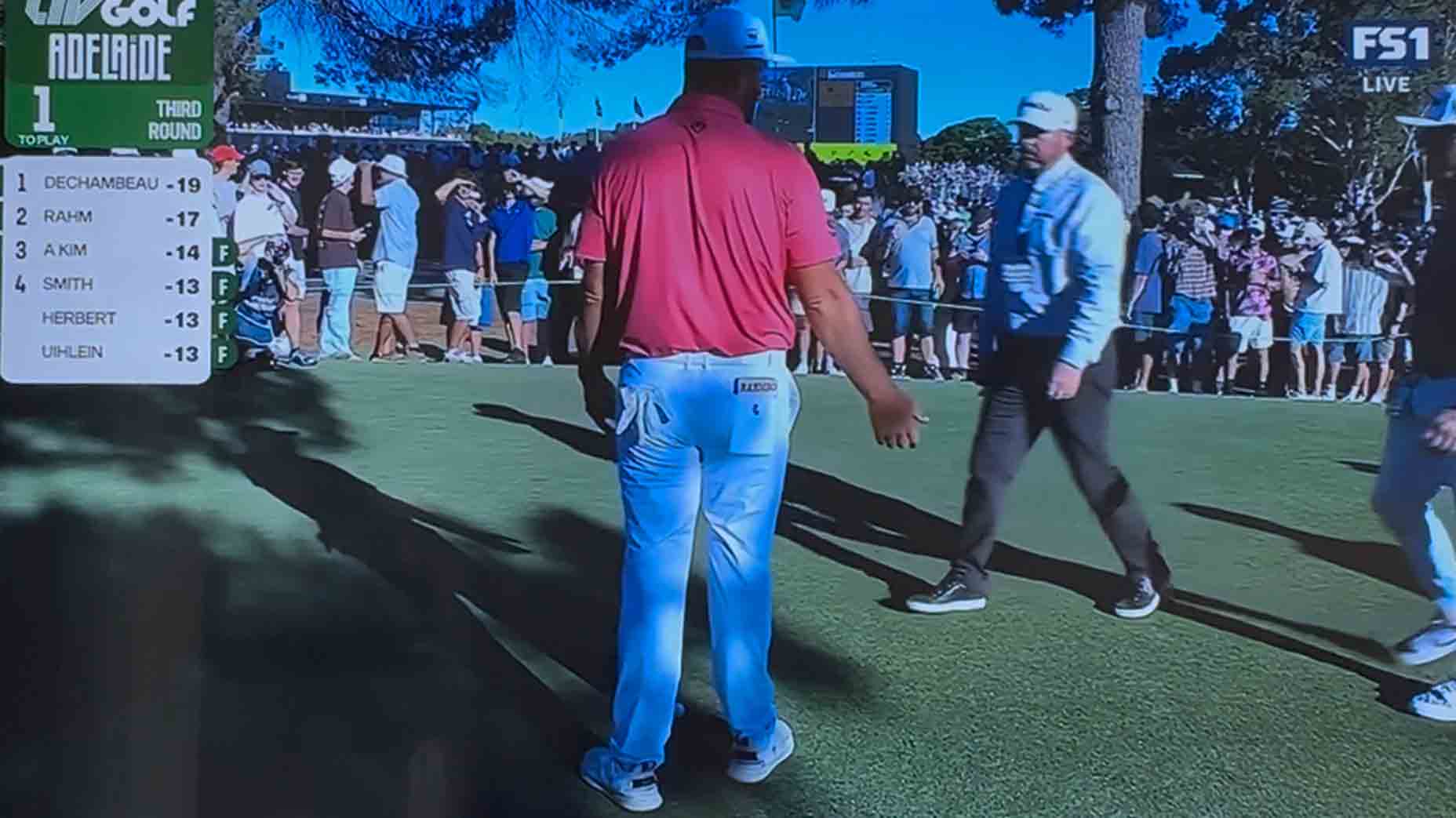
Jon Rahm’s Saturday sequence on the Grange Golf Club’s 18th hole tells us something important about elite professional golf that doesn’t always make it into highlight reels. On Friday, Rahm hit his tee shot left, into the adjacent 10th tee box, where temporary fencing created what the rules officials deemed a temporary immovable obstruction. Under the rules, he was entitled to a free drop—and more importantly, he *remembered* exactly where that drop was and what the relief looked like.
Twenty-four hours later, lightning struck twice. Same mistake. Same shot. But this time, Rahm didn’t panic or second-guess himself. He knew the play because he’d just executed it.
“Well, I would say it might be the most impressive thing I’ve done all week,” Rahm said, “which is pull it that far left twice, hit the cart path twice, and end up on the 10th tee twice. The odds of that are pretty low.”
There’s self-awareness in that quote, sure. But there’s also something else: the confidence of a competitor who understands the rules deeply enough to turn a penalty into an advantage. In my three and a half decades covering this tour, I’ve noticed that the players who consistently win majors and signature events aren’t just the ones with the prettiest swings—they’re the ones who know the rulebook like a constitutional lawyer.
Bryson’s Shock, and What It Reveals
Now, let’s talk about Bryson DeChambeau’s reaction, because it’s genuinely revealing. Here’s a guy who’s won a U.S. Open, played at the highest levels of competitive golf, and he was visibly stunned by what he was witnessing.
“I didn’t know that’s what could happen, so that was most of what the shock was. It was like, what the heck, you can do that? I didn’t know that. But ultimately, I didn’t really know from my perspective that it was OK over there, so I was kind of shocked.”
The camera caught DeChambeau literally mouthing “What?” and rolling his eyes—a moment that probably became a viral clip within minutes. But here’s what strikes me about his response: it’s honest. And it’s a reminder that even at this elite level, the rules of golf can catch you off guard.
What impressed me wasn’t that DeChambeau didn’t know about the temporary immovable obstruction rule. It’s that he owned his ignorance and adjusted his perspective almost immediately. He didn’t complain or suggest impropriety. He essentially said, “That’s interesting. I didn’t know that, but fair play.”
“I’ve had way worse shots, by the way, too. It was just a bit of a shock at the moment, and then I was like, you know what, I’ve done way worse than that, too.”
In my experience as a caddie back in the ’90s, that kind of composure is what separates champions from contenders.
The Execution, Not the Fortune
Here’s where I want to push back gently against the narrative that Rahm got lucky. Yes, the rules relief was fortunate. Yes, ending up in the ideal position was fortunate. But what happened next—that 62-meter approach shot in the wind that ended up in the hole—that wasn’t fortune. That was execution.
“It was actually the best spot to be pretty much for every single pin for that distance. It was a really good number, 62 meters into the wind, trying to land it about six, seven short. Obviously executed it pretty well, and the rest is what you all saw. I’m not really expecting to make it. I’m hoping to hit it close, but obviously ended up with the grand prize on that one.”
Rahm’s humility here is noteworthy. He didn’t expect the ball to go in. He was aiming for a makeable birdie putt. But because he was in the right spot—a spot he’d earned through knowledge of the rules—he was in position to execute a shot that mattered.
That’s the real story. Not that the rules favored him, but that his understanding of the rules put him in position to convert when it counted.
What This Means for Sunday
Rahm and DeChambeau head into the final round tied for the lead. Both are playing as well as any two golfers in the world right now. But here’s my read: Rahm’s confidence just got a significant boost. He’s proven to himself that he can navigate chaos, remember crucial details under pressure, and execute when the stakes are highest.
DeChambeau, meanwhile, has something equally valuable: knowledge. He now knows that temporary immovable obstructions exist on this course, and where they are. In golf, information is currency.
What we witnessed Saturday wasn’t just a wild sequence. It was a masterclass in how professional golf works at the highest level—the intersection of technical knowledge, mental composure, and execution when the moment arrives. And that’s why we keep coming back to watch.
