

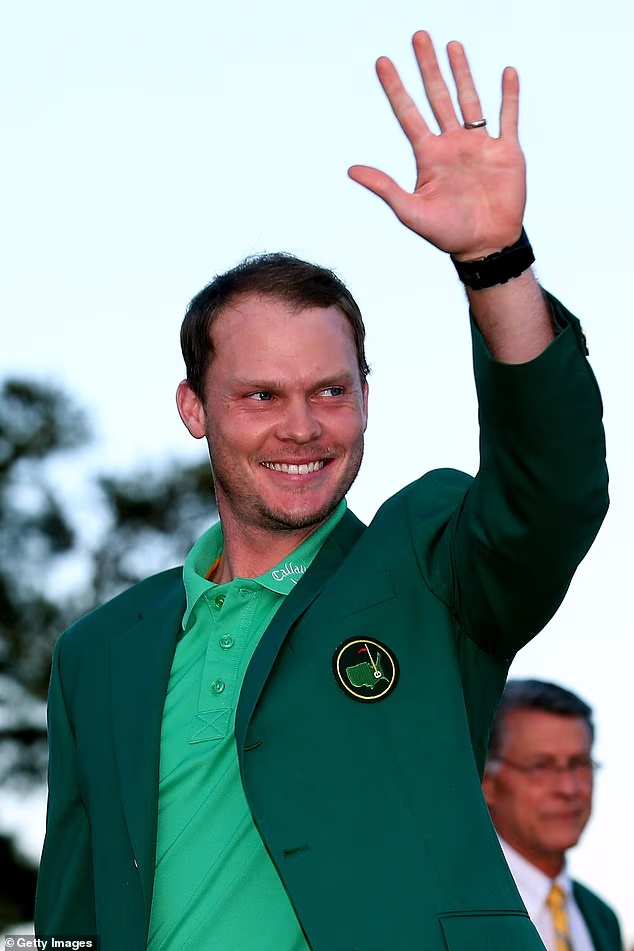

Danny Willett at 38: The Masters Winner Wrestling With Golf’s Cruelest Paradox
There’s a question I’ve been wrestling with for 35 years in this business, and Danny Willett’s story – particularly where he finds himself today at 382nd in the world rankings – has me thinking about it again: Why does winning golf’s greatest prize sometimes feel like a curse?
I don’t mean that literally, of course. Willett would be the first to tell you that winning the Masters in 2016 was the pinnacle of his life, and rightfully so. But there’s something peculiar about major championship golf that I’ve observed time and again from my perch covering the tour. The higher the peak, it seems, the steeper the valley that follows.
The Weight of Augusta
Reading Willett’s reflections on that extraordinary April afternoon – his recollection of every yardage, every gust, even his bathroom thoughts at the 16th tee – I was struck by something he said that I think reveals the real story here:
“I reckon I’ve only watched the round back in its entirety two or three times. To be honest, I don’t need to. It’s all in my head, every step of it.”
That’s not just the mark of a golfer with a good memory. That’s a man carrying something. In my experience caddying for Tom Lehman back in the day, I learned that champions remember their victories differently than other golfers remember their best rounds. It’s not nostalgia – it’s almost like reliving it. The neural pathways stay lit.
What strikes me about Willett’s decade since that green jacket is that he’s experienced the full spectrum of what professional golf can dish out. The 20-year drought he ended for English golfers at Augusta? That’s genuinely historic. But here’s what the casual fan doesn’t grasp: that kind of historical weight doesn’t lighten with time. If anything, it gets heavier.
The Mountains and Valleys
Let’s look at the actual arc of Willett’s career since 2016:
- 2016: Masters Champion
- 2018: DP World Tour Championship
- 2019: PGA Championship at Wentworth
- 2021: Alfred Dunhill Links
- 2018: Fell from 9th to 462nd in rankings (two years post-Masters)
- 2020: Briefly back in top 30
- 2023: Lost PGA Tour title to three-putt from three feet
- Early 2024: Ranked as low as 624th
That’s not volatility. That’s a roller coaster that would make most people physically ill. And it’s instructive that Willett himself frames it this way:
“There have been great moments and some really, really, really s****y bits. Golf is hard. And it’s harder when you get bad injuries. Things fall out of sync, consistency is harder to find and then your confidence is low and that makes it worse.”
In covering 15 Masters, I’ve seen how this particular tournament tests not just your golf game but your psychological constitution. Augusta National is less forgiving than any other course – not because of its setup, but because of what winning there means. You become part of history. You can never un-become that.
The Thing Nobody Talks About
Here’s what I think matters most about where Willett is today: He’s honest about it. He’s 38, ranked 382nd, and he’s not pretending the back injuries and shoulder problems are just excuses. But he’s also not surrendering. There’s a crucial distinction.
I’ve seen players with major championships on their resume retreat into mythology – endlessly replaying the glory, letting it become their entire identity. Willett’s actually done the opposite. He deliberately *hasn’t* rewatched his round much:
“To be honest, when I was playing s*** and injured and not feeling very good about life, I wasn’t really in the mood.”
That’s wisdom. That’s a guy who understands that nostalgia can be a prison if you’re not careful.
Is There Still Gas in the Tank?
The question everyone’s asking is whether Willett can win again. My read? I think he can. Not the Masters again – that’s probably behind him – but a tournament of genuine significance. Here’s why: He’s still got the skill set. He proved that with the DP World Tour Championship and those other titles. What he’s lost isn’t talent; it’s consistency and health. Those are the hardest things to recover in your late 30s, but they’re not impossible.
What I find encouraging is that Willett hasn’t fallen into the trap of bitterness. Plenty of players in his position would spend their time complaining about the unfairness of injuries, the randomness of form. Instead, he’s reflective. He understands cause and effect.
In three decades of covering this tour, I’ve learned that the players who bounce back from adversity aren’t necessarily the ones who had the smoothest paths. They’re the ones who look at their struggles honestly and still believe they can compete. Willett still has a seat at the Champions Dinner table for life. That’s not just a privilege – it’s a reminder of what he’s capable of.
The real story isn’t whether Danny Willett wins again. It’s whether he can find peace with being a one-major champion in an era where that’s increasingly rare. And from what I’m reading, I think he’s already started getting there.
