

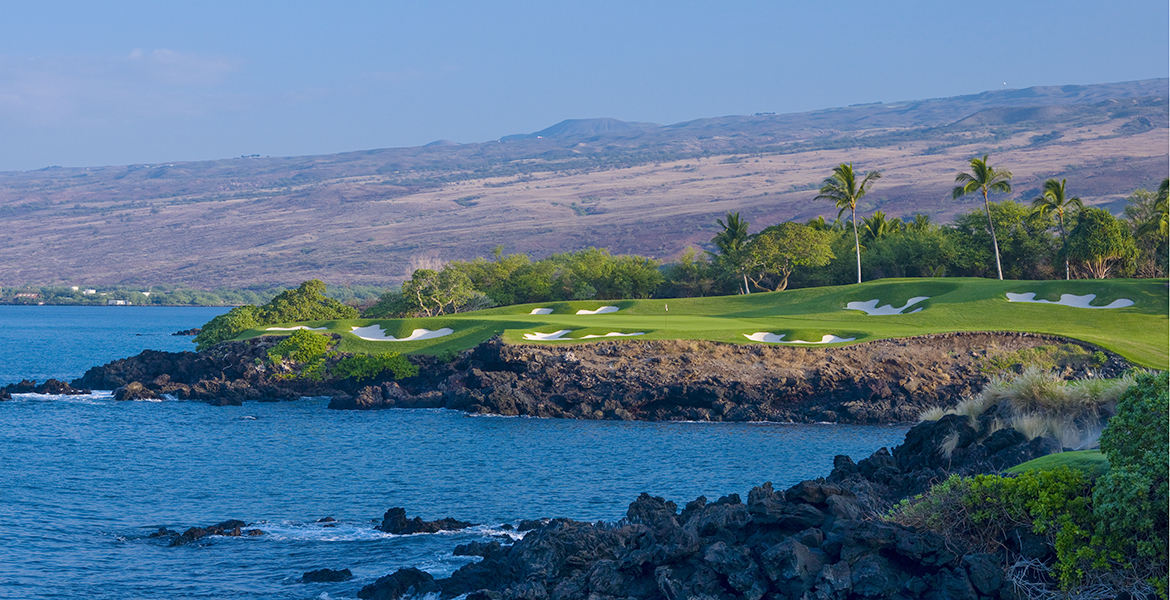

There are golf courses, and then there are *experiences*. Mauna Kea Golf Course on the Big Island of Hawaii firmly plants itself in the latter category. It’s a place that transcends the simple act of hitting a golf ball, a testament to visionary thinking, audacious engineering, and the sheer audacity of one of golf’s greatest architects, Robert Trent Jones Sr.
I’ve been fortunate enough to walk the fairways of over 200 courses, spanning linksland in Scotland to the sandy wastes of the Arabian Gulf. I’ve seen the calculated boldness of a Pete Dye, the natural elegance of an Alister MacKenzie, and the minimalist genius of a Tom Doak. But there are few places that grab you by the senses quite like Mauna Kea, where the aroma of plumeria sometimes mingles with the salty tang of the Pacific, and the vibrant green of the fairways pops against the ancient, dark lava.
Genesis on Lava Rock
The story of Mauna Kea Golf Course begins not with meticulously drawn blueprints, but with a leap of faith over an untamed landscape. In 1960, Laurance Rockefeller, the scion of a powerful family with a knack for resort development, surveyed the Big Island’s Kona-Kohala coast. What he saw was a perfect crescent beach, yes, but also a desolate panorama of brown volcanic rock. His chosen architect, Robert Trent Jones Sr., was tasked with the seemingly impossible: to route 18 holes across this barren, undulating terrain.
Rockefeller, understandably, had his doubts about constructing a golf course on such a site. Jones, ever the pragmatist, saw potential where others saw desolation. His son, Robert Trent “Bobby” Jones Jr., vividly recalled his father’s direct approach:
“Dad picked up two lava stones and pummeled them together. They fractured. The pieces crumbled and fell to the ground.”
That simple action, a demonstration of the lava’s surprising friability, was the “aha!” moment. It confirmed Jones’s hypothesis that the pervasive volcanic rock could be crushed and transformed into a viable soil base. This wasn’t merely a construction challenge; it was a pioneering act of landscape architecture. Jones, in his own words from 1988, reflected on this groundbreaking process:
“We determined that, with enough water, the lava rock could support plant life. Using a bulldozer fitted with a specially ribbed roller [that Jones and construction superintendent Homer Flint invented], we crushed the lava into a red dust the consistency of talcum powder and spread almost a foot of it over the course… We mixed it with coral sand from nearby Kawaihae Harbor and put the seed down. When it sprouted, we got the cleanest grass you’ve ever seen. There were no weeds, because nothing had ever grown in the material before.”
Imagine, if you will, the sheer willpower and ingenuity required to engineer a vibrant ecosystem for 18 holes of championship golf out of what was essentially a desert of igneous rock. This wasn’t just building a course; it was creating a garden on the moon.
The Jewel in the Crown: The 3rd
While the entire course is a masterclass in routing over 300 feet of elevation change, bending holes strategically left and right, and crafting perched, bunkered greens that demand aerial approaches, one hole stands above the rest: the infamous par-three 3rd. It’s not just a hole; it’s a pilgrimage.
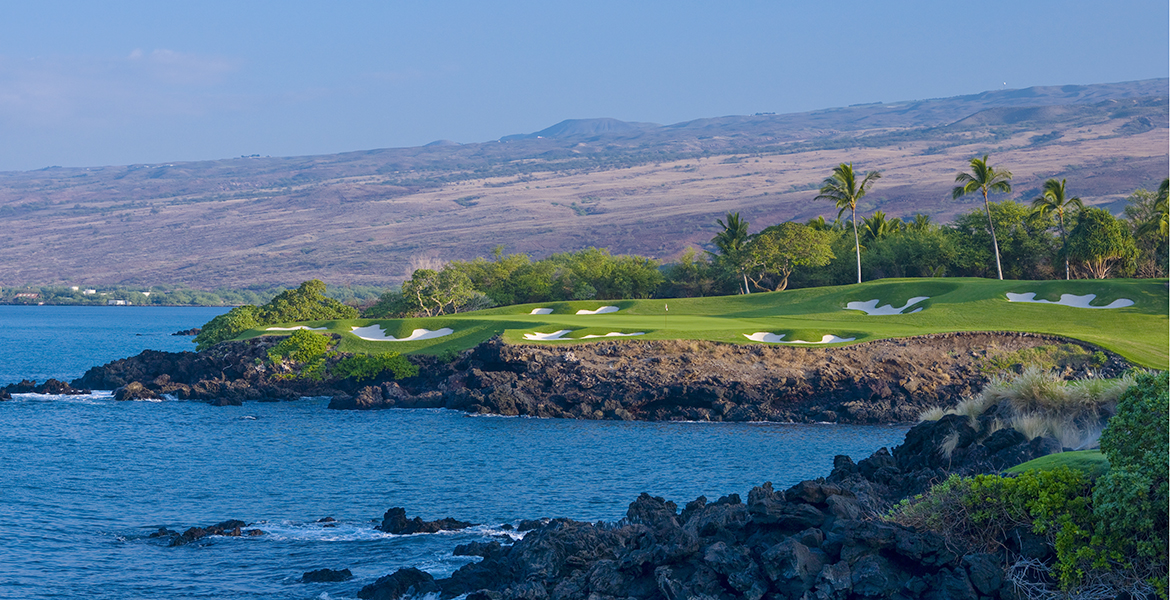
From the original back tee measuring 250 yards (now stretched to 272), the shot is a baptism by fire – a forced carry over the turbulent, endlessly blue Pacific to a sprawling, kidney-shaped green. The tee box itself is carved into 5,000-year-old lava rock, providing a dramatic perch from which to launch your ball into the trade winds. Jones knew he had something special, famously telling Rockefeller, “Larry, if you allow me to build a golf course here, this will be the most beautiful hole in the world.”
Bobby Jones Jr. perfectly capsules his father’s philosophy behind this design:
“My dad was into drama. When he saw the two rock outcroppings, he routed the golf course to get to that. Any architect would kill for that site. It’s one of the iconic holes in the game.”
Indeed, the genius of Jones here is not just finding the drama, but making it playable, albeit challenging. The green is expansive, offering a generous, if distant, target. Bunkers guard its flanks, ready to swallow anything short or misjudged, but the real challenge is mental: overcoming the visual intimidation of the vast ocean chasm.
A Legacy Etched in Lava
Mauna Kea opened in December 1964 with an exhibition featuring the “Big Three”: Arnold Palmer, Jack Nicklaus, and Gary Player. The lore surrounding Player’s alleged inability to clear the chasm on the 3rd at its full length only adds to the hole’s mystique. Fifty years later, Player himself reminisced, “I had never seen anything like that before.” Nobody had, Gary.
This course, and especially its signature 3rd hole, represents a turning point in golf architecture. It showed that golf could not only coexist with, but thrive within, the most extreme natural landscapes. It’s a testament to human ingenuity and a bold vision that transformed a “barren” landscape into a lush, emerald paradise.
For those planning a Hawaiian golf escape, Mauna Kea remains a must-play. Located on the Kohala Coast, it’s easily accessible and offers an unforgettable experience. Come for the challenge, stay for the views, and leave with a profound appreciation for a course that dared to dream bigger than its volcanic surroundings.
