


The Cruel Poetry of Pebble Beach: What Min Woo Lee’s Near-Miss Tells Us About Modern Golf
I’ve been covering professional golf for 35 years—long enough to know that Pebble Beach doesn’t give up its gifts easily. But what I witnessed in the final moments of this week’s PGA Tour event was something that struck me differently than most heartbreaking finishes I’ve covered. It wasn’t just about Min Woo Lee losing $2 million in prize money. It was about what his loss—and his grace in defeat—reveals about where professional golf stands in 2026.
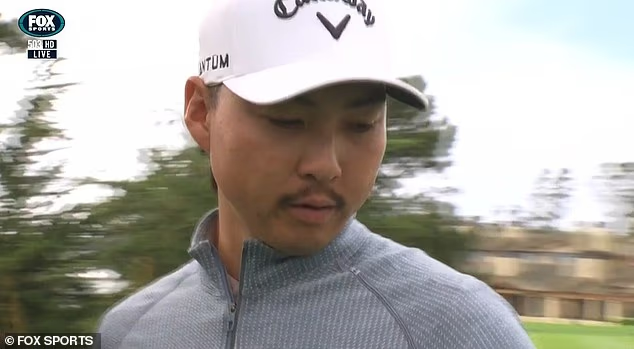
Let me set the scene for those who might have missed it: Lee went to the clubhouse as the leader after birdying 17 and 18 in his final round. For a few moments, he had his hands on a second PGA Tour victory. Then Colin Morikawa—trailing by one after a bogey at 17—stepped to the 18th tee into a vicious crosswind and did something that belongs in the highlight reels alongside the greatest Pebble Beach moments I’ve witnessed.
“He smashed his iron well left and over the water, which then allowed the wind to bring the ball back over the green and land next to the putting surface.”
That’s not luck. That’s expertise wrapped in audacity.
When Skill Meets Circumstance
Here’s what fascinates me about Morikawa’s shot, and what I think gets lost in the “heartbreak” narrative around Lee: this is what separates good players from great ones on the biggest stages. In my three-and-a-half decades around this tour, I’ve seen a thousand solid golfers who can hit fairways, make putts, and shoot respectable scores in calm conditions. What separates the winners is the ability to trust their swing when everything—wind, pressure, stakes—is screaming at them to do something cautious.
Morikawa’s seventh PGA Tour victory wasn’t handed to him by fortune. Yes, the wind cooperated with his shot shape, but that’s only because he understood the conditions well enough to use them as a partner rather than fight them as an enemy.
The real story here, though, isn’t about celebrating Morikawa’s brilliance at Lee’s expense. It’s about recognizing that Min Woo Lee’s second-place finish—and the $3 million payday that came with it—tells us something important about professional golf’s evolution.
The Prize Money Paradox
Let’s talk about the numbers, because they matter. Lee walked away with more than $3 million for finishing second. That would have been the bulk of his annual earnings a decade ago. Today, it’s a respectable consolation prize in what’s becoming an increasingly top-heavy prize structure on the PGA Tour.
The gap between first place ($5 million) and second place ($3 million) represents exactly $2 million—a sum that would have seemed unimaginable when I started caddying for Tom Lehman back in the late ’80s. What strikes me is how this reflects a broader shift in professional sports: the money is becoming more abundant, but it’s also becoming more concentrated among the elite few.
I’m not here to wring my hands about it. This is the world we’re in. The television contracts are bigger, the corporate sponsorships are more lucrative, and the global reach of professional golf has expanded exponentially since I covered my first Masters in the early ’90s. But it does create an interesting dynamic where a player can execute beautifully, finish in the top two, and still leave with a seven-figure paycheck that validates his week—even in defeat.
What Lee’s Composure Reveals
What impressed me most about this week wasn’t Morikawa’s shot. It was what the article describes about Lee’s reaction:
“The Aussie was impressed but equally deflated given the stroke essentially set Morikawa up to steal victory.”
That’s maturity. That’s perspective. In my experience, young players sometimes struggle with this balance—they’re either devastated to the point of bitterness, or they’re performing a version of grace that feels hollow. Lee seemed genuinely affected (as any competitive player should be) while maintaining the professional composure of someone who understands the nature of our game.
If Lee had claimed victory at Pebble Beach, it would have become his second PGA Tour win. That’s significant for his career trajectory, but here’s what I think matters more: he proved he belongs in these conversations. He proved he can close out a tournament under pressure. Next time he’s in contention at a major venue—and there will be a next time—he’ll have this week as a reference point. Not as a failure, but as evidence that he can compete with the very best.
The Australian Connection
Having covered golf long enough to see players evolve through their careers, I’m increasingly impressed by the depth of talent coming from Australia. Min Woo Lee represents something important for global golf: the pathway from the international stage to sustained success on the PGA Tour is more accessible than it’s ever been. He won’t define his career by this loss. He’ll define it by how he responds.
The Pebble Beach finale this week was cruel, yes. But it was also fair. Two excellent players tested their skills against one of golf’s most demanding arenas, and one of them executed better in the deciding moment. That’s the poetry of this game—the thing that’s kept me writing about it for 35 years.
Lee will be back. And next time, maybe the wind will blow differently.
