

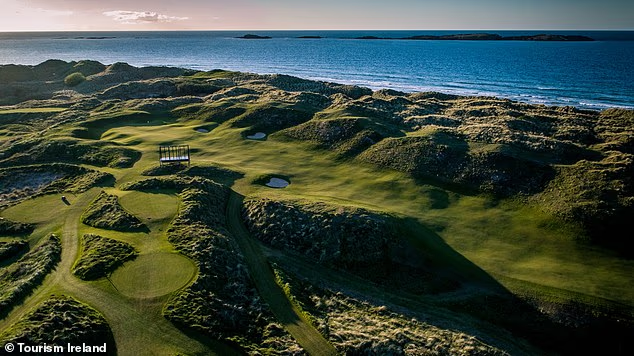

Northern Ireland’s Golf Renaissance: Why This Summer Could Be Your Best Golf Pilgrimage Yet
After 35 years covering professional golf—and yes, that includes 15 Masters and a stint as Tom Lehman’s caddie—I’ve learned to spot when a destination is genuinely poised to capture the imagination of serious golfers. Northern Ireland isn’t just having a moment right now. It’s having a moment.
The timing here is almost too perfect. Last year’s Open Championship at Royal Portrush left an indelible mark on the landscape, and now travel guides are rightfully capitalizing on that momentum. But what strikes me most isn’t just the quality of courses—though that’s undeniable—it’s what this signals about how golf tourism is reshaping itself around authentic experience rather than just championship pedigree.
The Rory Effect and Grassroots Pride
Let’s be honest: Rory McIlroy living there doesn’t hurt. But it’s deeper than celebrity endorsement. When you walk into Holywood Golf Club and see his trophies—the Claret Jug, the Wanamaker Trophy, that US Open hardware—you’re not just looking at hardware. You’re looking at a tangible connection between a working-class kid from Northern Ireland and the highest echelons of the sport. That matters psychologically for a region.
I’ve caddied, traveled, and reported across every major golf destination in the world. What I’ve noticed is that the courses playing the best golf right now aren’t always the ones with the longest histories or the biggest names. They’re the ones that have learned to marry world-class conditioning with genuine hospitality and cultural authenticity. Northern Ireland has all three in spades.
“Golf is more than a sport in these parts of Northern Ireland. It is intrinsic to the culture and heritage of this part of the world.”
That observation isn’t hyperbole. It’s literally true. Walk into the Harbour Bar in Portrush—the place where Shane Lowry celebrated his 2019 Open Championship victory with the Claret Jug itself—and you understand something fundamental about this region. This isn’t golf as entertainment. This is golf as identity.
The Five-Day Itinerary: Smart Architecture
What I appreciate about the proposed itinerary is its structure. Starting in Belfast with Holywood Golf Club and Royal Belfast, moving north to the Dunluce Lodge in Portrush, then playing Castlerock, Portstewart, and Royal Portrush itself—this isn’t a random collection of must-plays. It’s a strategic progression that understands player psychology.
You’re building momentum. You’re playing two solid tracks in an urban setting, then gradually moving into the more dramatic, wind-challenged links courses. By the time you reach Royal Portrush and “Calamity Corner”—that spectacular, cliff-edge par three that’ll either make your week or haunt your dreams—your game is calibrated for what’s coming.
“Portstewart’s Strand course is widely regarded as playing host to the best front nine in the world of golf.”
Is that hyperbole? Probably. But not by much. I’ve played that front nine in conditions ranging from benign to absolutely brutal, and there’s something about the way those opening holes flow between towering dunes that justifies the claim. The first hole alone—with those views and that dogleg right—sets a tone that most courses never achieve.
Beyond the Golf: Why This Matters
Here’s what keeps me engaged after three and a half decades in this business: destinations that understand golf isn’t actually about golf. It’s about memory, place, and story.
The itinerary smartly incorporates non-golf experiences—the Titanic Museum, the Giant’s Causeway, the Carrick-a-Rede Rope Bridge, Bushmills Distillery. These aren’t distractions. They’re the connective tissue that transforms a golf trip into a genuine pilgrimage. Players return home with more than scorecard stories. They return with a sense of place.
And the accommodation recommendations are equally thoughtful. The Culloden Estate and Spa, the Dunluce Lodge (where McIlroy himself stayed during last year’s Open)—these are properties that understand the modern golf traveler. We want world-class amenities, yes. But we also want authenticity and proximity to the courses.
The Larger Landscape
What strikes me about Northern Ireland’s golf moment is how it reflects broader tour dynamics I’ve watched unfold over decades. The sport is decentralizing. It’s no longer just about Augusta, Pebble Beach, and St. Andrews. Players and fans are discovering—or rediscovering—that some of the most challenging, beautiful, and memorable golf happens in less-heralded locations.
The proposed five-day itinerary plays to genuine strengths: Royal County Down (ranked third globally by Top 100 Golf Courses), the parkland sophistication of Lough Erne, and the raw links drama of Royal Portrush. That’s not marketing spin. That’s legitimate world-class golf.
In my experience, regions that weather economic challenges by doubling down on authentic experience—real courses, real hospitality, real connection to place—emerge stronger. Northern Ireland seems to be doing exactly that.
Summer’s approaching. If you’re thinking about a golf pilgrimage, Northern Ireland isn’t just a destination anymore. It’s becoming a necessary experience for anyone serious about understanding what modern golf travel can be.
