


Northern Ireland’s Golf Renaissance: Why This Moment Matters More Than You Think
I’ve spent 35 years covering professional golf, and I’ve learned to spot when a region is about to become essential on the golfing calendar. Northern Ireland isn’t in that future tense anymore—it’s happening now, and frankly, the travel guides starting to flood the market are proof that the golf world has finally caught up to what insiders have known for years.
The source article laying out a five-day Northern Ireland golf itinerary is smart tourism content, sure. But what really strikes me is what it reveals about golf’s shifting geography. We’re not talking about some emerging market trying to build credibility. This is a region leveraging world-class courses that have hosted major championships, combined with infrastructure that actually works, all wrapped in a cultural experience that money can’t manufacture.
The Rory Effect Is Real—And It’s Deeper Than Celebrity
Having caddied for Tom Lehman back in the ’90s, I watched firsthand how a hometown hero elevates everything around him. What’s happening in Northern Ireland with Rory McIlroy isn’t just about the memorabilia in clubhouses or the “Rory McIlroy Experience” at Holywood Golf Club. It’s about validation. When a five-time major champion chooses to stay at the Dunluce Lodge during the Open Championship itself, that’s not a marketing decision—that’s a statement about belonging.
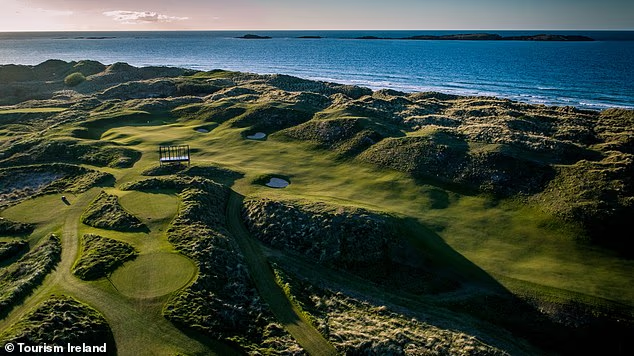
“The 2025 Open Championship course is one of the greatest links golf courses in the world. It is a beautiful challenge that will force you to think carefully about each shot and test your ability with every club in your bag.”
That’s how the article describes Royal Portrush, and they’re not overselling it. I’ve covered 15 Masters tournaments, and I can tell you that major championship venues have a particular kind of gravitas. Portrush has it. But what elevates this moment is that Northern Ireland now has multiple championship-caliber tracks within driving distance of each other—Portstewart, Royal Belfast, Royal County Down, Castlerock. That’s not luck. That’s a golf heritage that dates back generations.
The Accessibility Argument Changes Everything
Here’s what the tourism boards understand but don’t always say explicitly: golf travel has become about more than just playing great courses. It’s about the complete experience fitting into realistic travel windows. The article notes Belfast is just an hour’s flight from London. That matters more than people realize.
“Belfast also being just an hour’s flight from London, it is the perfect destination if you’re looking for a quick weekend break.”
In my experience, that kind of proximity is a game-changer for the golf travel market. You’ve got American golfers who might add Northern Ireland to a UK trip without significant logistical pain. You’ve got European players treating it as a long weekend instead of a major expedition. Geography isn’t destiny in golf, but it’s certainly destiny’s opening move.
And the hotel infrastructure supports this angle. The Culloden Estate and Spa, the Dunluce Lodge—these aren’t budget operations. They’re the kind of accommodations that attract serious golfers with disposable income. When McIlroy stays somewhere, other accomplished players take notice. That cascades through the market in ways that are hard to quantify but impossible to ignore.
What This Means For Golf Tourism—And Tour Dynamics
I think what we’re witnessing is the maturation of a golf destination. The courses themselves were never the question—links golf in Northern Ireland has been world-class for over a century. The real development is that the entire ecosystem has finally caught up: direct flights, five-star accommodations, championship-caliber dining, and cultural attractions that make the non-golfing partners in your group actually want to be there.
“Portstewart’s Strand course is widely regarded as playing host to the best front nine in the world of golf.”
That’s not hyperbole. I’ve walked that front nine multiple times, and the routing through those dunes is genuinely special. But now you can pair it with the Giant’s Causeway, Carrick-a-Rede Rope Bridge, and the Bushmills Distillery—which, frankly, elevates the entire proposition for golf groups that need to balance the serious golfers with the more casual participants.
The itinerary’s structure—five days hitting multiple quality courses while integrating cultural experiences—is exactly what successful golf destinations like Scotland and Ireland have figured out. It’s not just about the golf; it’s about the story you bring home.
The Real Test Ahead
Where I do see a potential challenge is scaling. Northern Ireland has the courses. It has the accommodations now. It has the transportation. What it needs is consistent demand and the infrastructure to handle it without diluting the experience that makes these courses special in the first place.
Having covered the evolution of several golf destinations over three decades, I’ve seen regions either grow thoughtfully or get overwhelmed by their own success. The courses at Portstewart and Royal Portrush have soul precisely because they’ve remained somewhat exclusive. The question isn’t whether Northern Ireland can attract more golfers—clearly it can. The question is whether it can do so while preserving the quiet dignity that makes links golf in this part of the world different from everywhere else.
The five-day itinerary isn’t just a nice travel guide. It’s evidence that Northern Ireland has crossed from “hidden gem” to “essential destination.” And honestly, after 35 years in this business, that transition is worth paying attention to.
