


Beyond the Selfie: What Paige Spiranac’s Comeback Tells Us About Modern Golf Culture
In my 35 years around professional golf—from caddie bibs to press credentials—I’ve learned that the most interesting stories are rarely about what happens on the course anymore. They’re about what happens when the spotlight gets too bright, when the performance becomes exhausting, and when someone finally decides to step back and reclaim their life.
That’s what this Paige Spiranac moment is really about, and I think we’re missing the forest for the trees if we’re just focused on a glamorous selfie from a night out.
The Weight of Being “Golf’s Glamour Girl”
Let me be direct: the golf media and fan culture have done Paige Spiranac a disservice. Yes, she built an empire on her Instagram presence and her willingness to engage with followers in ways that traditional tour players wouldn’t dare. Four million followers is genuinely impressive. But somewhere along the way, the narrative calcified. She became a one-dimensional story—the pretty girl in golf wear—when she’s always been considerably more complex than that.
What strikes me about her recent candid livestream is the raw honesty. She didn’t hide behind corporate-speak or vague references to “taking time for myself.” Instead, she gave her followers something rarely seen in the influencer space:
“I feel like I’ve just been so in my head about everything and I’m just trying to work through it. This has been going on for a little bit. I feel like I haven’t been posting as much because I am just overthinking everything and I just feel like my anxiety has taken control.”
That’s vulnerability. That’s real. And in a sports media landscape obsessed with highlight reels and carefully curated narratives, it’s refreshing—even if it made people uncomfortable.
The Influencer Burnout Nobody Talks About
Here’s what casual fans don’t understand about the influencer economy in sports: it’s relentless. I’ve covered 15 Masters tournaments. I know what pressure feels like. But those players get to step away from the public eye between tournaments. They can breathe. Influencers? They’re performing 24/7/365. The algorithm demands constant content. The followers expect engagement. One week of silence and people wonder if you’re still relevant.
Spiranac took a social media hiatus at the end of 2025, and what did we get? A splash headline about her “stepping away due to anxiety.” Which, yes, is accurate. But it’s also reductive. She wasn’t just managing anxiety—she was managing the architecture of her entire professional identity.
More importantly, she admitted something crucial that I think applies to a lot of people in public life:
“I think that I put so many walls up because this job can be draining sometimes and quite soul-sucking. I put barriers up to protect myself and started to morph and change into a person that I didn’t really recognize.”
When was the last time you heard a prominent sports personality say that? Not many do, because vulnerability reads as weakness in a competitive culture. But Spiranac—to her credit—chose authenticity over invulnerability.
The Return, and What It Actually Means
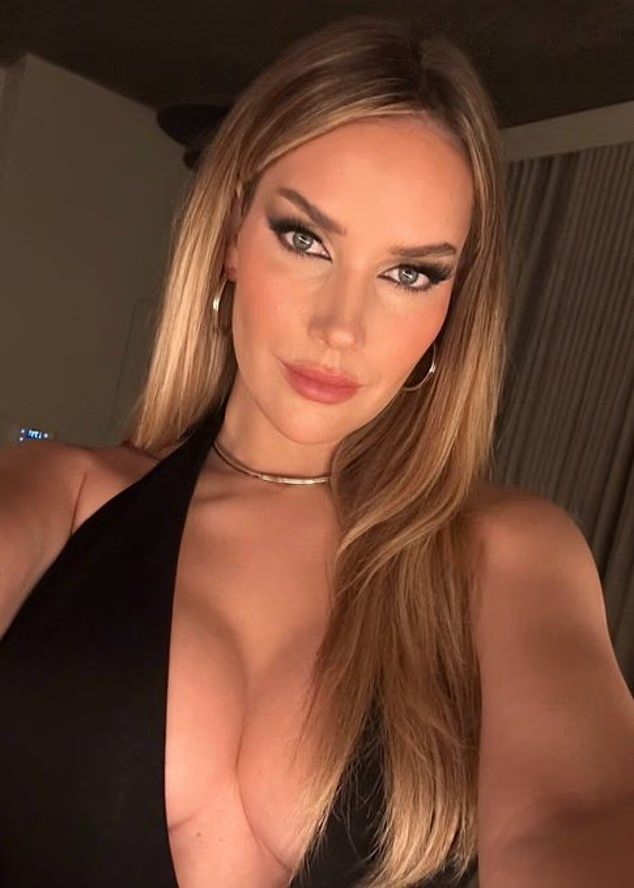
Fast forward to February 2026. She’s returned from her hiatus with a new look, increased confidence, and apparently, a night out in a black dress that sent social media “into a frenzy.” The article breathlessly reports this as if it’s shocking that someone would dress up for a night out.
But here’s what I actually see: a person reclaiming ownership of their image and their life. The selfie caption—”Sometimes I get to dress up”—is simple, almost offhand. But it’s significant. It suggests she’s no longer performing for the algorithm. She’s just living, and occasionally posting about it.
The fan responses in the article are telling too. “You can’t always be in golf wear,” one follower wrote. “May as well go all out.” There’s permission embedded in that comment—and maybe that’s what Spiranac needed to hear. That she’s allowed to be multidimensional. That she doesn’t have to be “golf’s glamour girl” 24 hours a day. That she can be a golfer, an influencer, a businesswoman, AND just a person who likes to dress up sometimes.
What This Means for Golf Culture
In my experience covering professional golf, the sport has always struggled with identity. It’s been too stiff, too traditional, too afraid of authenticity. The PGA Tour spent decades trying to control narratives and manage images. Then social media happened, and suddenly players—and former players turned influencers—had their own megaphones.
Spiranac represents both the promise and the peril of that shift. On one hand, she’s democratized golf commentary and made the sport more accessible and fun. On the other, she’s paid a personal price for that accessibility.
Her decision to step back and reassess, then return on her own terms, strikes me as mature and healthy. She’s signaling to other athletes—especially young women in sports—that you don’t have to burn yourself out for the algorithm. You can take breaks. You can change. You can be more than your brand.
The fact that a glamorous selfie is still dominating the conversation tells me we haven’t fully learned that lesson yet. But I think Paige Spiranac has. And that’s worth paying attention to.
