



As a golf architecture enthusiast who has walked the fairways of over 200 courses across the globe, I firmly believe there’s a certain magic woven into the fabric of the game’s Golden Age. That period, roughly 1915-1935 (though some stretch it to 1910-1940), gifted us a collection of architectural masterpieces that continue to captivate and challenge generations of golfers. Architects like Donald Ross, A.W. Tillinghast, and Alister MacKenzie weren’t just moving dirt; they were crafting experiences, drawing strategic lines in the landscape that resonate with primal golf sensibilities.
The beauty of these Golden Age gems lies in their strategic depth and their innate ability to blend seamlessly with the natural topography. They rarely resort to theatrical forced carries or contrived hazards. Instead, they demand thought, precision, and an understanding of angles – principles that still hold true in the modern game. While many of these hallowed grounds are the exclusive domain of private clubs, I’m here to tell you that some of the greatest are, thankfully, within reach of the everyday golfer. The recent LINKS 100 U.S. list confirms this, with a significant number of courses from this era still gracing the top tiers, and a surprising few open to the public.
Pebble Beach Golf Links: Where Pacific Drama Unfurls
My first pilgrimage to Pebble Beach was an almost spiritual experience. You stand on that first tee, sea mist kissing your face, and you just know you’re about to embark on something extraordinary. What truly sets Pebble apart, beyond its undeniable beauty, is the routing. Samuel Morse, the visionary founder, had a radical idea for 1916: that the land itself was so exceptional even an amateur could design a course here without ruining it. He enlisted Jack Neville and Douglas Grant, both top amateur players, who brilliantly conceived a figure-eight layout that relentlessly hugs the Pacific coastline.
“While virtually every hole has been changed over the years, Neville and Grant’s brilliant figure-eight routing, maximizing holes along the ocean, remains intact.”
This ensures that the ocean is not just a backdrop, but an active participant in your round, influencing lies, wind, and nerves. The stretch from Nos. 5 through 10 is, in my opinion, unparalleled. It’s a dizzying ballet of risk and reward, where every shot feels amplified by the dramatic cliffs and crashing waves. And that final stroll up the 18th, curving majestically around Carmel Bay? It’s not just a finish; it’s a coronation. It’s a course that tests every facet of your game while simultaneously forcing you to pause and simply admire the sheer spectacle.

Pinehurst No. 2: Donald Ross’s Subtle Masterpiece
Cross-country to the Sandhills of North Carolina, we find a very different, yet equally profound, architectural statement in Pinehurst No. 2. Donald Ross’s genius here lies in his subtlety. There’s no overwhelming drama from individual features; instead, the genius emerges from the cumulative effect of strategic nuance. The course rolls gently, almost serenely, through the towering pines. It’s wide and inviting off the tee, lulling you into a false sense of security. But then you encounter the greens.
“Such emphasis is due to the turtleback greens that are receptive only to certain approach shots. Miss the green and players face one of the fiercest tests of chipping in golf, where almost any club in the bag has an equal chance of success or failure.”
These turtleback greens are legendary. They reject anything less than a precisely struck approach, falling away on all sides, daring you to try and hold them. Here, the short game becomes an art form, a dance of touch and creativity. What I appreciate most about No. 2 is that it proves you don’t need excessive length or constant water hazards to test the best players in the world. It’s a testament to the power of thoughtful green complexes and strategic bunkering. And for the average golfer, the joy is in the journey, the challenge of trying to decode Ross’s intentions without losing a single ball, often a pleasant surprise after such a demanding round.

Bethpage Black: Public Golf at its Most Ferocious
My visit to Bethpage Black solidified my belief that public access doesn’t equate to a watered-down experience. In the depths of the Great Depression, while much of the country struggled, New York State decided its citizens deserved a championship-caliber public course. What A.W. Tillinghast, assisted by Joseph Purbeck, delivered was nothing short of a masterpiece, blending the best elements of Pine Valley and Winged Foot. The infamous warning sign on the first tee, “Warning—The Black Course is an extremely difficult course which we recommend only for highly skilled golfers,” is not hyperbole; it’s a solemn vow.
This walking-only behemoth is a brute, an unrelenting test of power, precision, and mental fortitude. Massive bunkers gape like ancient craters, swallowing errant shots. The rough is a tangled beast, and the greens, though not as severely undulating as Pinehurst’s, are fast and subtly challenging. The uphill climbs, especially on some of those brutal par-fours, wear you down. Yet, it’s this relentless challenge that makes Bethpage Black so utterly compelling. It’s proof that public golf doesn’t have to sacrifice an ounce of architectural integrity or championship quality. Standing on that vast expanse, seeing the throngs of passionate golfers, I understood why it holds such a special place in the hearts of many.

Pasatiempo: MacKenzie’s Coastal Conundrum
Alister MacKenzie, the man behind Augusta National and Cypress Point, left us with another marvel that is surprisingly accessible: Pasatiempo. Tucked into the undulating hills above Santa Cruz, California, this course, built in 1929, is a masterclass in strategic design, proving that distance isn’t everything. At just 6,495 yards, par 70, it might seem demure on paper, but walk Pasatiempo once, and you’ll understand its bite. Many a storied professional, even the likes of Tiger Woods, Ben Hogan, and Byron Nelson, have struggled to better 67 here.
MacKenzie’s genius lies in exploiting the natural terrain. Rolling hills are crisscrossed by barrancas, demanding careful shot placement. Fairways are slender, framed by mature trees, and the Pacific Ocean breezes add an invisible layer of complexity. But the true stars here are the deep, artfully sculpted bunkers and the nightmarishly quick, canted greens. Every putt feels like a puzzle, every approach a delicate calculation. Thanks to Jim Urbina’s thoughtful restoration, much of MacKenzie’s original magic has been carefully brought back, ensuring that Pasatiempo continues to bewitch and bedevil golfers just as the good Doctor intended. It’s an essential pilgrimage for any architecture buff, offering a deeply insightful look into the mind of one of golf’s greatest designers.

Mid Pines & Pine Needles: Ross Revived in the Sandhills
Back in the North Carolina Sandhills, not far from Pinehurst, lie two more wonderful examples of Donald Ross’s accessible artistry: Mid Pines and Pine Needles. Both have benefited immensely from recent restorative work, particularly the insights of Kyle Franz, who played a pivotal role in bringing their original Rossian character back to life. Having walked these fairways, I can attest to the transformative impact of these efforts.
Mid Pines, with its 2013 restoration, now epitomizes the Sandhills aesthetic. Franz stripped away encroaching trees, revealing Ross’s original width, angles, and strategies. The hardpan sand dotted with wiregrass lining the fairways and greens isn’t just scenic; it’s a strategic element, punishing wayward shots while offering tantalizing options for recovery. The 325-yard par-four 4th epitomizes this. A precise tee shot hugging the sandy hazard on the left sets up the ideal angle to a shallow, plateau green. Anything less precise, and you’re contemplating a potential disaster. It’s a wonderful blend of challenge and strategic choice.

Pine Needles, meanwhile, holds its own as a celebrated tournament venue, hosting multiple U.S. Women’s Opens. While perhaps not as brutally difficult as Pinehurst No. 2, its crowned greens demand exacting approaches, a consistent theme in Ross’s work. Kyle Franz’s 2017 restoration similarly stretched the layout while conjuring its original character. The 475-yard par-four 2nd hole stands out as an early test, requiring a powerful drive to a plateau and then a deftly gauged downhill approach to a green that slopes away perceptibly. Both Mid Pines and Pine Needles offer a delightful, yet challenging, glimpse into the enduring brilliance of Donald Ross.

The Greenbrier (Old White): Classic Templates in the Alleghenies
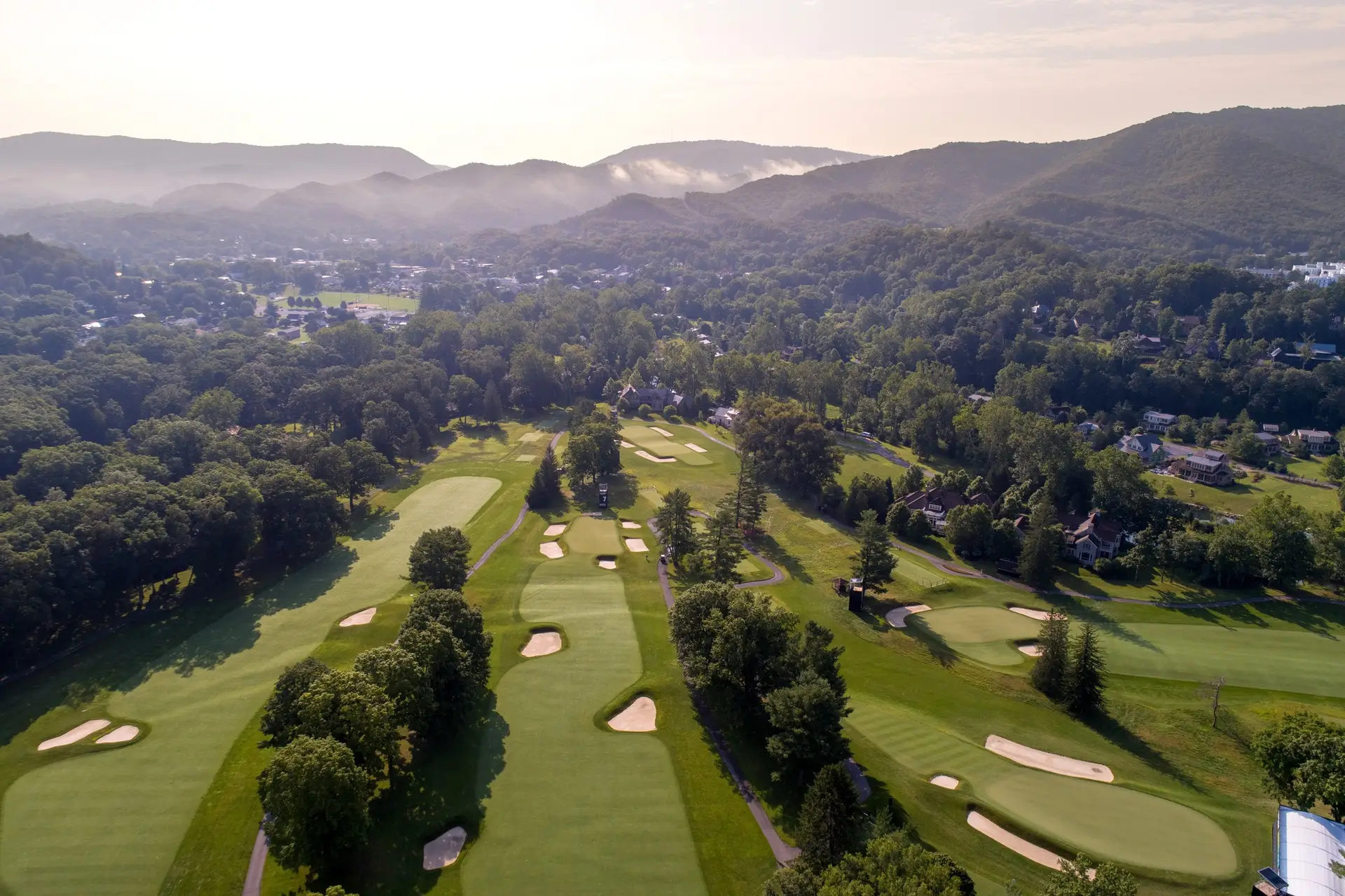
In the serene foothills of West Virginia’s Allegheny Mountains lies The Greenbrier’s Old White, a wonderful example of C.B. Macdonald and Seth Raynor’s template hole philosophy. Refurbished in 2007 by Lester George, it’s a joy to play for anyone who appreciates the historical lineage of golf design. The course is a living museum of classic holes, perfectly integrated into the undulating terrain. You’ll encounter famous templates like the Redan par-three 8th, the Punchbowl par-four 9th, and the Eden par-three 15th.
I find immense satisfaction in playing a course where each hole offers a recognizable, yet uniquely adapted, strategic problem. Macdonald and Raynor believed in the timelessness of these architectural forms, and experiencing them here at Old White is a treat. The challenge is thoughtful, rewarding strategic play over brute force. The course even closes with an unusual par-three 18th, a delightful and perhaps somewhat unsettling way to finish a round that has undoubtedly stretched your golf intellect.
These Golden Age courses are more than just layouts of grass, sand, and trees; they are living testaments to an era when golf course architecture was truly an art form. They offer a tangible link to the game’s rich history, providing strategic challenges and aesthetic rewards that remain as compelling today as they were a century ago. And the best part? You can play them. So, plan your trip, pack your clubs, and prepare to step back in time to experience golf at its most thoughtful and grand.
