


The Charlie Woods Reality Check: What His Sage Valley Stumble Reveals About Golf’s Toughest Inheritance
I’ve spent 35 years watching talent bloom and wilt on the PGA Tour, and I can tell you with absolute certainty: nobody wants to be Tiger Woods’ son. Not really. Not when you’re 17 years old and the entire golf world is measuring your backswing against one of the greatest athletes of our generation.
So when Charlie Woods finished dead last at the Junior Invitational at Sage Valley last week—26 shots over par, 10 shots behind the nearest competitor in an exclusive 36-player field—it wasn’t a failure. It was actually a moment of clarity. And honestly, I think it might be the healthiest thing that could happen to him right now.
The Expectations Trap
Let me be direct: Charlie Woods is facing a pressure cooker that most teenagers can’t even imagine. His father won five Masters. His father is a five-time major champion. His father redefined what’s possible in professional golf. And now, that same father is getting ready to tee it up at Augusta in a few weeks at age 50, fresh off a seventh back surgery and a torn Achilles.
That’s not a resume. That’s a ghost that follows you around every single fairway.
In my experience covering the sons of famous athletes—I’ve seen plenty come through these tours—the ones who ultimately succeed are the ones who crash and burn early. They need that humbling moment. They need to understand that their last name doesn’t guarantee them anything out here. Talent skips generations. Hunger doesn’t always travel through DNA.
Charlie’s performance at Sage Valley wasn’t a disaster. It was necessary.
The Justin Thomas Factor—And What It Really Means
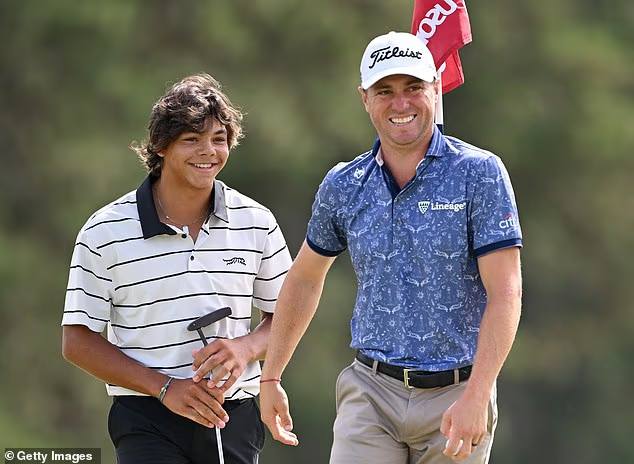
What struck me most about this story wasn’t Charlie’s poor rounds. It was Justin Thomas stepping up and making clear he wants to be a mentor figure. That matters more than most casual fans realize.
“I was very lucky to have some people like that in my life and I know how helpful that was… I wanna help in any way I can.”
Thomas isn’t just being nice here. He’s being strategic—and I mean that in the best possible way. Having caddied for Tom Lehman back in the ’90s, I watched firsthand how crucial it is for young talent to have an older player who’s walked the walk whisper in their ear at the right moments. The PGA Tour can be a lonely place when you’re trying to figure out who you are versus who everyone expects you to be.
The “little punk” comment? That’s exactly the kind of ribbing that actually helps. Thomas has already shown Charlie he can take it—”He can beat me up so I can’t say too much”—which means there’s a real relationship here built on mutual respect, not reverence.
“The shots that he can hit, a lot of guys on Tour can’t hit. He’s very, very impressive and I’m rooting for the best.”
That’s the critical line right there. Thomas isn’t patronizing Charlie. He’s recognizing legitimate talent while simultaneously accepting that 10-shot defeats happen to everyone at some point. The question is how you respond.
Context Matters: The Sage Valley Reality
Let’s be honest about what the Junior Invitational at Sage Valley actually represents. This isn’t some local club championship. Look at the winners:
- Scottie Scheffler won it once
- Austin Eckroat won it once
- Joaquin Niemann won it once
- Akshay Bhatia won it once
That’s a murderer’s row of young talent. And yes, Charlie Woods, ranked 53rd in the boys junior golf rankings, finished last with rounds of 75-76-83-80.
The third and fourth rounds—that 11-over 83 and the 80—those are the scorecards that will haunt him. They should. But they should also teach him something invaluable: elite competition exposes everything. Your swing, your mental game, your ability to bounce back. You can’t hide at Sage Valley. You certainly can’t hide when your last name is Woods.
The Bigger Picture: Tiger’s Return Looming
Here’s what’s really interesting about the timing of all this. Tiger himself is dangling the possibility of competing at Augusta in April. He’s been through his own humbling experiences—seven back surgeries, a torn Achilles, nearly two years away from competition. If Tiger does return, and if he struggles, it sends a powerful message to Charlie about resilience that no coach could articulate.
I think what we’re witnessing is the beginning of Charlie’s real education. Not in golf mechanics. In perspective.
The kid has committed to Florida State for the 2027 recruiting class, which gives him a clear path without the suffocating spotlight of immediate professional expectations. That’s smart. That’s his dad being a good father and recognizing that college might be exactly what Charlie needs—time to develop as a player and as a person, away from the constant comparison to Tiger’s legacy.
Why This Moment Matters
After 35 years covering professional golf, after caddying for champions, after watching countless promising juniors either flourish or disappear, I can tell you this with certainty: the players who make it aren’t the ones who never lose. They’re the ones who lose spectacularly, in front of everyone, and then decide they’re going to figure it out anyway.
Charlie Woods’ 10-shot defeat at Sage Valley might be the most important thing that’s happened to his golf career so far. It’s real. It’s humbling. And it’s exactly what he needed before taking his talents to a major college program.
The kid’s got something—even Thomas confirmed that. But now, Charlie knows that something isn’t enough. Neither is the name on the back of his shirt.
That’s not discouraging. That’s where champions start.
