


Phil’s South Africa Rustiness Masks a Deeper Question: Can the Lefty Find His Way Back?
By Jimmy Caldwell, Senior Tour Correspondent
I’ve covered enough comebacks in 35 years around professional golf to know that a four-over par 75 in your first competitive round back isn’t actually the story. What matters is what comes next—and more importantly, what got us here in the first place.
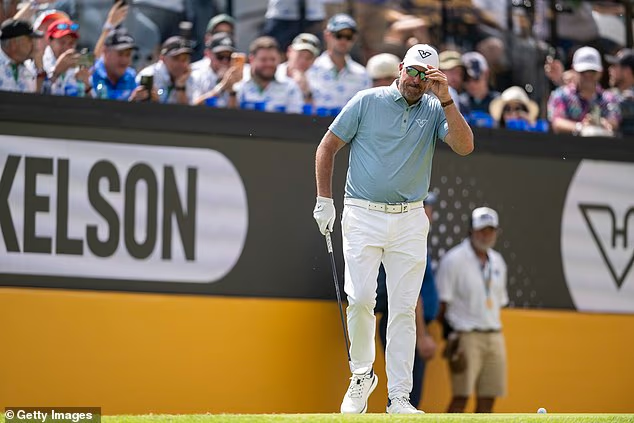
Phil Mickelson’s return to competitive golf Thursday in South Africa was, by his own standards, rough. A double and triple bogey sandwiched around two birdies doesn’t inspire confidence, especially with The Masters looming just three weeks away. But I’ll be honest: I’m less concerned about that single round than I am about the broader picture that’s emerged over the past seven months.
The Elephant in the Room
Let’s address what nobody wants to say out loud. Mickelson missed four LIV Golf events—initially framed as a brief “family health matter” in February that somehow stretched into a four-month absence. He’s chosen not to elaborate, and frankly, that’s his prerogative. Family comes first, always. But in professional sports, extended unexplained absences create a vacuum that gets filled with speculation.
What strikes me is the timing and the silence. In my three decades covering this tour, I’ve seen injuries, personal crises, and legitimate reasons for time away. But when a player vanishes for this long without detail—even vague detail—it raises questions about fitness and readiness that go beyond a single rusty round.
“I’ve really missed seeing everyone and competing. I’m so excited to be back with the guys this week.”
Mickelson’s social media message upon arrival in South Africa reads genuine enough. But I’ve heard plenty of excited rhetoric from players returning from layoffs, only to watch them struggle for weeks trying to find their rhythm. The 55-year-old hasn’t played competitive golf since last August—that’s eight months. For a player whose game has already declined measurably, that’s not a minor sabbatical.
The 2025 Reality We Can’t Ignore
Here’s what the numbers tell us, and why that South Africa 75 matters more than it seems:
- Missed the cut in 3 of 4 majors in 2025
- Failed to make the cut at The Masters for the first time in years
- Finished tied 56th at The Open Championship (Royal Portrush)
- Best finish in final six LIV events: tied 23rd
That’s not a slump. That’s a decline. And now Mickelson is hoping to reverse course at the one place where he’s proven he can still compete at the highest level—Augusta National, where three of his six major championships reside.
I’ve caddied for players trying to recapture magic at places that once loved them. It’s powerful, sure. But it’s also pressure that can paralyze. Mickelson is 55 years old coming off a rough year and an unexplained eight-month layoff. Augusta’s azaleas aren’t going to suddenly make him 50 again.
Why This Moment Matters Beyond Phil
Here’s what I think the golf world should really be watching: LIV Golf needs Mickelson to succeed right now, whether anyone admits it or not. Brooks Koepka and Patrick Reed have jumped ship back to the PGA Tour. The Saudi-backed circuit is facing legitimacy questions. The optics of their highest-profile American player—a six-time major winner—struggling through a rusty comeback in South Africa before a major isn’t ideal timing.
“Mickelson is in line to make his 34th appearance at the iconic Augusta course, a place where he has emerged victorious on three separate occasions (in 2004, 2006 and 2010).”
That’s incredible longevity. That’s also a 22-year gap since his last Masters win. The game has evolved. Phil’s peers have mostly aged out of contention. The window for a competitive run isn’t just closing—it’s approaching the point of being sealed shut.
The Glass-Half-Full Read
But here’s where I pump the brakes on pessimism: Mickelson has done miraculous things before. A 62-year-old winning the PGA Championship isn’t supposed to happen. We saw it happen. The man has defied conventional wisdom about age and athletic performance his entire career.
One rusty round doesn’t define a comeback. If he plays the next two weeks smartly—minimal risk, focus on fundamentals—he could arrive at Augusta sharp enough to make noise. And frankly, Augusta has always brought out something special in him. The course setup, the memories, the ghosts of his three victories there—these things matter more than people realize.
In my experience, the story isn’t whether Phil can shoot 75 or 72 in South Africa. The story is whether he can find the mental clarity and physical readiness to compete at Augusta. Whether whatever personal matter demanded his absence for eight months has been resolved enough that he can lock in on golf.
That’s the real comeback we’re waiting to see.
