


As a golf course architecture enthusiast who has walked the fairways of over 200 courses across the globe, there’s a particular reverence I hold for the Golden Age of design. This period, roughly spanning 1915–35, or as some argue, 1910–40, was a crucible where master practitioners like Donald Ross, A.W. Tillinghast, George Thomas Jr., William Flynn, and Alister MacKenzie forged the bedrock of American golf. These architects understood that a great course wasn’t just about length, but about strategy, natural integration, and an enduring challenge that rewards intelligence as much as power.
One course that consistently captivates my architectural sensibilities, and one that is thankfully accessible to the public, is Alister MacKenzie’s Pasatiempo. Tucked away in the rolling hills of Santa Cruz, California, Pasatiempo embodies everything that makes Golden Age design so enthralling.
Pasatiempo: MacKenzie’s Californian Masterpiece

From the moment you step onto the property, you sense the history and artistry that permeate Pasatiempo. Dr. Alister MacKenzie, the visionary behind Augusta National and Cypress Point, designed this course in 1929, and it quickly became his home and personal laboratory. It’s a testament to his genius that a course measuring a mere 6,495 yards and now playing to a par of 70 can still humble the game’s greatest. You might read those yardage figures and scoff, but Pasatiempo’s bite is far worse than its bark.
“Par has been shaved from 74 to 70 since Dr. Alister MacKenzie’s finest public access course first opened, yet it seldom takes a beating, even at the hands of Ben Hogan, Byron Nelson, or Tiger Woods—none of whom has bettered 67 on the 6,495-yard layout.”
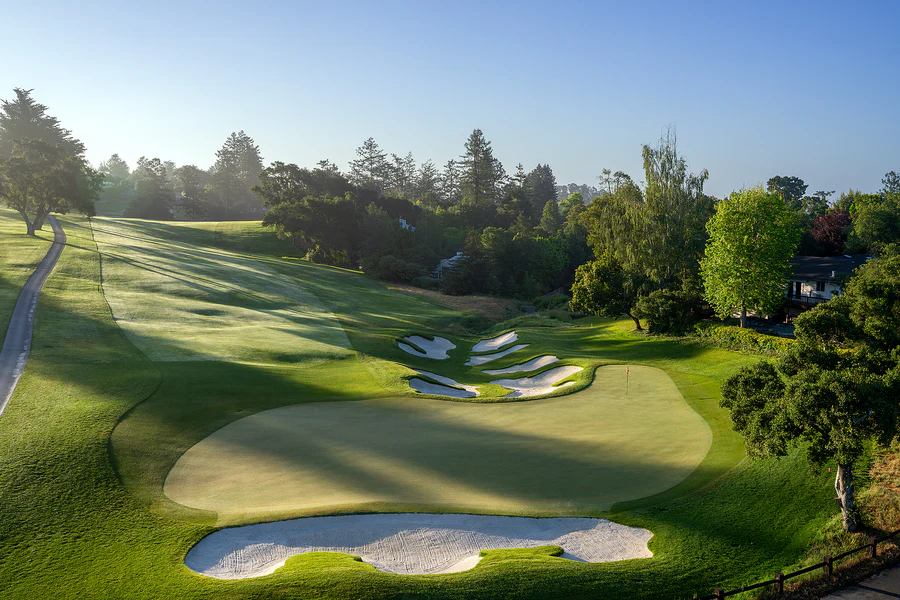
This quote from the source article speaks volumes. It highlights MacKenzie’s uncanny ability to create strategic complexity that transcends raw distance. What makes it so difficult? It’s a symphony of challenges that truly test every facet of your game. The rolling terrain, crisscrossed by dramatic barrancas, forces thoughtful tee shots and precise iron play. Fairways, often slender, are framed by mature trees, demanding accuracy over brute strength. Then there are the bunkers – deep, artfully sculpted, and strategically placed sentinels that punish any errant shot. Add to this the capricious Pacific Ocean breezes and MacKenzie’s famously quick, canted greens, and you have a puzzle that never truly yields its secrets.
A Masterclass in Strategic Design
MacKenzie’s philosophy of strategic design is on full display here. He champions the concept of “risk and reward,” where a bolder line of play might open up a better angle to the green, but carries the heightened risk of a penal outcome. There are no two holes where this feels more evident than the iconic par-3 3rd and the par-5 16th. The third, a downhill shot over a deep chasm, requires absolute commitment, while the sixteenth presents a tantalizing opportunity to reach in two for the brave, or a more conservative three-shot approach for the wise. The green complexes at Pasatiempo are legendary – bold contours, false fronts, and collection areas that demand exquisite touch and imagination around the greens. Recovering from off the green truly requires an artistry that many modern courses simply don’t cultivate.
I distinctly remember standing on the 6th tee, looking down at one of those signature Mackenzie greens, deeply contoured and seemingly guarded by omnipresent bunkers. It’s a short par 4, yet the approach demands absolute precision to find the right quadrant, otherwise you’re left with a putt that can swing wildly.
“How can such a pipsqueak in the yardage department play so difficult? Try rolling terrain that’s crisscrossed by barrancas, slender fairways hemmed in by trees, hordes of deep, artfully sculpted bunkers, Pacific Ocean breezes, and nightmarishly quick, canted greens.”
This perfectly encapsulates the Pasatiempo experience. It’s not about monstrous carries or brute force; it’s about thoughtful golf, strategic positioning, and a delicate touch. You won’t find water hazards on every turn, but the natural land movement and MacKenzie’s cunning use of bunkers create an equally formidable challenge. The recent Jim Urbina restoration has been a triumph, painstakingly bringing back much of the course’s original MacKenzie magic, ensuring that the course continues to challenge and delight as its architect intended.
A Public Gem Worth Seeking Out
Pasatiempo is a truly special place, a living testament to the enduring brilliance of Golden Age golf course architecture. Its public access status makes it a pilgrimage site for architecture buffs and serious golfers alike. Located in Santa Cruz, it beautifully blends the rugged California coast with an inland feel. Before you venture out, sharpen your short game and prepare for a masterclass in strategic golf. While it’s certainly a challenge, the joy of navigating MacKenzie’s vision, contemplating every shot, and seeing the natural beauty of the land unfold before you is an experience every golfer should savor.
Unlike many of its exclusive Golden Age brethren, Pasatiempo offers a more democratic access to architectural greatness. So, if you’re planning a trip to California, make sure Santa Cruz and Pasatiempo are high on your list. You’ll leave with a profound appreciation for one of the game’s true architectural masterpieces, and perhaps, a slightly lighter golf ball bag – but a much richer golfing memory.
