

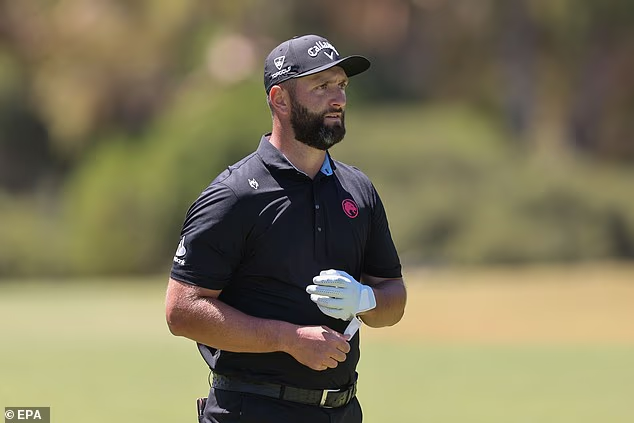

Rahm’s Stubborn Stand: Why One Man’s Refusal Could Reshape European Golf
In 35 years of covering professional golf, I’ve learned that the biggest stories rarely unfold on the fairways. They happen in conference rooms, over phone calls, and—increasingly—in the spaces between what players say publicly and what they’re actually thinking. Jon Rahm’s decision to reject a settlement offer that eight of his LIV Golf colleagues have accepted is one of those moments. And I think it tells us something important not just about Rahm’s character, but about the state of professional golf right now.
Let me be clear: this isn’t about whether LIV Golf is good or bad for the game. That ship sailed years ago. This is about a player making a calculated—or perhaps miscalculated—decision that could cost him dearly.
The Deal That Eight Accepted
Here’s what happened Saturday morning: the DP World Tour confirmed that Tyrrell Hatton, Laurie Canter, Thomas Detry, Tom McKibbin, Adrian Meronk, Victor Perez, David Puig, and Elvis Smylie all signed conditional releases that include some meaningful obligations. According to the tour’s statement:
“Each member has accepted the conditions specified by the DP World Tour for their release, which include: payment in full of all outstanding fines for breaches of the DP World Tour’s Regulations; participation in additional stipulated DP World Tour tournaments, as well as associated media activity and promotion; withdrawal of all pending appeals.”
By industry standards, this was generous. Tour insiders—and I’ve spoken to several—view it as an olive branch so substantial that rejecting it borders on stubborn. These eight players will pay their fines (which LIV has agreed to cover, anyway), play some extra DP World Tour events, and their slate gets wiped clean. By 2027, they’re eligible for the Ryder Cup. Done.
Rahm? He walked away from the table.
The £2.5 Million Question
Here’s where it gets serious. Rahm’s outstanding fines are estimated at around £2.5 million. If he continues down his appeals path and loses—and sources suggest an independent review could happen before summer—he faces a choice: pay up or lose his DP World Tour membership entirely. And without that membership, the 2027 Ryder Cup becomes inaccessible.
In my experience, very few players voluntarily step away from Ryder Cup eligibility. I’ve watched grown men in their 40s play reduced schedules just to maintain that possibility. I caddied for Tom Lehman in the mid-90s, and the fire he had for the Ryder Cup never diminished. That’s the European Tour’s enduring power—not the prize money, not the ranking points, but the Ryder Cup.
So why is Rahm fighting?
Pride, Principle, or Perspective?
What strikes me most is the contrast with Tyrrell Hatton. These two were allied in their resistance to the DP World Tour’s sanctions. Hatton, who was alongside Rahm in opposing the plans, took what we might call the pragmatic route. Both were controversially cleared to play in Europe’s victory last autumn through an appeals process, but both seemed to understand that indefinitely prolonging the row wasn’t sustainable.
Hatton blinked. Rahm didn’t.
The report notes something telling:
“Tour sources were stunned that Rahm had now decided to prolong the row.”
That’s significant. When institutional insiders are surprised by a player’s stubbornness, it suggests the player might be operating on a different logic than most would expect. Is Rahm gambling that he’ll win his appeal? Is he making a statement about principle? Or is he simply confident that a 2027 Ryder Cup will be negotiated differently by then, perhaps as part of a broader LIV-PGA Tour settlement?
I don’t have that answer. But I know Rahm is a thoughtful competitor who rarely makes impulsive decisions.
What This Means for Professional Golf
Here’s what matters beyond the headlines: this situation exposes the fragility of golf’s governance. The DP World Tour had to offer eight players a generously structured deal to move past this standoff. That suggests the tour was tired of the fight. The fact that Rahm is willing to extend it suggests either extreme confidence or a willingness to sacrifice significant opportunities for his convictions.
Neither scenario is comforting if you’re running European golf.
The good news? The other eight players—Canter, Detry, McKibbin, Meronk, Perez, Puig, and Smylie—are now on a path to stability. They’ve got clarity. Their 2027 Ryder Cup eligibility is secured. That’s a win for the tour and for the broader ecosystem of professional golf.
But Rahm’s intransigence suggests these tensions aren’t resolved. They’re just being managed on a case-by-case basis, which is exactly what institutions dislike.
The Waiting Game
An independent appeals body will likely hear his case before summer. If Rahm loses and still refuses to capitulate, he’ll be writing a check for £2.5 million or sacrificing his Ryder Cup future. Both are significant costs for a principle.
Having covered 15 Masters and watched golf’s landscape shift dramatically over three decades, I’ve learned that principle and pragmatism rarely coexist peacefully. Usually, one gives way. Sometimes, spectacularly.
We’ll find out which one matters more to Jon Rahm by September.
