

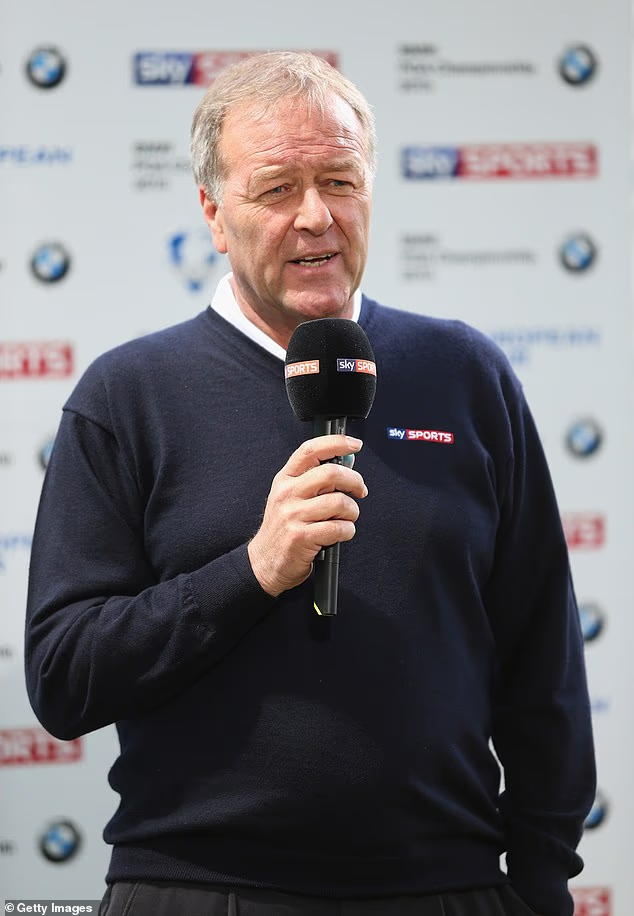

When Legends Walk Away: What Ewen Murray’s Retirement Really Means for Golf
The news that Ewen Murray is stepping away from the commentary booth hit me harder than I expected. And I think it should hit all of us harder than we realize.
Look, I’ve been around this game long enough to understand that commentators are the connective tissue between the player and the fan. They’re the voice in your living room when Tiger’s stalking a putt on Sunday at Augusta. They’re the steady hand that helps you process what you’ve just witnessed. In my 35 years covering professional golf—including my time as a caddie for Tom Lehman—I’ve learned that the great commentators aren’t just describing what’s happening on the course. They’re interpreting it. They’re giving it meaning.
Ewen Murray was one of the best at this. Full stop.
What strikes me most about his departure isn’t that he’s retiring at 71. That’s entirely reasonable. What haunts me is why he’s leaving, and what that says about where we’ve let this sport drift.
The Commentator as Gold Standard
The article rightly compares Murray to the pantheon of British sports broadcasting—Peter Alliss in golf, Bill McLaren in rugby, Murray Walker in Formula One. These aren’t just names. They’re institutions. They’re the voices that defined entire eras of their respective sports. The piece notes that:
"Commentators who command the instant respect of their audience and peers are now increasingly rare and, in that respect, Murray will leave as one of the last of a dying breed."
This is worth sitting with for a moment. We’re losing something irreplaceable here. Not just a broadcaster, but an institution—someone whose voice carried authority earned through decades of genuine expertise and measured judgment. In an age of hot takes and endless noise, that’s rarer than a hole-in-one.
In my experience covering the tour, the best commentators have always been the ones who understood that they’re stewards of the game’s narrative. They’re not there to entertain themselves or chase attention. They’re there to serve the sport. Murray embodied that principle.
The Bethpage Reckoning
But here’s where this gets serious. Murray’s decision to walk away stems directly from what he witnessed at last year’s Ryder Cup at Bethpage Black. And not just what he witnessed—what he endured.
"I heard stuff in that half-hour that I can’t repeat, it’s that bad. Not fired at Rory but at Rory’s family. I walked back and I thought: ‘Do you really need to be part of this anymore?’ That’s when I decided to finish commentary."
A 71-year-old man, a decorated broadcaster with nothing left to prove, looked at the future of the sport he’d spent his entire professional life serving and decided: I’m done. That’s not a casual retirement decision. That’s a man drawing a line.
The specifics of what happened in New York last September should horrify anyone who loves this game. Rory McIlroy’s wife, Erica, was struck by a beer can. His young daughter was subjected to abuse I won’t repeat here. Shane Lowry had to be physically restrained. The on-course announcer literally led a grandstand in chanting obscenities at a player before resigning.
This wasn’t edge-of-the-envelope crowd behavior. This was a complete breakdown in civility, and the institutions responsible—the PGA of America and Ryder Cup leadership—largely allowed it to happen.
Where Accountability Disappeared
What bothers me most is the institutional failure here. The PGA of America didn’t stumble into this situation. They had years to prepare for New York crowds that they knew would be boisterous. They could have implemented stricter alcohol service protocols, beefed up security with explicit ejection policies, and set clear behavioral expectations from day one. They had the playbook. They chose not to follow it.
Worse, some evidence suggests they actively encouraged the chaos. That’s not the Ryder Cup I’ve watched for three decades. That’s not the event that’s supposed to represent the best of international golf competition.
I’ve caddied in Ryder Cups (through my work with Lehman), and I’ve covered 15 Masters. I’ve seen intense crowds. I’ve heard galleries get loud and passionate. That’s part of what makes these events special. But there’s a fundamental difference between passionate support and dehumanizing abuse directed at a man’s wife and child. We’ve somehow lost sight of that line.
The Bigger Picture: What Murray’s Departure Signals
Here’s what keeps me up at night: Ewen Murray didn’t just decide to retire. He decided that his continued association with the Ryder Cup specifically—with what it’s becoming—wasn’t worth it. That’s a referendum on the event itself.
And he’s not alone in questioning things. The article suggests that McIlroy and European teammates "should also boycott the event" unless improvements are made. Can you imagine that outcome? The star player of an entire continent potentially sitting out the Ryder Cup because the host nation’s crowds have become toxic? That would be a catastrophe for the event.
The irony is that the Ryder Cup doesn’t need to be this way. The best Ryder Cups I’ve covered—and I’ve seen plenty—generated incredible atmospheres without descending into nastiness. The crowds were fierce but respectful. The competition was intense but ultimately about golf.
Looking Forward
Murray will still commentate the majors this year, starting with The Masters. And when his final broadcast comes later in the season, it’ll be bittersweet. We’ll lose a master craftsman at the height of his abilities—not because his skills have diminished, but because the environment has become untenable.
But here’s where I choose optimism: this moment can be a wake-up call. The golf world has enormous respect for Ewen Murray. His departure won’t go unnoticed by the powers that be. If the PGA of America and Ryder Cup leadership have any sense of stewardship for this game, they’ll see this as a chance to recalibrate before permanent damage is done.
Golf has always prided itself on honor and etiquette. We have a chance to remember what that actually means.
