

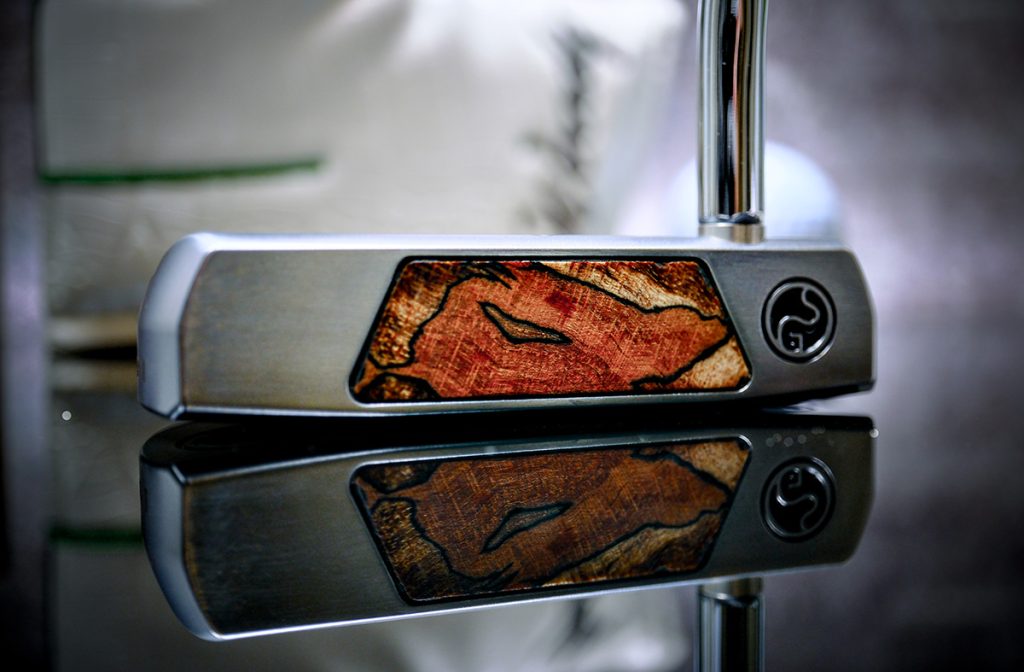

The Scott Golf Woody: A Different Stroke or Just a Pretty Face?
As the Equipment Editor for The Daily Duffer, my inbox is usually overflowing with grand claims of "revolutionary" technology. Most of the time, it’s just a new paint job or a negligible tweak to an existing design. So, when the buzz around the Scott Golf Woody started at the 2026 PGA Show, I was, admittedly, skeptical. A putter with a wood face? In an era where carbon fiber, multiple metals, and elaborate weighting systems dominate the putter landscape, this felt like a deliberate step backward, or at least a stark departure from the norm. But every once in a while, something genuinely unique comes along, and I owe it to our readers – and my own curiosity – to dig past the initial aesthetic and see if there’s real performance behind the pretty face.

My initial reaction, honestly, was mostly aesthetic appreciation. The craftsmanship looks superb, and the natural wood grain definitely offers a distinctive, almost artisanal feel. But as a club fitter obsessed with data, I needed to know if this was a functional piece of equipment or just a show pony. Petersen, the man behind Scott Golf, explains his motivation:
“I kind of liked the feel. I liked the look and the difference. The originality that we had that nobody else had.”
"Feel" and "originality" are great, but in putters, feel needs to translate to consistent roll and distance control. The true test of any putter, regardless of its materials, lies in its ability to get the ball into a pure forward roll as quickly as possible. Excessive skid means a loss of energy and unpredictable performance.
The Engineering Behind the “Woody”
The technical details are where the rubber meets the road for me. This isn’t just a block of wood slapped onto a shaft. The core of the putter is a forged 1020 carbon steel body, which is a premium material choice, offering excellent feedback and workability for precision milling. The wood insert itself is stabilized with resin, a critical step to ensure durability in varying golf course conditions. As Petersen put it:
“I had to figure a way to stabilize the wood so it wouldn’t be affected by moisture content. So, we dry it and we vacuum seal it with resin. It almost plasticizes that wood but keeps the beauty of the original piece.”
This stabilization process is key. Without it, wood would be entirely unsuitable for a putter face, susceptible to warping and inconsistent performance due to humidity and moisture. This tells me that Scott Golf isn’t just throwing wood at the problem; they’ve thought about the practicalities.

Now, for the performance claims. Petersen states that the wood face allows the ball to stay in contact "a little softer," potentially reducing initial skid. While the article notes "internal evaluation" and "testing with the Genus ball" showed roll characteristics competing with industry leaders, I’d really love to see independent launch monitor data here. We’re talking hard numbers: roll distance before full forward roll, ball speed consistency across the face, and launch angle data. My experience with hundreds of putter fittings tells me that while material certainly contributes to feel, the actual mechanics of roll are dictated by loft, lie, effective mass, and face balancing. A softer material might feel better, but unless it’s demonstrably improving roll geometry, it’s difficult to quantify a performance advantage beyond subjective preference.
However, the article does mention the putters (both the Blade and Scorpion mallet) exhibited "solid resistance to twisting on off-center strikes" and that "stability never felt like a weakness." This is a crucial practical point. Many boutique putters, while beautiful, can sacrifice MOI (Moment of Inertia) for aesthetics, leading to poor performance on anything but dead-center strikes. If these putters are indeed maintaining stability and offering a unique feel, that’s a compelling combination. A putter with good MOI will maintain ball speed and direction on mishits, which is far more important for most golfers than a tiny reduction in initial skid that can only be measured on a high-speed camera.

Who is the Woody For, and What’s the Real Value?
Priced at $849, this putter firmly sits in the high-end boutique category. For that price, golfers aren’t just buying a tool; they’re buying a piece of craftsmanship and exclusivity. The "one of one" aspect due to unique wood grain patterns and the extensive customization options (different woods, neck styles, grips, finishes) are certainly appealing to a specific type of golfer.
“What I’m seeing is the feel. It feels special.”
This quote perfectly encapsulates the target audience. It’s for the player who values the subjective "special" feeling over raw, quantifiable ballistic data. Now, as a fitter, I can tell you that "feel" and "confidence" are absolutely critical in putting. If a putter makes you feel better, more connected, and more confident over the ball, that can absolutely translate into better performance on the green, even if the launch monitor numbers aren’t drastically different from another well-fitted putter. I’ve fit countless golfers who gravitate towards a certain sound or feel, and their putting improves because of the mental boost.

For the average golfer looking to shave strokes, the significant investment might be better spent on a professional putting lesson and a more conventionally designed, well-fitted putter. However, for the golf enthusiast who appreciates unique craftsmanship, a connection to golf’s heritage, and a truly bespoke piece of equipment, the Scott Golf Woody offers a compelling proposition. It’s for the player who wants something nobody else has, a conversation starter that also performs. The review’s observation that "distance control was predictable and easy to calibrate" is encouraging, as ultimately, that’s the performance metric that matters most to my fitting clients. The explicit feedback on off-center hits ("You still know where you miss") is also great – you want that feedback to learn and improve.
Ultimately, the Scott Golf Woody is a compelling piece of engineering and artistry. While I would love to see independent, detailed launch monitor data quantifying the "reduced skid" claims, the underlying technical solutions to stabilize the wood and create a premium forged body are sound. For the golfer seeking a truly unique, custom-fitted putter that blends tradition with modern performance, and who understands that confidence on the greens is often derived from intangible feel, the Woody certainly merits a closer look. For serious gearheads and collectors, its distinctiveness and customizable nature make it a standout in a crowded market. Just make sure you get properly fitted to ensure that beautiful face is pointed true to your target.
