

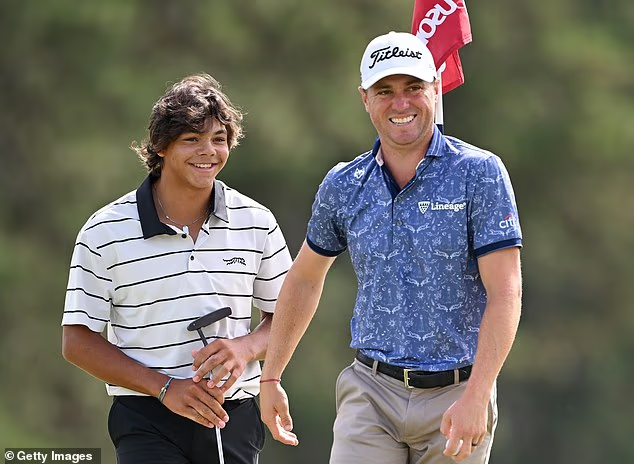

Justin Thomas, Mentorship, and the Weight of Expectations Around Charlie Woods
I’ve covered enough junior golf over the years to know that one bad tournament doesn’t define a career trajectory. But I’ve also been around this game long enough to recognize when a moment matters—not because of what happened, but because of what it reveals about the ecosystem surrounding young talent in professional golf.
Charlie Woods’ 10-shot collapse at the Junior Invitational at Sage Valley last week was, by the numbers, brutal. Dead last in a 36-player field. An 83 in round three that essentially ended any competitive hopes. The kind of week that gets replayed in highlight reels and, unfortunately, becomes the narrative.
But here’s what I found most compelling about this story: it wasn’t the poor performance that grabbed my attention. It was Justin Thomas stepping into the mentorship lane with purpose and genuine warmth.
The Value of a Big Brother
Having caddied for Tom Lehman in the ’90s and covered Tiger’s rise as closely as anyone in the media, I can tell you that the difference between a young player who crashes and burns versus one who learns and evolves often comes down to one thing: access to someone who’s been through it and actually cares.
Thomas gets this. When he said,
“I wanna be if he wants me to be. I was very lucky to have some people like that in my life and I know how helpful that was… I wanna help in any way I can,”
he wasn’t performing for the cameras on The Smylie Show. That’s the voice of someone who remembers what it felt like to be a young pro with questions and doubts. Thomas knows the tour’s rhythms, its pressures, its pitfalls. More importantly, he has the credibility—two majors, consistent top-10 finishes, genuine friendships—to mentor without preaching.
The “little punk” comment? Classic tour guy banter. I’ve heard versions of that between players a thousand times. It’s affection wrapped in irreverence. The fact that Thomas followed it up with acknowledgment that Charlie can now physically outmatch him—”He can beat me up so I can’t say too much”—shows a maturity and humility that’s often missing in these conversations. This is a guy secure enough in his own standing to celebrate a teenager’s physical capabilities.
Charlie’s Reality Check
Here’s what I think matters most: Charlie Woods needed this moment, even if it doesn’t feel that way right now.
Look at the numbers from Sage Valley. After two rounds, he was sitting at 7-over. Respectable, competitive. Then rounds three and four—an 83 and an 80—sent him tumbling. That kind of collapse reveals something about mental resilience and course management that no practice session can teach.
The Junior Invitational winners list reads like a who’s who of future tour players: Scottie Scheffler, Joaquin Niemann, Akshay Bhatia, Austin Eckroat. These guys didn’t just win because they hit better shots. They won because they handled pressure. Because when things went sideways, they had the mental architecture to recover.
Charlie’s ranked 53rd in the boys junior rankings—talented enough to get Florida State’s attention, but still learning. There’s a meaningful difference between being good at junior golf and being great at it. Last week, he learned that difference in real time.
The Tiger Factor
In my 35 years around this tour, I’ve never seen anything quite like the dynamic we’re watching with Tiger and Charlie. Every successful player has pressure. But how many have a five-time Masters champion as their father, coaching them toward a game he invented?
Tiger’s own situation right now—seven back surgeries, a torn Achilles, hasn’t played competitively since July 2024, yet hinting he might tee it up at Augusta—adds another layer. When Tiger said,
“There is” a chance he plays the Masters, and “I’m trying, put it that way,”
he was speaking as a competitor who refuses to accept limitations. Charlie is watching that. He’s internalized that mindset. What he needs to understand—and what someone like Justin Thomas can help him with—is that resilience isn’t about never failing. It’s about how you respond when you do.
What This Actually Means
The real story here isn’t Charlie’s bad week at Sage Valley. It’s that the tour community is actively invested in his development as a person, not just as a potential future competitor. Thomas’ willingness to mentor, his genuine affection mixed with honest assessment (“He’s still a little punk but not a total punk kid”), represents something healthier than the cutthroat, every-man-for-himself narrative we sometimes see in professional golf.
Charlie committed to Florida State for 2027. That gives him two years to develop, to fail in lower-pressure situations, to build the kind of foundational resilience that separates tour players from talented amateurs. A mentorship with someone of Thomas’ caliber—someone who knows Tiger personally but isn’t Tiger—could be exactly what he needs.
The kid can hit shots most tour players can’t. He’s committed to a strong program. And now, he has a big brother figure who’s been through it, succeeded at it, and genuinely wants to help.
One terrible week doesn’t erase any of that. In fact, it might be the best learning experience Charlie could have right now.
