


Tiger’s Return and the Messy Reality of Comebacks in Professional Golf
I’ve been covering professional golf for 35 years, and I’ve learned one thing with absolute certainty: comebacks are never clean. They’re messy, unpredictable, and often humbling for even the greatest champions. Tiger Woods’ return to competitive action at the TGL finals on Tuesday night was no exception—and that’s precisely what makes it so important.
Let me be direct: watching Jupiter Links GC get outclassed 9-2 by Los Angeles Golf Club was painful. Not because I enjoy seeing Woods struggle, but because it reinforced something I’ve observed throughout my decades on tour. The body may be ready, the mind may be sharp, but golf—especially elite-level golf—demands a synchronization between physical capability and competitive rhythm that simply cannot be rushed.
The Long Road Back
Here’s what strikes me about Tiger’s journey: the sheer catalog of physical setbacks would have ended most careers by now. Since his last PGA Tour event at the 2024 Open Championship, Woods has endured an Achilles tear, back surgery, disk replacement surgery, and countless hours of rehabilitation. That’s not a comeback timeline—that’s a medical odyssey.
Yet there he was on Tuesday night, stepping onto the simulator at SoFi Center in Palm Beach, competing against some of the world’s best players in a high-pressure environment. The fact that he showed up matters more than the result, even if that’s not how it feels in the moment.
Woods himself acknowledged the frustration, but also the reality:
> “We got our a** kicked at the end. It felt great to be back here with these guys… it was a great team, I’m frustrated that we didn’t get it done.”
And then, more tellingly:
> “It feels good to be back but I’d have liked it to be in better circumstances. But that’s the way sports is – you put yourself out there, sometimes you win, sometimes you lose. And you deal with it.”
That second quote is the one I keep returning to. In 35 years around this game, I’ve noticed that champions handle defeats in different ways. The great ones—and Tiger remains among the greatest—don’t make excuses. They acknowledge the loss, analyze what went wrong, and move toward the next opportunity. That’s exactly what we heard on Tuesday.
The Masters Question Looms Larger
What everyone really wants to know is simple: will Tiger play the Masters next month?
His answer was characteristically noncommittal, but revealing:
> “I want to play, I’ve loved the tournament, I’ve loved being there since I was 19 years old. So it’s meant a lot to me and my family over the years and I’m going to be there either way.”
Having caddied in the ’90s and covered nearly every major championship since then, I understand what that statement means. Tiger is essentially saying: “I’ll be at Augusta, but I’m not guaranteeing I’ll be in the field.” That’s diplomatic golf-speak for “we’re taking this week by week.”
And honestly? That’s the smart play. After a disk replacement surgery in October, jumping straight into a major championship would be reckless. But here’s what I think matters: Woods is clearly trending in the right direction. The TGL appearance itself—his first competitive action since the Achilles injury—is a significant milestone. Yes, his team lost badly. But he competed. He was in the arena.
Beyond the Scorecard
In my experience, when analyzing Tiger’s return, fans tend to fixate on either unbridled optimism or cynical pessimism. The truth, as usual, lives somewhere in the middle. What I observed Tuesday was a player still fighting, still learning what his body can and cannot do at age 49.
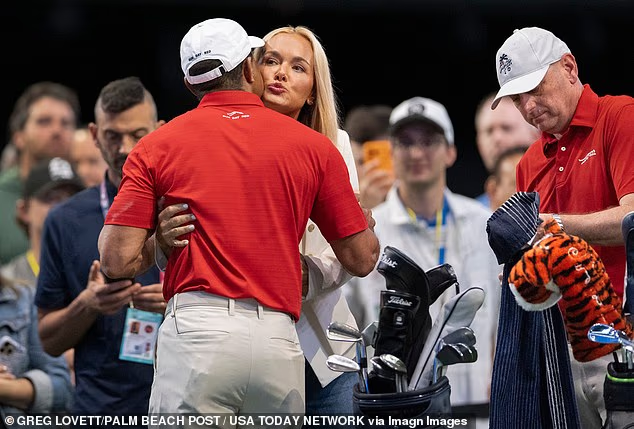
The presence of Vanessa Trump in the gallery, alongside the President’s granddaughter Kai and other members of the Williams family ownership group, underscores something important: professional golf has evolved into genuine entertainment infrastructure. The TGL exists partly because of investors and personalities like these. Whether you love it or question its place in professional golf, it’s become central to the sport’s ecosystem.
What struck me more than the celebrity sightings, however, was Woods’ honest assessment of his physical reality:
“I’ve been trying. It’s just this body doesn’t recover like when I was 24, 25. It doesn’t mean I’m not trying – I’ve been trying for a while. I’ve had a couple of back injuries the past year that I’ve had to fight through and it’s taken some time.”
That’s not the voice of someone in denial. That’s self-awareness. And after everything Woods has endured—the injuries, the surgeries, the public scrutiny—self-awareness might be his greatest asset moving forward.
What Comes Next
I think the real story isn’t Tuesday’s loss. It’s what happens between now and Augusta. Can Woods get enough competitive reps to feel comfortable in a major? Can his team find the right balance between building his confidence and protecting his health?
In three decades covering the tour, I’ve learned that the greatest comebacks aren’t determined by single events—they’re determined by trajectory. Is the arc pointing upward? Is there genuine progress week to week? Based on what I saw Tuesday, the answer appears to be yes, even if the scoreboard suggested otherwise.
Tiger Woods is back. Not where he needs to be yet. But back. And in professional golf, that’s often the hardest part.
