


Tiger’s TGL Stumble Masks a Bigger Story: What His Return Really Tells Us
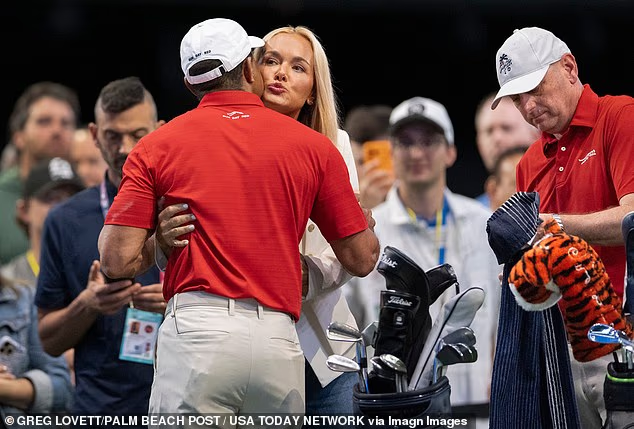
Look, I’ve been around professional golf long enough to know that a single match result—even a lopsided 9-2 loss in a made-for-TV event—doesn’t define a comeback narrative. But Tuesday night’s TGL finals in Palm Beach told us far more about Tiger Woods’ current reality than any scorecard could capture, and I think it’s worth unpacking beyond the headlines about Vanessa Trump and romantic gestures.
Let me be direct: Tiger got humbled. His Jupiter Links GC team, featuring Tom Kim and Max Homa, came up against a buzzsaw in the form of Justin Rose, Sahith Theegala, and Tommy Fleetwood. Woods himself acknowledged the sting. As he put it:
“We got our a** kicked at the end. It felt great to be back here with these guys… it was a great team, I’m frustrated that we didn’t get it done.”
In my 35 years covering this tour, I’ve learned that Tiger’s honest self-assessment—even in defeat—reveals something important. He’s not making excuses. He’s not blaming his partners or the format. He’s owning it. That’s the Tiger I respect, the one who showed up as a teenager at Augusta and never shied away from accountability.
The Physical Reality Check
But here’s what strikes me as the real story: the man hasn’t played a competitive PGA Tour event since the 2024 Open Championship. In the interim, he’s had back surgery, torn his Achilles, underwent another procedure, and had disk replacement surgery in October. We’re not talking about a golfer working through typical wear-and-tear. We’re talking about someone whose body has become a filing cabinet of surgical interventions.
When I caddied for Tom Lehman back in the ’90s, we understood the physical demands of tour golf at an elite level. But modern tour golf—the 72-hole events, the international travel, the analytics-driven preparation—it’s a different beast entirely. Tiger at 50 is attempting something we’ve rarely seen successfully executed in professional sports: a legitimate comeback after multiple career-altering injuries.
The fact that he’s still trying to make the Masters tells you something about his competitor’s heart. But his measured response when asked about Augusta National also reveals hard-won wisdom:
“I’ve been trying. It’s just this body doesn’t recover like when I was 24, 25. It doesn’t mean I’m not trying—I’ve been trying for a while.”
This isn’t the bravado of a 30-year-old convinced he’s invincible. This is a man who has genuinely confronted his own mortality on the golf course.
TGL as a Testing Ground
I’ll defend TGL against its critics—and there are plenty. When it launched, I was skeptical myself. But as a comeback vehicle for a player like Tiger, it’s actually ideal. Lower pressure than a major. Shorter format. Controlled environment. It allows him to test his body and his golf without the crushing weight of a 72-hole PGA Tour event bearing down on him.
Did he play poorly Tuesday? Absolutely. But he got meaningful competitive reps. He felt what it’s like to be in the arena again. That matters more than any single result.
What I noticed—and this is the caddie in me talking—is that he missed a short putt and visibly showed frustration. That’s not a damaged psyche; that’s a competitor’s reflex. The fact that he can still feel that fire after everything his body has endured? That’s encouraging, actually.
The Off-Course Narrative
Now, I’m not going to spend much ink on the personal stuff. It’s not really my lane, and frankly, golf fans should care more about what Tiger does on the course than who he’s dating. That said, having Vanessa Trump in the gallery—and the public display of affection—is notable in one respect: it signals stability. In my experience covering Tiger’s career, his personal life and his golf have been intertwined more than most players. If he’s in a grounded place off the course, that can only help his physical and mental recovery.
The reports about relationship dynamics, the “henpecking” narratives? I’ll take those with a massive grain of salt. That’s tabloid territory, and I’m not interested in speculating about anybody’s private life beyond what it means for their professional performance.
Looking Toward Augusta
As for the Masters: Tiger’s not committing, and I think that’s the smart play. He said it himself—he’ll practice at home this week and assess his progress. The beauty of the Masters is that it allows for late decisions. If his body responds well over the next few weeks, he’ll be there. If not, he’ll be honest about it.
“I want to play, I’ve loved the tournament, I’ve loved being there since I was 19 years old. So it’s meant a lot to me and my family over the years and I’m going to be there either way.”
Notice he said he’ll be there “either way”—meaning as a spectator if necessary. That’s maturity. That’s accepting reality while still chasing the dream.
The Bigger Picture
Tuesday night wasn’t a triumphant return. It was a humbling reminder that even the greatest golfer of this generation has genuine limitations now. But it was also evidence that he’s still fighting, still competing, still willing to put himself in uncomfortable positions to chase what he loves.
That’s the real story. Not the score. Not the dinner theater of celebrity galleries. But the stubborn refusal to accept a life on the sidelines, consequences and losses be damned.
We’ll know much more by mid-April.
