


Tiger’s Masters Hint: Why One Word Might Just Change Everything
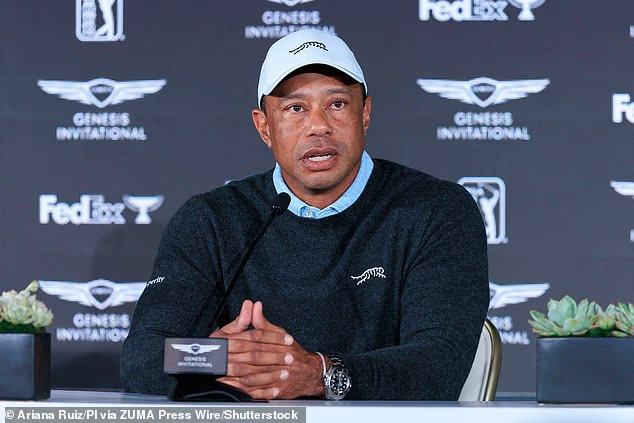
After 35 years covering professional golf—and having walked those fairways as Tom Lehman’s caddie back in the day—I’ve learned that sometimes the most significant golf stories aren’t about what players say, but what they don’t rule out. And on Tuesday, Tiger Woods just didn’t rule out Augusta National.
That single word—”No”—when asked if a Masters appearance in April is off the table, landed like a drive down the middle of the fairway. It’s not a commitment. It’s not even a prediction. But in the careful, measured language Tiger has perfected over five decades, it’s as close to a green light as we’re likely to get right now.
The Medical Reality Behind the Hope
Let’s be honest about what we’re dealing with here. Tiger recently turned 50, has endured his seventh back surgery since October, and is still recovering from a torn Achilles that kept him sidelined since March 2025. This isn’t some minor setback we’re talking about. These are the kinds of injuries that end careers, that make even walking difficult for most people.
And yet, here’s what strikes me after watching him manage his body through injuries for the better part of three decades: Tiger said he’s “back to hitting full golf shots.” That’s not nothing. That’s actually everything.
“I’m trying, put it that way,” Woods said. “The disc replacement has been one thing. I’ve had a fused back and now a disc replacement, so it’s challenging.”
In my experience, when Tiger says he’s “trying,” what he really means is he’s grinding. He’s not casually flipping wedges at his home course. He’s working through a specific progression with his medical team, testing thresholds, measuring what his body can handle. The fact that full golf shots are back on the menu? That changes the timeline significantly from where we were six months ago.
Masters Over Tour Events: A Strategic Calculation
Here’s something most casual fans miss: Tiger specifically mentioned considering Champions Tour opportunities but ruled out playing on the PGA Tour right now. That’s actually brilliant strategy. The Masters operates under different physical parameters—it’s 72 holes over four days at one familiar course, versus weeks of travel, practice rounds, and the grind of competitive golf week after week.
Having caddied in an era where injury management was becoming increasingly sophisticated, I can tell you this logic is sound. The Masters is controlled. It’s home. And crucially, it’s only once a year. If Tiger can build enough stability to play 72 holes at Augusta, that’s a completely different conversation than asking his body to sustain a full tour schedule.
“Each and every day I keep trying, I keep progressing, trying to get it to a level that I can play at the highest level.”
The key word there? “Progressing.” Not “hoping.” Not “waiting.” Progressing. That’s active recovery language.
The Ryder Cup Question and Tour Leadership
What’s equally fascinating—and perhaps more revealing about Tiger’s actual condition—is his willingness to explore the Ryder Cup captaincy for 2027. Think about this: why would a man still managing significant injuries commit mental energy to understanding tour politics, team dynamics, and strategic planning for a major international competition?
The only answer is that he’s already thinking beyond his playing career. And that might actually suggest his prognosis is better than the surface narrative. He wouldn’t take on the burden of figuring out “what we’re trying to do with our tour” if he genuinely thought he’d need to be managing pain day-in and day-out.
“Yeah, they have asked me for my input on it, and I haven’t made my decision yet. I’m trying to figure out what we’re trying to do with our tour.”
The Real Story: Augusta’s Golden Narrative
Here’s what nobody’s saying, and it matters: Tiger doesn’t need to play the Masters to be the story at the Masters. His presence alone—in the broadcast booth, on the grounds, anywhere—would be seismic. But if he actually plays? If he tees it up at age 50, coming back from his seventh back surgery and a torn Achilles, to compete at the only major he’s won five times?
That’s not just a golf story. That’s a sports mythology moment.
In my 15 trips to Augusta covering the tournament, I’ve never seen a narrative with more gravity. We’re talking about Rory McIlroy defending his first green jacket as the sixth member of the Career Grand Slam club, and Tiger—the man with 15 majors—potentially making his first start in two years at a place where he owns more history than any living player.
The Cautious Optimism We Should Embrace
What strikes me about Tiger’s comments is their fundamental honesty. He’s not guaranteeing anything. He’s not even hinting at a return date. But he’s also not closing the door, and that matters. In an era where we’ve learned to temper expectations around his health, even leaving the possibility open is a form of hope grounded in reality.
The man’s body has been through extraordinary trauma. But it’s also been through extraordinary comeback before. In my three decades covering this tour, I’ve learned that nobody—and I mean nobody—has Tiger’s combination of competitive drive, medical resources, and mental fortitude.
That single “No” might not guarantee we see him at Augusta in April. But it guarantees we’ll be watching to find out.
