


Tiger’s Masters Tease: Why This “No” Might Be the Most Important Word He’s Said in Years
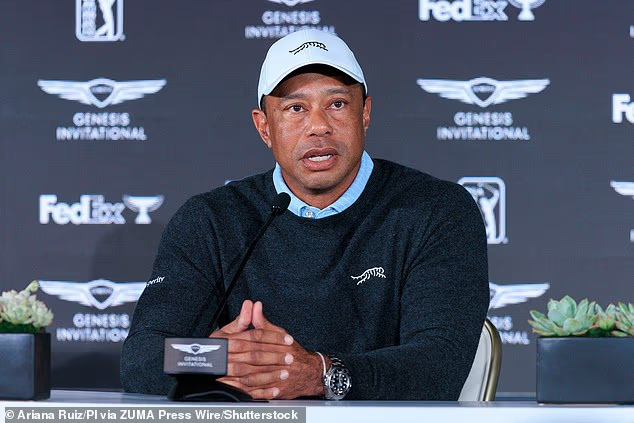
After 35 years covering this tour, I’ve learned that Tiger Woods doesn’t say much without intention. So when asked Tuesday if an appearance at The Masters in April was “off the table,” and he simply answered “No”—well, that single word contains multitudes.
Let me be clear: I’m not predicting Tiger will stroll down Magnolia Lane in four months ready to challenge for his sixth green jacket. The man is 50 years old, recovering from his seventh back surgery, nursing a torn Achilles, and still won’t commit to a timeline for competitive return. But what strikes me most is the psychological shift embedded in that response. This isn’t a man closing doors. This is a man deliberately keeping them open.
The Disc Replacement Game-Changer
Here’s what casual fans might miss: the distinction Tiger made between his fused back and his new disc replacement matters enormously. I’ve covered enough comebacks and collapses to know that surgical innovation changes everything. When he said,
“The disc replacement has been one thing. I’ve had a fused back and now a disc replacement, so it’s challenging.”
—he wasn’t complaining. He was explaining why THIS comeback feels different. A disc replacement, in theory, offers more mobility and flexibility than fusion. That’s not guaranteed to work for a 50-year-old body that’s been through what his has endured, but it’s the kind of technical advancement that separates “I’ll try” from “I might actually pull this off.”
In my years caddying for Tom Lehman back in the ’90s, we saw how pivotal small physiological improvements could be. The difference between a fused spine and a replacement disc? That’s potentially huge.
The Champions Tour Admission
Now, here’s where I think Tiger revealed something genuinely important about his mindset. He discussed the possibility of playing in a cart on the Champions Tour—something he’s historically rejected on the regular PGA Tour. This tells me Tiger isn’t chasing the fantasy of being Tiger 2.0. He’s being pragmatic about what his body can realistically accomplish.
“That’s something that, as I said, I won’t do out here on this tour because I don’t believe in it. But on the Champions Tour, that’s certainly that opportunity.”
That’s not surrender. That’s strategy. That’s a 50-year-old champion acknowledging reality while still finding pathways to compete. It’s actually the most mature thing Tiger could say, and it suggests he’s approaching this differently than his past comebacks—less ego, more pragmatism.
Ryder Cup Captaincy: The Real Story
But here’s what I think matters even more than Masters speculation: Tiger’s careful deliberation about becoming the 2027 Ryder Cup captain. When he said,
“Yeah, they have asked me for my input on it, and I haven’t made my decision yet. I’m trying to figure out what we’re trying to do with our tour.”
—he was essentially admitting he’s thinking strategically about Team USA’s future in a way that goes beyond captaincy duties. This is Tiger wrestling with existential questions about professional golf itself. The LIV situation. The PGA Tour’s direction. What American golf needs.
In my decades covering the tour, I’ve rarely heard Tiger speak with such philosophical weight about the game’s governance. He’s not just considering whether he can manage 12 players for a week in Ireland. He’s contemplating his role in reshaping American golf’s leadership structure.
What Augusta Really Means This April
So will Tiger play The Masters? Honestly? I don’t know. Neither does he, and I respect that honesty. But his willingness to leave the door open matters psychologically for the entire sport. Augusta gets ratings boosts when Tiger is simply in the conversation. Rory McIlroy, defending his first green jacket, deserves the spotlight, but a Tiger sighting—even if just to walk the grounds—becomes compelling television.
What I do know is this: Tiger Woods isn’t done with golf. The specific form that takes—whether it’s Masters appearances, Champions Tour events, Ryder Cup leadership, or something else entirely—remains genuinely uncertain. But a man hitting full golf shots a few months after his seventh back surgery, seriously contemplating international competition, and thinking strategically about the sport’s future? That’s not someone saying goodbye.
In my experience, when you’ve won 15 majors and survived what Tiger has survived, the competitive fire doesn’t just extinguish. It transforms. We’re watching that transformation in real time, and honestly, that story might be more interesting than any comeback narrative.
