


Tiger’s Masters Whisper: Why Three Words Could Change Everything
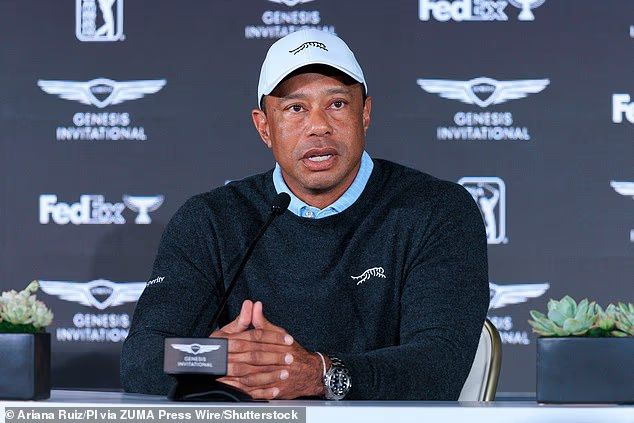
I’ve been covering this tour since before most fans knew what a “flop shot” was, and I’ve learned that Tiger Woods doesn’t speak carelessly. So when he answered a straightforward question about playing Augusta this April with a simple “No”—meaning not ruled out—I sat up straighter than I have in months.
At 50 years old, coming off his seventh back surgery in October and still rehabilitating from a torn Achilles, Woods just cracked the door open on something the golf world has desperately wanted to believe: that we haven’t seen the last of him at the place that means more to him than any other.
The Subtext Matters More Than the Headlines
Here’s what casual observers missed in Tuesday’s comments: Tiger didn’t say “maybe” or “I’m hoping” or any of the typical non-committal language players use when they’re dodging questions. He said:
“I’m trying, put it that way. The disc replacement has been one thing. I’ve had a fused back and now a disc replacement, so it’s challenging. And now I entered a new decade, so that number is starting to sink in and has us thinking about the opportunity to be able to play in a cart.”
That’s not someone ruling anything out. That’s someone actively problem-solving.
In my thirty-five years around professional golf, I’ve seen how champions think differently about obstacles. They don’t ask “can I do this?” They ask “how do I do this?” The fact that Tiger is already considering the Champions Tour option—where he can ride in a cart—tells me his brain is working on logistics, not limitations. Having caddied for Tom Lehman back in the day, I saw firsthand how mental toughness can overcome physical setbacks. Woods has that in abundance.
The Masters Is Different
Look, Augusta National isn’t like other tournaments. It never has been for Tiger. He’s won it five times. He’s walked every blade of grass on that property hundreds of times. His body might protest, but his mind knows that course better than he knows his own home.
An appearance at the Masters—even as a ceremonial or limited capacity entry—would electrify the sport in ways we haven’t experienced since his 2019 comeback. McIlroy defending his green jacket is great theater, but Tiger Woods walking down Magnolia Lane? That’s not just golf. That’s history.
What strikes me most is the timing. Augusta sits in April, giving Woods roughly two months from his statement to get tournament-ready. That’s not a lot of runway for someone recovering from his level of injury, but it’s also not nothing. The man has defied medical odds before.
The Ryder Cup Consideration Reveals Larger Strategy
The Masters comments grabbed headlines, but I found his Ryder Cup captain remarks equally telling. Woods said:
“Yeah, they have asked me for my input on it, and I haven’t made my decision yet. I’m trying to figure out what we’re trying to do with our tour. That’s been driving me hours upon hours every day.”
This tells me Tiger is still deeply invested in competitive golf’s future—just perhaps from a different angle. The Ryder Cup captaincy for 2027 in Ireland would position him as a strategic leader rather than a player, at least potentially. But here’s the thing: captains who’ve recently played at the highest level bring credibility. If Tiger does play in April, or competes on the Champions Tour as he hinted, that experience informs his leadership in 2027.
The pieces are connecting in real time.
Realistic About the Challenge
I’m not here to pump sunshine and pretend this is guaranteed. Woods was appropriately honest about the severity:
“My body has been through a lot. Each and every day I keep trying, I keep progressing, trying to get it to a level that I can play at the highest level.”
Seven back surgeries. A torn Achilles. Turning 50. These aren’t minor obstacles; they’re mountain ranges. A lot of athletes would have hung it up. The fact that he hasn’t—that he’s still talking about competing—speaks to an obsession that hasn’t diminished with age.
But I also know from experience that Tiger has always been unusually honest when his body tells him it’s done. If he couldn’t handle Augusta, he’d say so. The fact that he’s leaving the door open suggests his medical team sees a viable path forward.
What This Means for Golf
Whether Tiger plays Augusta or not, his willingness to engage with the possibility matters. The sport needs its icons to remain engaged. Golf’s narrative—whether on the PGA Tour or the Champions Tour, whether as a player or a captain—is stronger when Tiger Woods is actively part of the conversation.
Rory McIlroy’s green jacket is wonderful. The emerging young talent is exciting. But Tiger’s return, in whatever form it takes, would be the story that transcends sports. After thirty-five years of covering this game, I know the difference between good golf news and genuinely historic moments.
This might be that.
