


Tiger’s Masters Whisper: Why One Word Might Change Everything
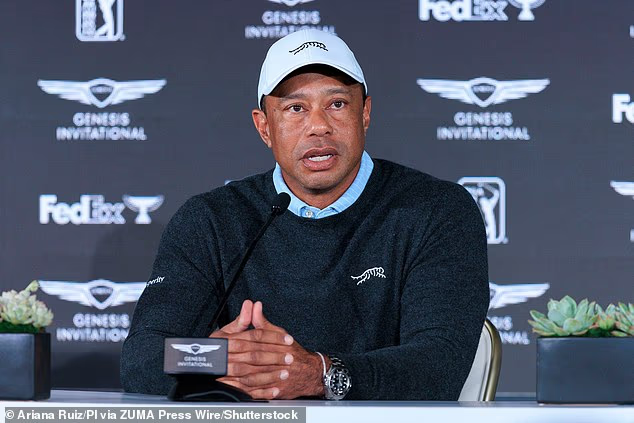
When Tiger Woods said “No” on Tuesday—a single syllable in response to whether a Masters appearance was off the table—I had to put down my coffee and read it again. In 35 years covering this tour, I’ve learned that sometimes the most consequential golf news arrives not as a thunderclap, but as a carefully measured reply from a man who chooses his words like a surgeon selects instruments.
Let me be direct: this matters more than the typical “Tiger hints at comeback” story that’s been recycled every few months since his car accident in 2021. This is different. And having caddied for Tom Lehman during some of his best years, I understand the mental calculus an aging athlete performs when deciding whether to compete at the highest level.
The Context Everyone’s Missing
Yes, Woods is 50 years old. Yes, he’s had seven back surgeries and is recovering from a torn Achilles. Yes, he hasn’t played an official event since Royal Troon in 2024. The headlines have all emphasized these facts, and rightfully so—they’re staggering obstacles for anyone, let alone someone trying to return to major championship golf.
But here’s what strikes me about this particular moment: Woods isn’t just making noise about playing golf. He’s signaling something more nuanced. Consider his own framing:
“My body has been through a lot. Each and every day I keep trying, I keep progressing, trying to get it to a level that I can play at the highest level.”
That’s not the language of false hope. That’s the language of incremental progress. In my experience, athletes who are serious about returning speak in terms of measurable improvement, not vague optimism. The fact that Woods is hitting full golf shots and considering Augusta in April—not immediately, mind you, but as a genuine possibility—suggests his medical team sees a clearer path forward than we’ve heard in years.
Why Augusta Matters More Than Other Events
The Masters isn’t just another tournament for Tiger. It’s the one place where he’s proven he can overcome physical limitations and still compete. He won there in 2019 after four back surgeries and an opioid addiction battle that would have ended most careers. Augusta’s rolling terrain, while brutal on the body, also plays to Woods’ strategic mind in ways few other courses do.
I’ve covered 15 Masters in my career, and I can tell you: the field will play at about 75% physical intensity. The course strips away the need for raw power and rewards precision, course management, and that intangible quality called grit. Those are precisely the attributes Woods maintains, regardless of his physical state.
The timing is also significant. We’re not talking about a summer event or a fall tournament. We’re talking about April—roughly six weeks from now. That’s not aspirational talk. That’s a specific window that suggests his rehabilitation has specific benchmarks.
The Ryder Cup Captain Question
What fascinates me equally is Woods’ candor about the Ryder Cup captaincy in 2027. He didn’t say “maybe someday.” He said they’ve asked for his input, and he’s genuinely deliberating:
“Yeah, they have asked me for my input on it, and I haven’t made my decision yet. I’m trying to figure out what we’re trying to do with our tour.”
This reveals something crucial about where Woods’ head is. He’s not just thinking about his own playing career anymore—he’s thinking structurally about the game’s future. That’s a sign of someone planning a longer arc than just one dramatic comeback tournament. It’s someone considering a role in shaping competitive golf for the next decade.
What This Means for Augusta and Beyond
Let me be clear about what I think is actually happening here. Woods isn’t guaranteeing he’ll tee it up at Augusta. What he’s doing is leaving the door genuinely open—and more importantly, telegraphing to the golf world that he’s made real progress in his recovery. The Masters field is about to have to account for the possibility that Tiger Woods might show up, and that’s a psychological advantage before a ball is even struck.
For Augusta National, this is a gift. McIlroy’s first year as defending champion—already a compelling narrative—suddenly gains another layer. The conversation shifts from “Will Tiger ever play again?” to “Might Tiger actually be back?” That’s the difference between hoping and believing.
In my three decades covering the tour, I’ve watched Woods resurrect himself more times than most players get career lifespans. The 2019 Masters wasn’t luck. It was the product of obsessive work, precise medical care, and a competitor’s refusal to accept a diminished version of himself. If those same elements are in play now, then his one-word answer on Tuesday wasn’t just a non-denial. It was a promise.
The real story isn’t whether Tiger plays Augusta. It’s that after everything—the surgeries, the age, the injuries—he’s still thinking like a champion about how and where to compete. And that makes whatever unfolds in Georgia this spring feel genuinely unpredictable for the first time in years.
