


Tiger at 50: When Want and Can Become Two Different Things
I’ve been covering professional golf for 35 years. I’ve watched Tiger Woods win 15 majors, miss cuts, undergo seven back surgeries, survive a near-fatal car accident, and come back more times than most athletes get chances to begin with. Tuesday night at the TGL Finals, I watched him do it again—sort of.
Here’s what struck me: This wasn’t like 2016, when he returned to the Hero World Challenge after 15 months off following back surgery. This wasn’t like 2017, or 2009, or any of the other “Tiger is back” moments I’ve documented. This was different. And that difference tells us something important about where we are in one of sports’ greatest careers.
The New Reality of a Legend’s Return
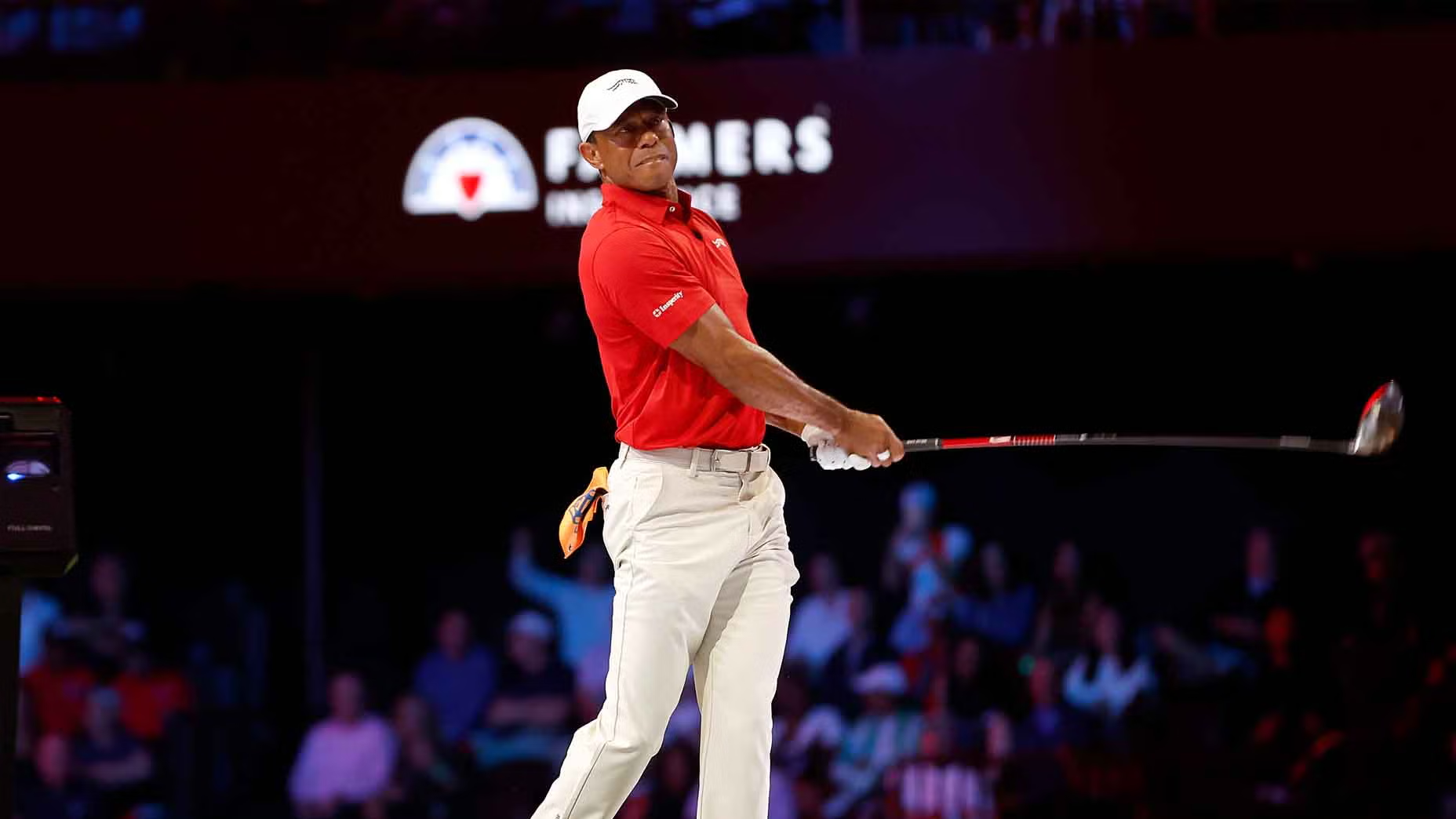
Tiger’s TGL appearance—his first competitive golf in over a year following a ruptured Achilles’ tendon and his seventh back surgery—was deliberately modest in scope. No walking. Limited full swings. A simulator league, not the PGA Tour. And yet, the moment he stepped up to the virtual tee, the energy changed. The golf world paid attention.
That’s not really about TGL being significant competitive golf. It’s about Tiger Woods still existing in a space where his mere presence matters. Even diminished, even limited, even 50 years old with a metal rod in his leg.
“I’m going to be rusty. As far as setting myself up for the competitive golf future, it’s just one step at a time. Tonight is a nice step because I haven’t played competitively in a very long time.”
Having caddied in the ’90s, I remember the invincibility. Tiger at 25 was a different animal—a force of nature who bent the game to his will through sheer dominance and an almost preternatural ability to recover from injury. His body was a weapon. His mind was sharper than everyone else’s.
At 50, those weapons are still there. I watched that patented stinger—176 mph ball speed, 3-degree launch angle, 275 yards. Classic Tiger. But the context around it has changed entirely.
The Mathematics of Aging and Athletics
Here’s what I think casual fans miss: The issue isn’t whether Tiger *wants* to play the Masters. He clearly does. The issue isn’t whether he still believes he can win. He’s on record saying exactly that. The real tension is between those two things—what he wants and what his body can deliver—and at 50, after the injuries he’s sustained, those two things are increasingly divergent.
Consider the record since his car accident in 2021:
- Made the cut in just 2 of 8 majors
- Best finish: 47th place at the 2022 Masters
- Over 600 days since his last PGA Tour start (2024 Open Championship, missed cut)
- Seven back surgeries total
- One ruptured Achilles’ tendon requiring extensive rehab
I’m not being cynical when I say those numbers matter. I’m being realistic. In my three decades around this game, I’ve watched enough great players age to know that willpower, even in a 15-time major champion, has limits.
The Masters Question
Tiger was asked directly: Does Tuesday’s TGL return tell you whether you can play the Masters?
“As I said, I’ve been trying. Just this body is—it doesn’t recover like it did when it was 24, 25. It doesn’t mean I’m not trying. I’ve been trying for a while.”
When pressed on whether he’d make a decision by Friday before the Masters, he offered no commitment. “We’ll see how it goes,” he said. “I’ll be practicing and playing at home this week and keep trying to make progress.”
That’s not the language of a man who’s decided to show up. That’s the language of someone still evaluating whether his body will allow it.
And here’s what matters: That’s okay. It’s actually honest.
The Difference Between Legend and Legacy
What strikes me most about Tiger’s current reality is that he’s stopped pretending the past still applies. In 2024, when asked about being an honorary starter at Augusta, he rejected the notion outright—”I still think that I can [win]. I haven’t got to that point where I don’t think I can’t.” That wasn’t false bravado. That was genuine competitive belief.
But Tuesday’s TGL appearance, followed by his comments about recovery and aging, suggests evolution in his thinking. He’s not giving up. But he’s also not denying reality.
In my experience, that’s actually the mark of a true competitor in his final chapters—the ability to still want it badly while accepting that want and can are now different conversations.
The golf world is still clinging to hope that Tiger authors one final comeback. And maybe he does. But Tuesday’s return to a simulator league, not the PGA Tour, is the clearest sign yet that we’re watching a different kind of comeback now. Not a return to dominance, but a reckoning with what’s possible when the body finally starts winning its argument with the mind.
We’ll know more in two weeks at Augusta. But my guess is that decision runs right down to that Friday before the tournament. And whatever Tiger decides—whether he tees it up or walks the grounds as a patron—it’ll be the right call. He’s earned that wisdom along with everything else.
