


When Golf’s Sanctuary Becomes a Crime Scene: The Players Championship and a Troubling Reality
I’ve covered 15 Masters tournaments, walked the grounds of Augusta National more times than I can count, and spent three decades around some of the most pristine golf properties in the world. In all that time, I’ve come to view championship golf courses as something almost sacred—places where the manicured fairways and gallery ropes create a bubble of civility and sport, separate from the chaos of everyday life.
That bubble burst on March 13th near TPC Sawgrass, and it’s forced me to confront an uncomfortable truth: no amount of gallery rope or PGA Tour security can insulate us from the darker impulses that simmer just beyond the white-picket fence of professional golf.
A Tragedy That Hit Too Close to Home
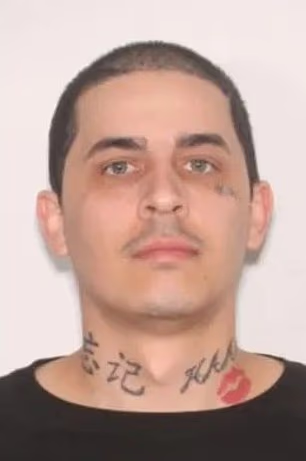
The facts are grim. Christian Barrios, 32, allegedly gunned down Melissa Wood, 46, and Jason Chatham, 42, in a Walgreens parking lot less than a mile from the Players Championship venue. What makes this tragedy particularly unsettling isn’t just the violence itself—it’s the bizarre intersection of that violence with one of golf’s most prestigious events.
According to Sheriff Rob Hardwick, Barrios fled across the highway and onto the TPC Sawgrass grounds itself, where he made contact with PGA Tour employees and stole a tournament radio. That radio—a detail that would almost be darkly comic if the circumstances weren’t so tragic—became the tool that helped law enforcement track him down.
“He is out of prison again on probation, committing another violent felony. It makes me sick to my stomach… families are going to mourn two people that were shot and killed over a domestic violence situation.”
Sheriff Hardwick’s frustration is palpable and, frankly, justified. Barrios has 27 prior arrests, including a 2023 vehicle theft charge, yet he was back on the streets.
The Systemic Problem Nobody Wants to Discuss
In my experience covering golf for over three decades, we in the sports media tend to operate in a carefully curated bubble. We talk about purses, storylines, comebacks, and drama on the course. We rarely address the systems—criminal justice, mental health, domestic violence—that exist outside the ropes but inevitably find their way in.
What strikes me most about this incident isn’t the proximity to golf or the temporary disruption to tournament operations. It’s the jaw-dropping criminal history of the suspect and the apparent ease with which he remained a threat to the public despite his record.
Barrios reportedly had his own mother drive him to the scene. His mother heard the “flurry of gunfire” and immediately called 911. Think about that for a moment—a mother facilitating her son’s access to a murder scene, then immediately reporting him. That’s a family in complete crisis, and yet this individual was walking free on probation.
TPC Sawgrass Handled the Crisis Well
To be fair to PGA Tour officials and the security team at TPC Sawgrass, they responded professionally to an extraordinary situation. The third round of play was delayed while law enforcement cleared the perimeter. Nearly 35,000 fans were kept outside while hospitality areas remained closed. It wasn’t ideal, but the priority was safety—and nobody can fault that decision.
The round eventually started on schedule at 8:15 a.m., and the Players Championship concluded without further incident. Cameron Young took home the trophy in what should have been a triumphant moment for the American star. Instead, the tournament’s final rounds played out under a shadow.
The Human Cost We Can’t Overlook
Beyond the operational hiccup or the brief security scare, there are real people grieving. Melissa Wood’s family described her as “amazing, outgoing, and generous.” She’d recently become a grandmother. Her brother, Jeremy Hackward, launched a GoFundMe to cover funeral costs, describing his sister as “gunned down by an insecure, jealous ex-boyfriend.”
What’s particularly striking is that Wood’s daughter pushed back against the narrative of “romantic envy,” suggesting her mother may have simply been trying to help her troubled ex. That speaks to a woman with genuine compassion—a compassion that ultimately may have cost her her life.
Jason Chatham’s niece, Aliya Jade, posted this tribute on social media:
“I will make sure your light never goes dull here on earth while you’re giving heaven the best party ever.”
These aren’t abstractions. These are real people whose lives ended near a golf course that happened to be hosting a tournament.
What This Means for Golf Going Forward
I’m not suggesting the PGA Tour bears responsibility for what happened—that’s not fair or accurate. But this incident does illuminate something we should acknowledge: major sporting events operate in real communities, and those communities face real challenges that don’t pause for tournament week.
The Players Championship will continue to thrive. TPC Sawgrass will remain one of golf’s crown jewels. But for the families of Melissa Wood and Jason Chatham, for the community of Atlantic Beach, and frankly for anyone paying attention, this serves as a stark reminder that the pristine world of professional golf exists alongside—and sometimes intersects with—a much darker reality.
In 35 years of covering this game, I’ve learned that golf, at its best, represents hope, excellence, and redemption. But it can’t solve every problem. Sometimes the chaos beyond the ropes demands more than a gallery and a scorecard can provide.
