

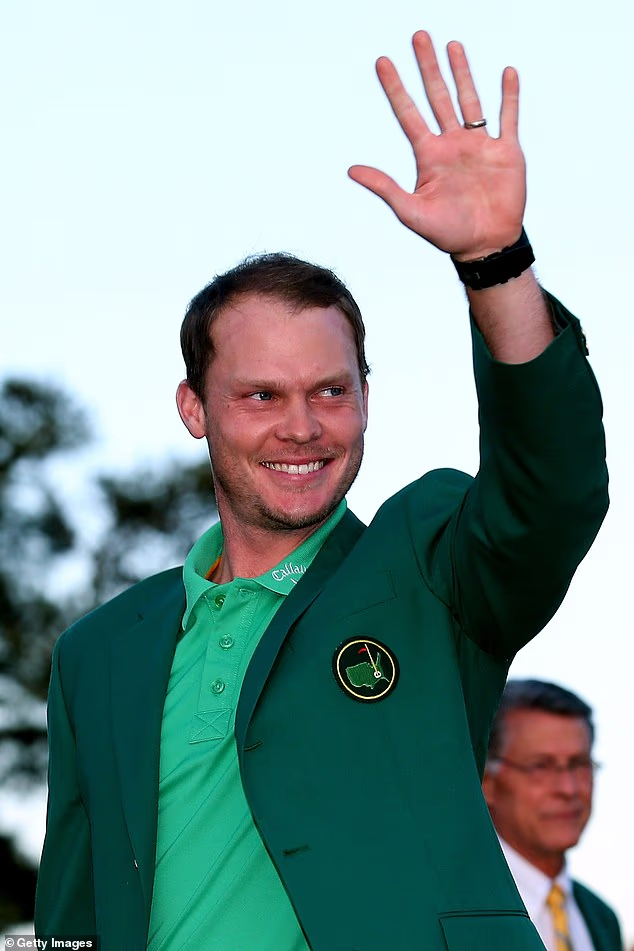

Ten Years On: Danny Willett’s Masters Victory Reminds Us Why Golf’s Greatest Moments Still Matter
I’ve been around this game long enough to know that a Masters champion never really leaves Augusta National, even when he wants to. Danny Willett learned that lesson the hard way – first at a Las Vegas airport, then for the next decade of his life. The man won golf’s most prestigious major championship in 2016, pulled off one of the gutsiest performances under pressure I’ve witnessed in 35 years of covering this tour, and somewhere along the way, the world decided to remember his victory primarily for what Jordan Spieth did wrong rather than what Willett did right.
That’s a shame. And it’s worth correcting.
The Collapse That Overshadowed Excellence
Let’s acknowledge the elephant in the room first. Spieth’s back-nine implosion – five shots evaporated, a quadruple-bogey seven at Amen Corner – was genuinely historic in its brutality. I was watching it unfold like everyone else, and even hardened golf journalists had to sit back and process what we were witnessing. In my three decades covering the tour, I’ve seen pressure get to players, but that specific sequence of events at 12, 11, and 10 was something else entirely.
But here’s what I think gets lost in that narrative:
“I was a couple of groups ahead so had no idea at first what was happening to Jordan. You hear a few noises but they don’t have screens at Augusta or any of that. First proper clue I got was at the 15th – there’s one of those giant old leaderboards by the green. I saw Jordan had gone from seven under to one under and I’m leading the Masters on four under. Wow.”
Willett didn’t know he was winning until the final holes. That’s crucial context. He wasn’t playing defensively or waiting for someone else to stumble. He was playing his own round, executing under the most intense pressure imaginable at golf’s toughest venue. When opportunity arrived – that rare, unexpected gift that the Masters sometimes delivers – he didn’t blink.
The Moment Nobody Talks About
What strikes me most about Willett’s recounting of his victory is his clarity about the mental side. Most players in that position would talk about adrenaline or instinct, but Willett actually articulated his thought process:
“I took myself to the bathroom on 16, and came out and just sort of said, ‘Look, five nice swings here and hole a couple of putts, and we’ll see where we’re at in 40 minutes time’. I remember it all quite vividly.”
That’s not luck. That’s not catching a break. That’s a 28-year-old having the mental discipline to compartmentalize, to reduce the magnitude of the moment into manageable chunks, and to execute under conditions where most players would be paralyzed. Having caddied for Tom Lehman in the ’90s, I saw that exact same quality – the ability to shrink the moment when it matters most. It’s not something you can teach. You either have it or you don’t.
The final margin – three shots over Spieth and Lee Westwood – wasn’t some fortunate accident. Willett shot 67 in the final round at Augusta National, a course that punishes complacency like no other venue in professional golf. He can still recount every club, every distance, every bounce.
“I reckon I’ve only watched the round back in its entirety two or three times. To be honest, I don’t need to. It’s all in my head, every step of it.”
The Hidden Cost of Winning Big
What’s genuinely heartbreaking about Willett’s story, though, is what came after. This is where I have to be honest about something I’ve observed throughout my career: winning a major championship can be a double-edged sword. The expectations, the attention, the pressure to maintain that level – it’s crushing for many players.
Willett’s trajectory since 2016 has been genuinely difficult to watch. He climbed as high as 9th in the world rankings following his Masters victory, then fell to 462nd two years later. He clawed back to the top 30 by 2020, only to plummet to 624th early last year. Chronic back and shoulder injuries, swing breakdowns, a three-putt from three feet that cost him a PGA Tour title in 2023 – the guy has endured the kind of lows that would break most people.
Yet here’s what I respect: he’s still here. At 38, ranked 382nd in the world, and he genuinely believes there are more wins ahead. In my experience, that kind of resilience is rare. Most players who suffer that extended a drought would have walked away. Some would have given up on themselves internally even if they kept showing up.
Eight Wins and a Lifetime Seat
Let’s not overlook what Willett has actually accomplished. Beyond the Masters, he’s won the DP World Tour Championship (2018), the PGA Championship at Wentworth (2019), and the Alfred Dunhill Links (2021) – eight titles total. That’s not a career that’s been derailed by one peak. That’s legitimate, sustained excellence punctuated by devastating injuries and form valleys.
What matters now is whether he can manage his health and rediscover that consistency. He’s got the skill set. He’s proved it repeatedly. And he’s got something that nobody can ever take away – a seat at the Champions Dinner at Augusta for life. That 10-year-old kid in Yorkshire who won the Masters will always have that, even when things get really, really difficult.
That’s worth remembering when people try to reduce his victory to Spieth’s collapse. Willett didn’t win because Jordan failed. He won because on one specific Sunday in April, he was better. Everything else is just noise.
