


Gary Woodland’s Courageous Stand: Why His PTSD Battle Matters Beyond the Fairways
I’ve been around professional golf long enough to know that we rarely see our heroes bleed. In 35 years covering this tour, I’ve watched players mask injuries, conceal personal crises, and paint on smiles for the cameras with the consistency of a metronome. It’s part of the fabric of professional sports—the stiff upper lip, the “next shot” mentality that defines competitive golf at the highest level.
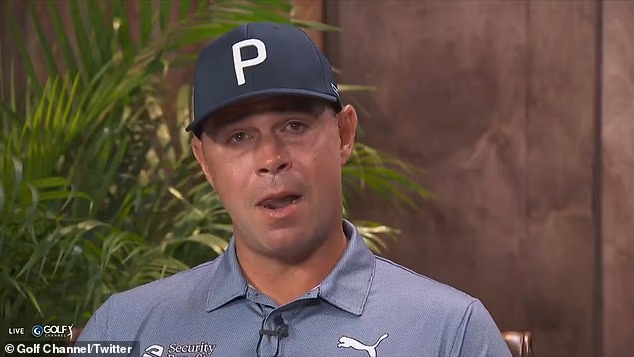
So when Gary Woodland sat down with Rex Hoggard at the Golf Channel just days before the Players Championship and admitted he’s been “dying inside” and “living a lie,” something shifted. Not just in how I view Woodland—though my respect for him grew considerably—but in what his honesty might mean for a sport that has historically treated mental health as a personal problem rather than a legitimate crisis.
The Tumor That Changed Everything
Let’s establish the facts first. In September 2023, Woodland underwent surgery to remove a brain lesion. The procedure was successful—surgeons performed a craniotomy, cutting a baseball-sized hole in the left side of his head to remove as much of the tumor as possible, which was replaced by a titanium plate. The tumor had been growing on his amygdala, the very part of the brain responsible for triggering fear and anxiety responses.
By any measure, Woodland is fortunate to have survived. But here’s what strikes me about his situation: the physical victory hasn’t translated to emotional recovery. This is the part of the story that most sports narratives gloss over. We love comeback stories—the player who returns to competition, defies odds, proves he’s still got it. What we rarely discuss is what happens when the body heals but the mind remains fractured.
“I can’t waste energy anymore hiding this. I felt like I was dying inside and living a lie by keeping it a secret.”
That’s Woodland’s truth three years post-surgery, and it’s devastatingly honest.
PTSD on the Tour: A Crisis Nobody Talks About
Having caddied for Tom Lehman back in the ’90s and spent decades inside the ropes, I’ve seen firsthand how the tour operates. It’s built on performance metrics, on showing up, on leaving everything on the course. The mental side is discussed in terms of “course management” and “staying in the moment”—not in terms of clinical PTSD or neurological trauma.
What Woodland revealed about his panic episodes is particularly striking. During a recent round, a walking scorer accidentally startled him from behind. His response? Hypervigilance that triggered a full dissociative episode. He couldn’t remember what he was doing. His eyesight blurred. He found himself unable to hit his shot. Then came the tears—so many that he spent the rest of the day cycling between bathrooms and his car, hiding from his fellow competitors.
“I went into every bathroom to cry the rest of the day. When I got done, I got in my car and got out of there.”
This isn’t weakness. This is neurobiology. The amygdala, once traumatized, doesn’t simply reset because you won a major championship or because doctors successfully removed the physical threat. Woodland’s brain had been rewired by trauma, and that rewiring doesn’t disappear with modern medicine.
Where the Tour Gets It Right—And the Larger Questions
I want to be fair here: the PGA Tour has been responsive. In the months since Woodland went public, the organization has worked with him to implement security protocols that allow him to feel safer on the course. That’s progress, and it’s meaningful. The tour could have hidden from this conversation. Instead, it’s engaged.
But here’s what troubles me after three and a half decades covering this game: Why did it take a major champion literally crying in fairway bathrooms for the tour to take mental health infrastructure seriously? How many other players are quietly struggling? And more fundamentally—how do we create a culture where seeking help isn’t seen as a threat to your competitive standing?
Woodland himself articulated the tension beautifully. Doctors have recommended he avoid high-stress environments. The logical choice would be to step away. But he won’t.
“In an ideal world I’m probably not playing. But in an ideal world I don’t have this. This is my dream.”
There’s something almost defiant about that statement. He’s not returning to golf despite his trauma—he’s choosing to live his dream while managing his trauma. Those are fundamentally different propositions, and the second one is far more complicated.
The Toll on Family, and the Strength to Speak
What struck me most deeply, though, was Woodland’s reflection on how his condition affected his family. His wife Gabby had to manage three young children—Jaxson, Maddox, and Lennox—while their father struggled to regulate his nervous system. When his kids got excited, Woodland had to leave the room. The stimulation was too much for his brain to process. He’d retreat to a dark room to decompress.
Having raised a family while working 150+ days a year on the tour, I understand the collateral damage of professional golf. But the guilt Woodland expressed—the devastation of not being fully present for his children because his amygdala couldn’t handle joy without triggering fear—that’s a different level of sacrifice.
The fact that he wrote a letter to his children before surgery, preparing them for the possibility that he wouldn’t survive, and then survived to discover he’d have to manage invisible wounds for years to come—that’s the kind of resilience we should be celebrating. Not as a feel-good comeback story, but as a model of human vulnerability and determination.
What Happens Next Matters
Woodland’s public conversation about PTSD has already created space for others. He mentioned speaking with veterans who reinforced a crucial message: “You can’t do this on your own, no matter how strong you think you are.” That’s not the language we typically use in professional golf, but maybe it should be.
His willingness to fight for his dreams while admitting he’s struggling gives permission to others to do the same. In a sport built on individual achievement and emotional control, that’s revolutionary.
I’m rooting for Gary Woodland not because I expect him to win majors again—though stranger things have happened—but because he’s chosen to live authentically in a world that demands performance. That matters beyond the fairways.
