


Gary Woodland’s Courage Exposes What We Don’t Talk About in Professional Golf
I’ve been around this tour for 35 years. I’ve watched guys grind through injuries, personal disasters, and financial ruin. I’ve seen them smile for the cameras on Sunday while their marriages fell apart on Monday. But I can’t recall many moments when a legitimate major champion—a guy who’s proven he belongs at the highest level of this game—has been willing to sit down in front of the golf world and say, plainly, “I’m struggling and I need help.”
Gary Woodland did exactly that this week, and it matters more than most people realize.
The Surgery That Changed Everything
Let’s start with the clinical reality: Woodland underwent emergency brain surgery in September 2023 to remove a tumor from his amygdala—the part of the brain responsible for processing fear and anxiety. Surgeons literally cut a baseball-sized hole in his skull and installed a titanium plate. He survived. The tumor came out. By any reasonable measure, that’s a victory.
But here’s what I’ve learned in my time around professional athletes: medical recovery and psychological recovery are two entirely different animals. A surgeon can remove a tumor. Nobody can remove the memory of writing a letter to your three children that might be the last words they ever read from you.
That’s the part Woodland is living with now, and it’s the part nobody really wants to talk about in professional sports.
The PTSD Nobody Expected
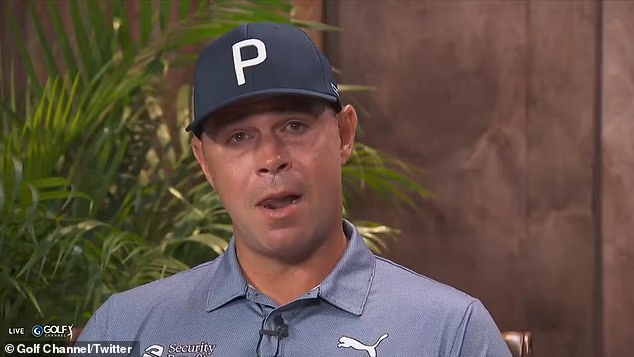
In his emotional interview with Golf Channel’s Rex Hoggard just days before the Players Championship, Woodland detailed something that sounds almost incomprehensible if you haven’t experienced trauma: a routine moment on the golf course—a walking scorer accidentally approaching from behind—triggered a complete neurological shutdown. Here’s what he described:
“I was hyper-vigilant. A walking scorer startled me, got close to me from behind. I pulled my caddie and said, ‘You can’t let anybody get behind me.’ Next thing you know, I couldn’t remember what I was doing. My eyesight started to get blurry. It was my turn to hit and I couldn’t hit.”
What strikes me most about this confession isn’t the symptom itself—it’s what happened next. With his caddie Brennan Little suggesting they withdraw, Woodland insisted on fighting through it. He played the rest of the round while crying in bathrooms between holes. That’s not heroic. That’s survival mode dressed up as professionalism.
I’ve caddied for Tom Lehman in pressure situations I wouldn’t wish on most people. I’ve seen guys handle adversity that would break normal people. But there’s a difference between competitive grit and simply enduring psychological torture on national television because you’ve convinced yourself it’s what you’re supposed to do.
The Family Cost We Never Discuss
Here’s where Woodland’s honesty gets really uncomfortable—and really important. He didn’t just talk about his own struggles. He talked about his wife, Gabby, and their three children (son Jaxson and twin daughters Maddox and Lennox). He described having to leave rooms when his kids got excited because his traumatized brain couldn’t process normal stimulation. He talked about his wife essentially raising their children alone while managing his care.
“It was tough on my wife, my three little kids. When they got excited, I had to leave the room because my brain couldn’t handle the stimulation. They don’t understand why I have to go lay in the bed in a dark room to slow everything down. That was devastating for me.”
In my experience covering professional golf, we rarely acknowledge what I call the “silent cost” of competing at this level. Wives become de facto single parents. Kids grow up confused about why Dad needs isolation instead of Little League games. The public sees the tournament victories; they don’t see the family dinners that never happen.
Woodland is being radically honest about this, and I think that matters enormously—not just for him, but for everyone else dealing with similar situations who’ve been told to simply “toughen up.”
What the Tour Is Getting Right (Finally)
To the PGA Tour’s credit, they’ve moved quickly to help. Woodland has worked with tour officials to implement security protocols that allow him to feel safer while competing. He played in front of thousands at the Cognizant Classic and survived the notoriously rowdy Waste Management Phoenix Open.
Are these accommodations perfect? Probably not. But they represent something I haven’t seen enough of in professional sports: institutional recognition that mental health crises require concrete, practical support—not platitudes.
The Dream Won’t Wait
Doctors have recommended Woodland step away from high-pressure environments. He’s refused. His reasoning is simple and, I think, profoundly human:
“In an ideal world I’m probably not playing. But in an ideal world I don’t have this. This [playing golf] is my dream.”
I understand the argument that he should rest, recover fully, step back. But I also understand something else: sometimes what keeps us alive is doing the thing that makes us feel alive. For Woodland, that’s professional golf. Who am I to tell him that shouldn’t matter?
After 35 years covering this tour, I’ve learned that courage isn’t always about winning tournaments. Sometimes it’s about showing up when showing up is the hardest possible thing to do. Sometimes it’s about being honest when being quiet would be easier.
Gary Woodland did that this week. Whatever happens next for him on the golf course, that matters.
