

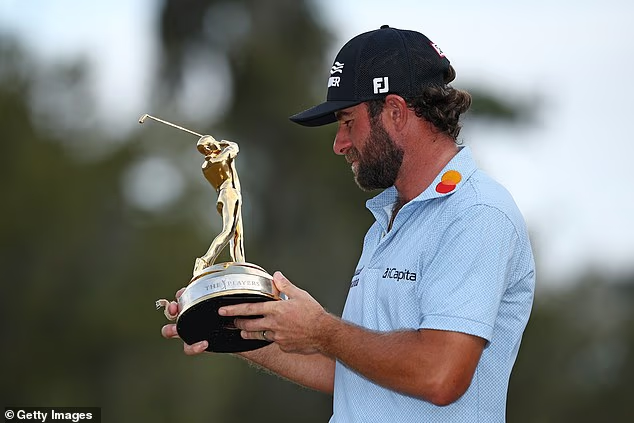

Cameron Young Has Finally Arrived—And The Players Championship Proves It
I’ve been covering professional golf long enough to know the difference between a guy who can win and a guy who will win. After 35 years on the tour beat, you develop an eye for it. Cameron Young just made the leap from the former category to the latter, and his victory at The Players Championship on Sunday tells us something important about both the player and the current state of professional golf.
Young’s win wasn’t just another trophy. It was the Players Championship—what we still call the fifth major, even if the tour’s realignment has muddied those waters a bit. He beat one of the hottest players in the world in Matt Fitzpatrick down the stretch, did it in brutal wind conditions at Sawgrass, and earned $4.5 million in the process. More importantly, he’s now No. 4 in the world rankings. That’s not luck. That’s arrival.
Breaking Through the Narrative
Here’s what strikes me about Young’s path to this victory: he had to exorcise some demons first. Last year, he was the embodiment of the tour’s underachiever narrative—a talented kid with seven runner-up finishes and only one PGA Tour victory. The media loved that story because it was easy: talented but can’t close. I’ve seen dozens of players get trapped by that narrative. Some break free. Some don’t.
Young won at the Wyndham Championship last summer, and I remember thinking at the time it was significant but perhaps not transformative. The Wyndham is a good tournament, but it’s not The Players. It’s not a major. It doesn’t carry the same weight in the golf world’s consciousness. But that win—his second career victory—appears to have been the psychological breakthrough he needed. Now he’s proven he can win at the highest level when it matters most.
“The nerves kicked in over the 8-inch putt on the last. That hole looked really, really small there from pretty close range. So happy to have finished it off, and just really excited to have played the way I did.”
That quote from Young after the tournament tells you something important. He’s not claiming he was ice-cold and fearless. He’s admitting the nerves were there. That’s actually the mark of a mature competitor. In my three decades covering the tour, I’ve noticed the players who acknowledge the pressure are often the ones best equipped to handle it.
Fitzpatrick’s Missed Opportunity
Let’s not overlook what happened to Matt Fitzpatrick on Sunday. He played beautifully through 17 holes and had a legitimate chance to win a second major championship. The fact that he came up short—missing an 8-foot par putt on 18—is the kind of thing that sticks with players. But Fitzpatrick handled the loss with grace and perspective.
“I felt like I hit a good drive. And once you’re out of position it’s difficult to make your par.”
When I caddied for Tom Lehman back in the day, I learned that golf is often about accepting what you can’t control and executing what you can. Fitzpatrick’s drive on 18 went right into the pine straw—not an ideal spot, but recoverable. He didn’t get it done from there. That’s the game. He’ll have other chances.
What’s interesting about Fitzpatrick’s runner-up finish is that it shows the talent level at the top of professional golf right now is genuinely elite. The margin between winning and losing has compressed. Matt Fitzpatrick is a major champion playing at an incredibly high level, and he still comes up short. That’s not a criticism of Fitzpatrick—it’s a testament to how good Young was on Sunday.
The Aberg Collapse Nobody Saw Coming
Now, Ludvig Aberg’s implosion on the back nine—that’s worth examining. He held a three-shot lead going into Sunday and turned in a 40 on the back nine for a 76. In my experience, when a player with that lead falters, it’s usually one of two things: either the pressure got to him, or he made poor decisions. Looking at Aberg’s scorecard, it seems like some of both happened. Water on consecutive holes is the kind of thing that suggests a player trying too hard rather than playing his game.
But here’s the thing about Aberg that people should remember: he’s 24 years old and finished tied for fifth at The Players Championship. He’s going to have plenty more opportunities. Sometimes you have to lose one before you learn how to win one.
Young’s Ryder Cup Moment
What fascinates me most about Young’s win is where he drew his confidence from. He mentioned that his Ryder Cup experience at Bethpage Black—where he was the best American player that week during the U.S. rally—gave him confidence down the stretch. That’s not the kind of thing you can manufacture. That’s earned.
“Definitely some nerves, but also some confidence. That was literally child’s play compared to Bethpage.”
Young played with Fitzpatrick in the final group, and the crowd was pulling for the American. Fitzpatrick actually joked about it afterward, noting that if people think the Sawgrass crowd was intense, they should experience Bethpage in a Ryder Cup atmosphere. He’s right—and it’s also fair to say Young benefited from that experience. He knew what real pressure felt like, and by comparison, Sunday afternoon was manageable.
What This Means Going Forward
Cameron Young is now positioned to make some real noise in the majors. The Masters is coming up, and he enters Augusta in tremendous form after winning The Players. I’ve seen this pattern before—a player breaks through at a major event, and suddenly the monkey is off his back. The confidence compounds. The next tournament feels different.
Young proved on Sunday that he belongs at the highest level of professional golf. He hit the shot of his career when he needed it most, stayed composed when others around him fell apart, and finished the job. That’s not luck. That’s what champions do.
