

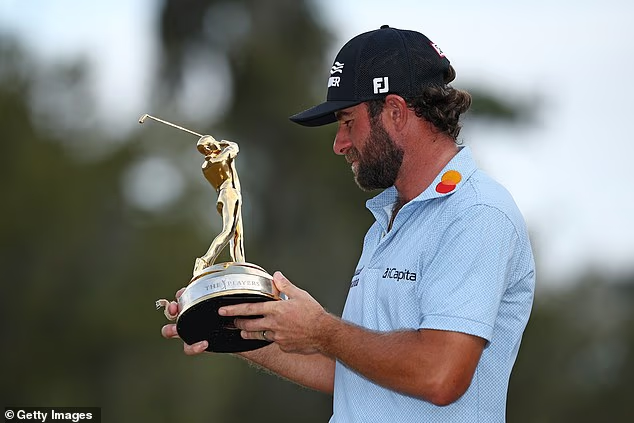

Cameron Young’s Players Victory Signals Arrival of a Different Breed of Closer
I’ve been covering professional golf for 35 years, and I’ve learned that winning The Players Championship tells you something a casual observer might miss: it separates the pretenders from the real deal. This isn’t just another PGA Tour event, and Cameron Young’s Sunday victory proved he’s ready to play at the highest level when it matters most.
What strikes me most about Young’s performance wasn’t the obvious—that $4.5 million check or his leap to No. 4 in the world rankings. It’s the way he absorbed pressure from a field that included one of the hottest young players in the world imploding in real time, while simultaneously matching shots with an experienced competitor like Matt Fitzpatrick down the stretch. That’s the signature of a player who’s figured something out.
The Evolution of a Closer
Here’s what the casual fan doesn’t understand about Young’s journey: those seven runner-up finishes before his Wyndham Championship victory last summer weren’t failures. They were a graduate seminar in how to handle pressure. In my three decades around this tour, I’ve seen plenty of talented players never get over that hump. Young did it differently. He kept showing up in contention, kept learning, and then when it mattered—at The Masters prep event, no less—he delivered the goods.
“The nerves kicked in over the 8-inch putt on the last,” Young said. “That hole looked really, really small there from pretty close range. So happy to have finished it off, and just really excited to have played the way I did.”
That’s not false bravado. That’s a 28-year-old who understands the mental architecture of closing out tournaments. He admitted the nerves, but more importantly, he executed when it mattered. The 375-yard drive on 18—the longest ever recorded on that island green—wasn’t luck. That’s a player who knew what he needed to do and had the nerve to trust his swing.
When Talent Meets Experience
I had the privilege of caddying for Tom Lehman back in the ’90s, and one thing Tom taught me was that major championship golf—or in this case, “fifth major” golf—separates players who can handle pressure from those who can’t. Young’s bogey-free back nine while the field was imploding around him is the kind of resume bullet that matters come April at Augusta.
Ludvig Aberg’s collapse is the other side of this coin, and it’s instructive. Aberg came in with a three-shot lead, which in tournament golf should feel like a comfortable cushion. Instead, he shot 40 on the back nine. Water on consecutive holes. That’s not bad luck—that’s a player whose mind started playing tricks on him when the pressure arrived. It happens. It’s happened to the best of them. But it also tells you something about where Aberg is developmentally as a closer.
“I would have loved to be standing where Cameron is standing right now,” Aberg said. “It definitely stings a little bit.”
That’s honest, and Aberg will learn from it. But Young learned it faster.
The Ryder Cup Factor
Young referenced his Ryder Cup experience at Bethpage Black last fall, and I think that’s more significant than people realize. Having caddied in high-pressure team events myself, I know that kind of environment either breaks you or builds you. Young was the best American player that week in a losing effort. That’s not a consolation—that’s a credential.
“Definitely some nerves, but also some confidence,” Young said of drawing from that experience.
When Fitzpatrick made his dig about the crowd noise at The Players compared to Bethpage—essentially saying American galleries need to get tougher—he was inadvertently giving Young a compliment. Young thrived in that hostile environment. That’s the kind of mental toughness that translates.
The Field and What It Tells Us
Xander Schauffele finishing third with a closing 69 that included a 20-foot birdie on 18 shows us he’s still knocking on the door. Robert MacIntyre fourth. These are players who will win majors. But they didn’t close this one. Young did.
Matt Fitzpatrick played well enough to win—finishing at 13-under, just one shot back—but that’s the thing about The Players. One shot is the difference between legend and also-ran. Fitzpatrick’s comment about the Bethpage crowd showed some frustration, which is understandable. He played a good golf tournament and came up just short. But he also had 8 feet for the playoff and missed it. That’s on him, not the crowd.
Looking Ahead to Augusta
Cameron Young will arrive at The Masters next month in as good form as any American player in the field. He’s proven he can close. He’s proven he can handle pressure from multiple angles. He’s got the talent—everyone already knew that. Now we know he’s got the temperament.
In my experience, that combination—when it finally clicks for a young player—produces major championship winners. It might not happen this year at Augusta. But mark this Players Championship as the moment when Cameron Young stopped being a talented player with seven runner-up finishes and started being a legitimate threat in majors.
That’s what really matters about Sunday at TPC Sawgrass.
