


Akshay Bhatia’s Bay Hill Breakthrough: Why This Win Matters More Than the Scoreboard
I’ve covered 35 years of professional golf—sat in the bag for some of Tom Lehman’s best moments, watched 15 Masters unfold from inside the ropes—and I can tell you something: you don’t always recognize a turning point when it happens. Sometimes it sneaks up on you. This past Sunday at Bay Hill, Akshay Bhatia’s victory over Daniel Berger in a playoff felt like one of those moments, though maybe not for the reasons the highlight reels will emphasize.
Yes, the $4 million check matters. Yes, the signature event win on his resume matters. Yes, the timing—just days before the Players Championship, one of the season’s biggest stages—matters tremendously. But what struck me most about this performance wasn’t the mechanics of how Bhatia closed out a two-shot deficit and held his nerve in sudden death. It was what he said afterward, and what it reveals about a generation of players learning to navigate the weight of human experience alongside competitive excellence.
The Two-Year Drought Nobody Was Talking About
Here’s the thing about professional golf that casual fans don’t always grasp: a nearly two-year victory drought at the PGA Tour level is career-defining for someone in Bhatia’s position. He’s 24 years old. He’d tasted success early—wins at the Barracuda Championship in July 2023 and the Valero Texas Open in April 2024. But then? Silence. In a sport where confidence is everything, where one good week can shift an entire season’s trajectory, Bhatia was searching.
All three of his PGA Tour victories have come via playoff—tight margins, narrow escapes. That’s actually a fascinating pattern. Some players never win a playoff. Some seem to have an almost supernatural ability to thrive in them. In my experience covering the tour, I’ve noticed that players who win tight matches early in their careers develop a certain psychological resilience. They learn that tournaments aren’t won on Sunday at 4 p.m.—they’re won in those extra holes when everyone’s nervous. Bhatia’s developing that skill set, and that’s valuable currency.
When Sports Transcends Sport
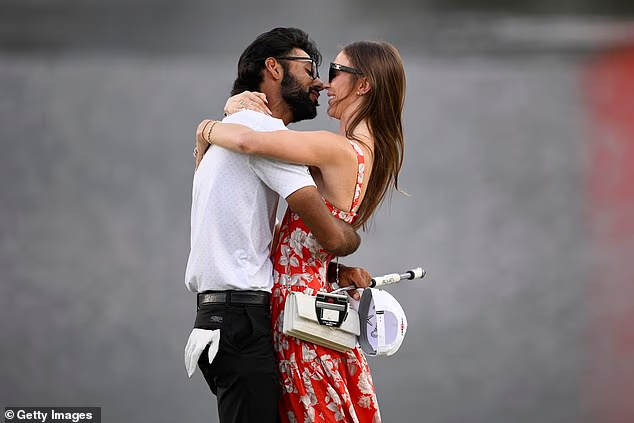
But here’s what elevated this particular Sunday beyond the typical tour victory narrative. After embracing his wife Presleigh on the 18th green, Bhatia didn’t just thank his sponsors and his team. He spoke about his niece, Mia, who passed away in December after battling a rare disease.
“My niece passed away in December, and so I knew she was looking over me this year. You know, I made this win for her, for sure.”
Later, in his press conference, he added more context that genuinely moved me as someone who’s spent decades in this game:
“When I saw that rainbow on 18, it reminded me of her so that was really cool, a special moment for us.”
Mia was his sister Rhea’s daughter—remarkable kid, by all accounts. She wasn’t supposed to make it past her first year, but she fought. She made it to Bhatia’s wedding, even though traveling was nearly impossible given her condition. She passed away the day of that wedding, in a house called “Heaven on Earth.” That’s the kind of detail that doesn’t make the SportsCenter highlight but tells you everything about what matters to these players beyond tournament scores.
In my three decades around professional golf, I’ve seen this evolution happen gradually. Players are more willing now to acknowledge that their lives extend beyond the ropes. That their performances mean something to people beyond the galleries and TV audiences. It’s healthier, frankly. It’s more human.
The Context of Dominance
What strikes me about Bhatia’s breakthrough is its timing within the larger PGA Tour narrative. We’re living through an era of remarkable parity and depth on the men’s side of professional golf. The days when a single player could dominate for years without serious challenge are largely behind us. Young players like Bhatia represent that new reality—talented, hungry, but operating in a hyper-competitive environment where everyone’s tracking strokes gained and neural patterns.
Yet here’s the tension: all that data, all that analytics, all that precision coaching—none of it accounts for what actually moved Bhatia on Sunday. A rainbow. A memory. The dedication of a win to someone he loved. That’s the element that separates golf from most other sports. It’s played over four hours in the elements. Weather changes. Light changes. Emotions shift. And sometimes, those intangibles matter more than the swing mechanics.
Looking Ahead to the Players
Bhatia heads into the Players Championship this week carrying genuine momentum now. Not just the confidence that comes from a win—though that matters—but the clarity that seems to come when you’re playing for something beyond yourself. In my experience, that’s often when young players make their real breakthrough pushes through fields of exceptional talent.
His father Sonny once explained that Bhatia’s golf journey began by watching his older sister Rhea play—he was too young at first, but his father told him, “Watch your sister and your time will come.” Both have been playing ever since. There’s something poignant about a young player fulfilling that family legacy while honoring family tragedy. That’s the narrative arc that sticks with you.
Three victories via playoff. All of them close. All of them clutch. That’s not luck—that’s a player who’s learning something essential about himself under pressure. Bay Hill was never just about the Arnold Palmer Invitational. For Akshay Bhatia, it was about claiming something he’d been chasing for two years while carrying something much heavier: grief, memory, and love for a niece named Mia.
That’s a story worth telling.
