


Gary Woodland’s Courage Is What Professional Golf Needs Right Now
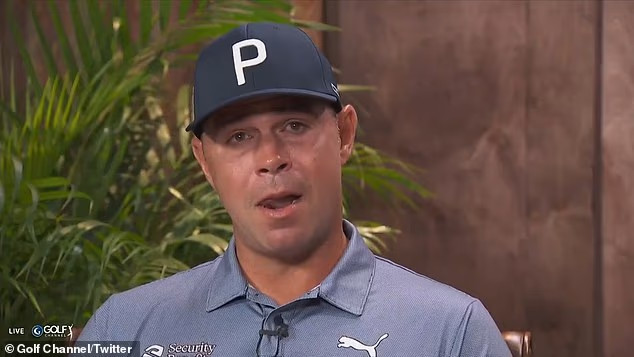
I’ve been covering this tour for 35 years, and I can tell you without hesitation: what Gary Woodland did this week took more guts than most majors I’ve watched him play in. Not the brain surgery part—though surviving that certainly qualifies as courageous. I’m talking about what he did Monday at the Players Championship, sitting down with Rex Hoggard and essentially telling millions of viewers that he’s been “dying inside” and “living a lie.”
That’s the kind of honesty that doesn’t come easy in professional golf, where the culture has always been built around toughness, stoicism, and keeping your cards close to your chest. We celebrate the guy who plays through pain. We romanticize the grind. But what Woodland did was different—he showed what real strength actually looks like.
The Invisible Wound
Here’s what strikes me most about Woodland’s story: the tumor is gone. The surgery was a success. Surgeons performed a craniotomy in September 2023, cutting a baseball-sized hole in the left side of his head to remove as much of the lesion as possible. They replaced it with a titanium plate. By the clinical measures, the job was done.
But as anyone who’s been around professional sports long enough knows, physical healing and mental healing are entirely different animals. The tumor was growing on his amygdala—the part of the brain that triggers fear and anxiety responses. Think about that for a second. The very organ that processes threat and danger was compromised for years before he got treatment. That doesn’t just disappear when you wake up from surgery.
The PTSD that followed is what we in sports tend to ignore or minimize. We see a guy back on the course, making cuts, and we think, “He’s fine.” But Woodland’s account of his recent round tells a different story entirely:
“I was hyper-vigilant. A walking scorer startled me, got close to me from behind. I pulled my caddie and said, ‘You can’t let anybody get behind me.’ Next thing you know, I couldn’t remember what I was doing. My eyesight started to get blurry. It was my turn to hit and I couldn’t hit.”
That’s a man whose nervous system has been fundamentally altered by trauma. And yet he kept playing. He even kept it private for nearly three years.
Why This Matters Beyond Golf
In my experience, athletes at Woodland’s level—US Open champions, guys who’ve played in majors and competed against the world’s best—they’re wired differently than most people. There’s a particular breed of self-reliance that gets you to that level. You learn early that weakness is a liability. You learn to compartmentalize pain. You learn to perform regardless of circumstance.
That mentality served Woodland well when he was grinding through years of medications and treatments before his diagnosis. It got him through the surgery itself. But post-traumatic stress doesn’t respond to willpower the way a tough lie in the rough does. You can’t grind your way through PTSD. You can’t outwork it.
What I find genuinely encouraging is that Woodland has worked with the PGA Tour to implement security protocols that help him feel safer on the course. That’s institutional support—real, tangible help—and it matters. The Tour gets criticized plenty from where I sit, but they’re taking mental health seriously here, and that deserves acknowledgment.
A Different Kind of Fight
Woodland was clear about his reasoning for staying on tour despite medical recommendations to avoid high-stress environments:
“In an ideal world I’m probably not playing. But in an ideal world I don’t have this. This [playing golf] is my dream.”
I respect that. I also respect that before his surgery, he did something most of us can barely fathom—he wrote letters to his three children, Jaxson, Maddox, and Lennox, preparing them for the possibility that he might not survive the craniotomy. He’s called it “the hardest thing I’ve ever done in my life, but it’s something I’m glad I did.”
That’s perspective. That’s understanding what actually matters.
In having caddied for Tom Lehman back in the ’90s, I saw up close how the tour can chew people up. I’ve covered 15 Masters tournaments and watched careers get derailed by injuries, by pressure, by the simple fact that professional golf is brutally unforgiving. But I’ve rarely seen someone return from something this serious—something this neurologically invasive—and keep fighting.
The Broader Conversation
What matters now is that Woodland’s willingness to speak openly might give permission to others struggling silently. Veterans and active military personnel have reached out to him after hearing his story, according to his comments:
“I’ve talked to veterans, and one thing I’ve heard from multiple people is you can’t do this on your own, no matter how strong you think you are.”
That’s the real victory here. Not whether he wins another tournament (though I wouldn’t count him out). It’s that he’s using his platform to normalize the conversation around psychological trauma and mental health in a sport that desperately needs it.
Gary Woodland didn’t have to tell anyone about his struggles with PTSD. He could’ve quietly worked through it, hired the right specialists, and managed it all behind the scenes. Instead, he chose vulnerability on one of golf’s biggest stages, three days before the Players Championship.
In 35 years of covering this game, I’ve learned that real toughness often looks different than we expect it to.
