


Gary Woodland’s Courage Signals a Reckoning We’ve Needed in Professional Golf
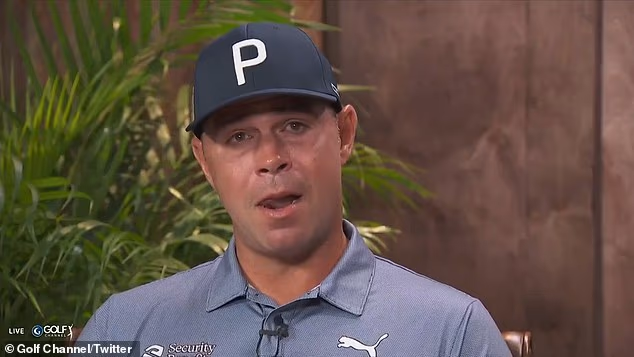
In 35 years covering this tour, I’ve watched players battle everything from the yips to divorce to gambling addiction. But I can’t remember the last time I saw a major winner sit down in front of the cameras and say, plainly and tearfully, that he’s “dying inside” and “living a lie.” Gary Woodland just did exactly that, and it matters far more than whether he makes the cut at Sawgrass.
What strikes me most about Woodland’s revelation isn’t the medical drama—though a craniotomy to remove a tumor from your amygdala certainly qualifies as dramatic. It’s that he’s forced the tour, and maybe the entire sport, to confront something we’ve systematically ignored: professional golfers are human beings experiencing real, documented trauma, and our sport’s culture has historically treated mental health like a missed putt you simply don’t discuss.
The Tumor Was Just the Beginning
Here’s what matters medically: Woodland had a brain lesion removed in September 2023. Surgeons cut a baseball-sized hole in the left side of his skull to extract as much of the growth as possible, then sealed it with a titanium plate. The operation succeeded. The tumor came out.
But what Woodland is dealing with now—nearly three years later—isn’t a surgical problem. It’s a neurological and psychological one. The tumor was located on his amygdala, the part of your brain responsible for processing fear and anxiety. Before surgery, he experienced seizures, debilitating anxiety, and an inability to focus. After surgery, those symptoms technically resolved. But the brain’s response to trauma doesn’t simply vanish when the source is removed.
Having caddied for Tom Lehman back in the ’90s, I saw plenty of pressure-induced moments on tour. But pressure and PTSD aren’t cousins—they’re different animals entirely. When Woodland describes a walking scorer accidentally startling him from behind, leading to blurred vision, memory loss, and an inability to execute his golf swing, that’s not nerves. That’s his nervous system misfiring.
“I was hyper-vigilant. A walking scorer startled me, got close to me from behind. I pulled my caddie and said, ‘You can’t let anybody get behind me.’ Next thing you know, I couldn’t remember what I was doing. My eyesight started to get blurry. It was my turn to hit and I couldn’t hit.”
The image of the 2019 US Open champion crying in fairways and bathroom stalls should’ve shocked the golf world. Instead, what’s genuinely shocking is how rarely we hear about this kind of thing. How many other tour players are quietly managing similar struggles without ever saying a word?
The Family Cost Nobody Talks About
In my experience covering this tour, we obsess over stroke averages and FedEx Cup points. We barely mention the toll on families. Woodland’s honest about it: when his children got excited at home, he had to leave the room because his brain couldn’t handle the stimulation. His wife became a de facto nurse, monitoring his condition daily while also raising three young kids, while he attempted to perform at the highest level of professional sport.
Before his surgery, Woodland wrote letters to his children—Jaxson and twins Maddox and Lennox—in case he didn’t survive the procedure. That’s the reality check nobody in our comfortable media bubble likes to address.
“Daddy’s got a big team around him. They’re your team now. There’s a lot of people that will be here for you.”
The fact that he had to write those words should matter to everyone watching professional golf. This isn’t about golf. It’s about a man fighting for his life and his family’s security.
What the Tour Should Learn (and Seems to Be Learning)
Here’s where I see genuine progress: The PGA Tour has apparently worked with Woodland to implement security protocols that make him feel safer on the course. That’s not nothing. That’s an organization responding to a real problem with tangible solutions.
Woodland played at the Cognizant Classic in front of thousands of fans. He competed at the Waste Management Phoenix Open—admittedly the rowdiest tournament on the calendar. He’s still fighting, still showing up, still pursuing his dream despite doctors recommending he avoid high-stress environments.
“I can’t waste energy anymore hiding this. I hope somebody that’s struggling sees me out here still fighting and battling and trying to live my dreams.”
That’s not just admirable. That’s leadership. Because now, any tour player dealing with similar invisible wounds has permission to speak about it. That changes culture.
The Uncomfortable Truth
Professional golf has always rewarded toughness. Grinding through pain. Never showing weakness. I’ve seen it countless times—players playing through injuries, personal tragedy, and genuine mental anguish because that’s what competitors do. But we’re learning, slowly, that some battles can’t be won through sheer willpower and a good short game.
Woodland’s courage suggests the tour is beginning to understand that, too. Not perfectly. Not everywhere. But movement in the right direction matters.
He might never win another major. He might never contend regularly again. But if his willingness to be vulnerable helps even one player—or one caddie, or one spouse—seek help instead of suffer in silence, then Gary Woodland’s real victory happens nowhere near a scoreboard.
