


Gary Woodland’s Courage Exposes Golf’s Invisible Opponent
In 35 years covering professional golf, I’ve seen plenty of players battle adversity on the course—weather delays, bad breaks, the occasional club-throwing incident. But what Gary Woodland is fighting right now exists in a realm most fans never see, and frankly, most athletes are too proud to talk about openly. That’s what makes his decision to speak up so significant.
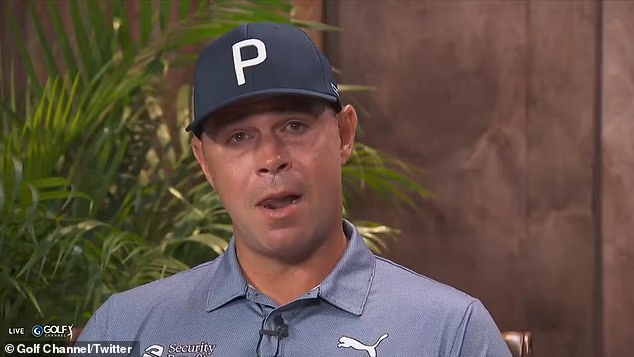
When Woodland sat down with Rex Hoggard at the Golf Channel just days before the Players Championship, he wasn’t there to promote a new equipment deal or discuss his game plan for the week. He was there to tell the world that he’s been “dying inside” and “living a lie” for nearly three years since his brain tumor surgery. That kind of honesty from a major champion? That’s rare. That’s important.
The Invisible Wound
Here’s what strikes me most about Woodland’s story: brain surgery and tumor removal typically get framed as a neat narrative arc in sports media. Guy gets sick. Guy gets fixed. Guy comes back to play. End of story. But the human nervous system doesn’t work that way, and Woodland is proving it.
The tumor was located on his amygdala—the part of the brain that controls fear and anxiety responses. After a craniotomy (that’s cutting a baseball-sized hole in the skull to access the tumor), you don’t just walk away without consequences. The surgery was successful in removing the lesion, but what came after is PTSD in its rawest form. Hypervigilance. Panic episodes in the middle of a fairway. A grown man crying in bathroom stalls because a walking scorer got too close behind him.
“I was hyper-vigilant. A walking scorer startled me, got close to me from behind. I pulled my caddie and said, ‘You can’t let anybody get behind me.’ Next thing you know, I couldn’t remember what I was doing. My eyesight started to get blurry.”
In my three decades around professional golf, I’ve never heard a player describe a panic attack with this level of specificity. Most athletes would rather lose a tournament than admit their mind turned against them mid-round.
The Family Behind the Scoreboard
What really got to me, though, wasn’t Woodland’s struggles on the course—it was what he revealed about his life at home. Before the surgery, when doctors were essentially telling him his odds weren’t great, he wrote a letter to his three children: Jaxson and twin daughters Maddox and Lennox. He called it “the hardest thing I’ve ever done in my life.”
Then, even after the surgery succeeded, the fallout continued. His wife Gabby had to manage the household while their kids couldn’t understand why Dad needed to disappear into a dark room whenever they got excited.
“When they got excited, I had to leave the room because my brain couldn’t handle the stimulation. They don’t understand why I have to go lay in the bed in a dark room to slow everything down. That was devastating for me.”
That’s the part casual fans don’t see. That’s the weight behind every tee shot.
A Different Kind of Comeback
Now here’s where I think the narrative shifts into something genuinely inspiring, and I don’t use that word lightly. Woodland knows what doctors are telling him. They’ve essentially said: stop playing competitive golf in high-stress environments. It’s not good for your brain. It’s not sustainable.
His response? He’s playing anyway.
But not recklessly. He’s worked with the PGA Tour to implement security protocols that make him feel safer on the course. He played in front of thousands at the Cognizant Classic. He teed it up at the Waste Management Phoenix Open—arguably the rowdiest tournament on the schedule. He’s not ignoring medical advice; he’s working within it while pursuing his dream.
“In an ideal world I’m probably not playing. But in an ideal world I don’t have this. This [playing golf] is my dream.”
Having caddied in the ’90s, I learned that golf teaches you something most sports don’t: how to function when things are falling apart. You’re out there for five hours with nowhere to hide. But Woodland isn’t just functioning—he’s being transparent about his dysfunction while still showing up.
What This Means for the Tour
I think what Woodland has inadvertently done here is crack open a conversation the PGA Tour needs to have. How many other players are struggling with invisible wounds? How many are medicating, isolating, or simply retiring because they felt they had no choice?
The Tour’s willingness to work with Woodland on security measures suggests an institutional shift. That matters. Mental health in professional sports is no longer just an athlete’s personal problem—it’s becoming recognized as something worthy of structural support.
At 41, Woodland has already won a US Open. He doesn’t have anything left to prove. The fact that he’s still out there fighting through panic attacks in fairways because he won’t abandon his dream? That’s not just admirable. It’s a lesson for anyone—athlete or otherwise—who thinks they have to hide their struggles to be worthy of respect.
That takes a different kind of courage than winning majors. It’s the courage to be seen, to be vulnerable, and to keep swinging anyway.
