


Gary Woodland’s PTSD Battle Reveals What Golf’s Real Toughness Looks Like
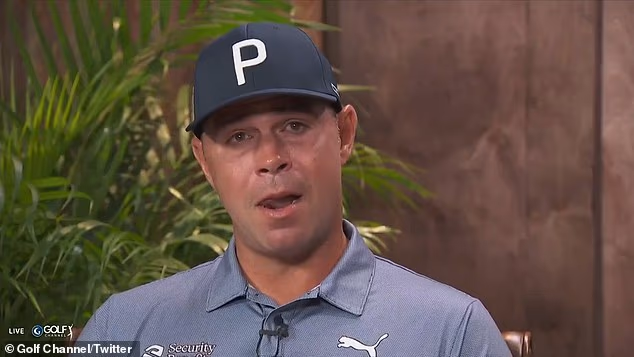
I’ve covered 35 years of professional golf, caddied for some of the game’s greats, and sat with players through injuries, slumps, and career-defining moments. But I have to tell you—what Gary Woodland did this week, sitting down with the Golf Channel just days before the Players Championship to detail his battle with post-traumatic stress disorder, that took a different kind of courage than I’ve seen on many fairways.
The headlines focus on the medical facts: brain tumor, surgery, successful removal. Those details matter. But what’s striking me most, as someone who’s spent decades around competitive golf, is how Woodland’s honesty cuts against the very grain of what this sport has traditionally valued.
The Unspoken Code Gets Challenged
Look, I grew up in golf’s old guard. Toughness meant playing through pain. Toughness meant not talking about your problems. When Tom Lehman and I were out there in the ’90s, you handled your business quietly and moved on to the next tournament. That mentality isn’t entirely gone—it’s embedded in the tour’s DNA.
That’s why this moment feels genuinely important. Woodland’s revelation that he’s been struggling with trauma responses, that he’s had to hide in bathrooms to cry, that his family has suffered because his brain couldn’t process normal stimulation—this isn’t weakness disguised as vulnerability. It’s actually the opposite.
What strikes me most is his specificity about the mechanism of his struggles. During a recent round, a walking scorer startled him from behind, and suddenly Woodland couldn’t function:
“I was hyper-vigilant. A walking scorer startled me, got close to me from behind. I pulled my caddie and said, ‘You can’t let anybody get behind me.’ Next thing you know, I couldn’t remember what I was doing. My eyesight started to get blurry.”
That’s not just difficult to hear—it’s clinically honest. Woodland isn’t asking for sympathy by vagueness. He’s educating us about what PTSD actually looks like on a professional golf course. It’s not theatrical. It’s disorienting and it’s real.
The Tumor, the Amygdala, and Why This Matters Beyond Golf
Here’s something most casual golf fans might miss: Woodland’s tumor was growing on his amygdala—the part of the brain that controls fear and anxiety responses. Doctors identified seizures as part of his declining health. This wasn’t just a physical challenge; the surgery itself created neurological consequences that he’s still processing nearly three years later.
In my experience covering the tour, I’ve seen players manage back injuries, shoulder issues, even career-threatening illnesses. But brain surgery? That’s different. It rewires things at a fundamental level. The fact that Woodland is still competing—let alone competing at a high level—speaks to something we don’t have a good word for in sports. It’s beyond toughness. It’s almost reckless optimism, but in the healthiest possible way.
What also impresses me is how he’s framed his return. He’s not pretending the struggle is over. He’s not telling us he’s “back to normal” or “stronger than ever.” Instead, Woodland is honest about ongoing therapy, about working with the PGA Tour on security protocols, about the daily difficulty:
“I can’t waste energy anymore hiding this. I’ve talked to veterans, and one thing I’ve heard from multiple people is you can’t do this on your own, no matter how strong you think you are.”
That’s significant. Woodland is explicitly rejecting the isolationist approach that golf culture has long championed. He’s asking for—and accepting—help. That’s revolutionary in professional sports.
The Tour’s Response Matters Too
I’d be remiss not to acknowledge the PGA Tour’s role here. The fact that Woodland was able to work with officials to implement security protocols shows an organization responding thoughtfully to a player’s medical needs. That’s not always been the tour’s default setting, frankly. In my early years covering the circuit, accommodation for anything beyond a physical injury was rare.
The tour allowed Woodland to manage his environment in ways that reduce his anxiety triggers. He played the Cognizant Classic in front of thousands. He competed at the notoriously rowdy Waste Management Phoenix Open. These aren’t small accomplishments when you’re managing a nervous system that’s been rewired by trauma and surgery.
The Letter to His Children
One detail in his story has stayed with me all day: Before his surgery, Woodland wrote a letter to his three children—Jaxson, Maddox, and Lennox—preparing them for the possibility that he might not survive. He later called it
“the hardest thing I’ve ever done in my life, but it’s something I’m glad I did.”
That’s parenting under extraordinary pressure. That’s also someone who faced his mortality directly and came out the other side determined not just to survive, but to live meaningfully. To keep chasing his dream. To be honest about the cost.
What This Means for Golf
I think what Woodland’s doing matters for the sport’s culture. When major winners—when US Open champions—start talking openly about mental health struggles, about the limits of willpower, about the necessity of professional help, it changes what’s possible for everyone else.
Young players coming up the ranks will see that vulnerability doesn’t disqualify you from competing at the highest level. Veterans managing their own silent struggles might realize they don’t have to manage them alone. Fans will understand that athletic excellence and human fragility aren’t opposites—they’re part of the same story.
In 35 years around this game, I’ve learned that the players who last, who truly matter, are the ones willing to adapt—not just their swing, but their entire approach to what it means to be a competitor. Woodland’s doing that right now. He’s choosing his dream, choosing honesty, choosing to let people help him. That’s toughness I respect more than any major championship.
