


Wyndham Clark’s Awkward Moment With Kay Adams Reveals Golf’s Still-Evolving Media Culture
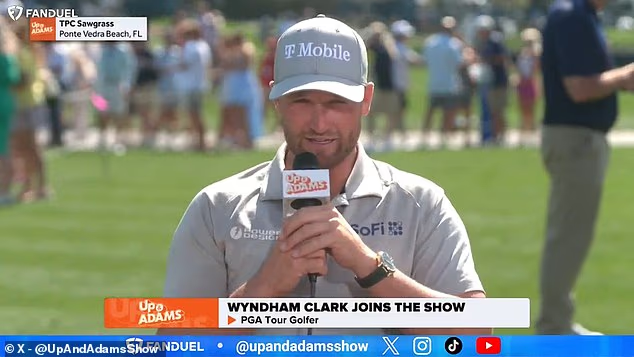
I’ve been around professional golf long enough to know that not every awkward moment on camera is a scandal. But Wyndham Clark’s “week-long girlfriend” comment during his appearance on Kay Adams’ Up & Adams show at The Players Championship this week does tell us something interesting about where professional golf sits right now—caught between its buttoned-up traditions and the more casual, social media-driven landscape younger players are navigating.
Let me be clear: I don’t think Clark was being malicious. The comment was clumsy, sure, but from what I saw, he was attempting self-deprecating humor that simply landed the way a three-wood into the wind lands—short of the target. Still, the social media firestorm that followed raises some worthwhile questions about professionalism, boundaries, and how the modern tour player interacts with media in real time.
Context Matters More Than the Headline
Here’s what struck me about this exchange: Clark was actually in the middle of a perfectly fine interview about equipment—specifically his recent driver changes. The 2023 US Open champion explained his situation plainly enough:
“I’m a free agent and sometimes it’s nice to spice things up [and switch drivers]. The honeymoon stage can be really nice.”
That’s legitimate tour talk. Driver fitting is a constant conversation out here. I’ve spent countless hours in my caddie days watching players tinker with shafts and heads, chasing that perfect feel. Clark had changed drivers four times already in 2026, which actually tells you something about where equipment technology stands—there’s real performance variance week to week, and players are rightfully experimenting to find edges.
But then came the pivot. When Adams asked about his “regular switch” of drivers, Clark attempted to extend the metaphor into his personal life.
“Sometimes it’s nice to have a week-long girlfriend, you know? I’m just kidding,”
he said, before immediately walking it back:
“Yeah, I’m kidding, I just haven’t found the right one, and when you find the right one, you lock it down.”
Adams handled it with grace, continuing the equipment analogy herself, and Clark even self-corrected with a joke: “We’re still talking about drivers, right?” But the internet had already moved on to its own interpretation.
What Social Media Got Wrong (And Right)
The social media reaction was swift and divided. Some users called it “wilddd” or labeled it a “painful watch.” One comment I saw asked, “Do you enjoy being objectified by these man-babies?” Others tried to frame it as Clark “shooting his shot” with Adams.
Look, I think both perspectives miss the mark slightly. This wasn’t some calculated flirtation or attempted pickup line—that gives Clark far too much credit for smooth execution. But it also wasn’t sexual harassment or predatory behavior. What it was, in my experience, is a young athlete who made a slightly awkward joke in live television and immediately recognized it didn’t land. It happens. I’ve seen far worse mic moments at tour events over 35 years.
What does concern me, though, is the broader pattern it reflects. Professional golfers—particularly younger ones—are increasingly comfortable freestyling during media appearances. That’s not inherently bad. I’d argue it’s actually healthier than the robotic, media-trained responses we got for decades. But there’s a skill to knowing where the line is, and not every 28-year-old has developed that instinct yet.
The Real Story: Golf’s Media Evolution
Having caddied through the ’90s and covered this tour since 1991, I’ve watched the relationship between players and press transform completely. When I started out, tour players spoke in carefully scripted soundbites. They feared reporters. They feared saying anything remotely interesting.
Now? Guys like Clark are doing podcast appearances, social media streams, and going on the road with popular sports personalities. There’s genuine value in that—the game is more accessible and more human because of it. But with that accessibility comes a learning curve about maintaining professionalism within a more relaxed environment.
Adams herself managed the moment beautifully, by the way. She didn’t shut Clark down or make him feel crucified. She smiled, expressed mock shock, and pivoted back to the actual story. That’s professional broadcasting. The social media pile-on, by contrast, felt disproportionate.
Clark’s Real Focus Should Be The Course
Here’s what matters most: Wyndham Clark is a tremendously talented player. He won the US Open in 2023, he’s a three-time PGA Tour winner, and he was at The Players Championship—one of the most important tournaments on our calendar—trying to prepare mentally and physically for one of the year’s biggest tests. That’s where his energy should be focused.
In my experience, the best players let this kind of noise roll off their backs and focus on execution. They make a mental note about what landed awkwardly, they move on, and they play golf. That’s the hope here for Clark moving forward.
The bigger lesson for the tour as a whole is that media training might need to evolve. Not to make players more robotic, but to help younger guys understand the difference between being authentic and personable versus crossing into territory that gets misinterpreted. There’s a middle ground there, and most of the game’s emerging talents will figure it out naturally.
For now, this moment will fade from the news cycle, social media will find its next outrage, and we’ll get back to focusing on what actually matters: who’s swinging the putter best on the greens of TPC Sawgrass.
