


When Golf’s Safe Harbor Gets Shaken: The Players Championship and a Troubling Reality
I’ve been covering professional golf for 35 years, and I can count on one hand the number of times I’ve had to write about something that has nothing to do with birdies, bogeys, or the occasional heated rules dispute. Friday night’s tragedy at TPC Sawgrass is one of those moments—and it deserves more than a passing mention in the back pages.
Two people are dead. A domestic violence situation in a Walgreens parking lot less than a thousand feet from one of golf’s most prestigious venues spiraled into violence, and a suspect with 27 arrests and a history that, as St. Johns County Sheriff Rob Hardwick put it, would make anyone’s stomach turn, fled onto the PGA Tour’s most iconic property.
The Immediate Response: Caution Over Panic
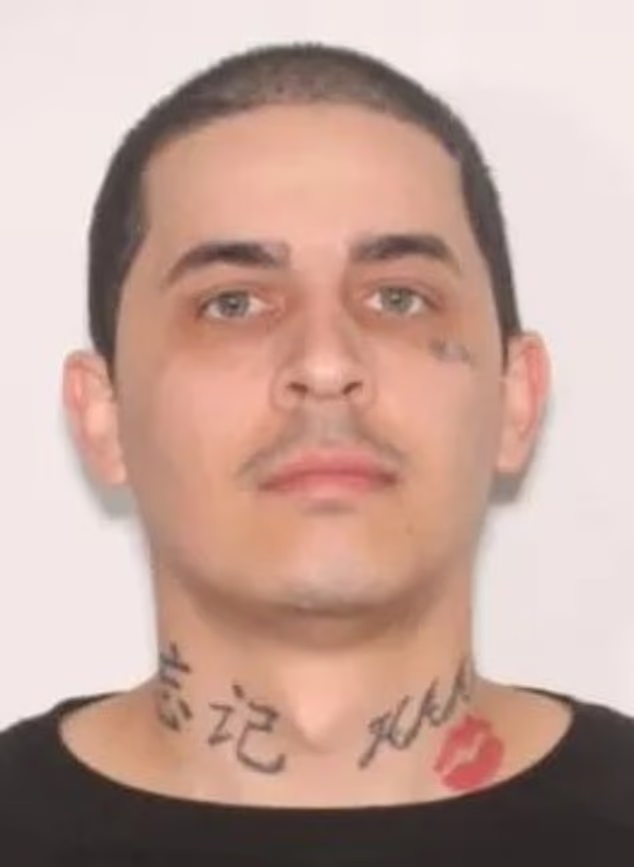
Let me be clear about what didn’t happen: nobody on the golf course was hurt. The suspect, 32-year-old Christian Barrios, was apprehended by early Saturday morning in Nassau County, about an hour north of the course. Tournament officials made the prudent decision to delay gate opening until 9am on Saturday, citing “operational considerations,” before play began at 8:15am with hospitality areas following at 11am.
“His criminal history is embarrassing. It makes me sick to my stomach. [Barrios] is out of prison again on probation, committing another violent felony.”
That restraint matters. In my experience covering the tour through 9/11, weather disasters, and various security incidents, I’ve watched how golf handles crisis. The sport has learned to balance transparency with measured response. Nobody overreacted. Nobody canceled. They secured the premises, worked with law enforcement, and got back to business. That’s exactly what you want to see.
What strikes me most, though, is that this incident reveals something the golf community has largely taken for granted: our events happen in real places, surrounded by real communities with real problems. The Players Championship isn’t played in a bubble. It’s in Ponte Vedra Beach, Florida—a metropolitan area like any other.
An Uncomfortable Intersection
Having caddied for Tom Lehman back in the ’90s, I’ve spent enough time at tour events to understand the security apparatus that surrounds professional golf. It’s substantial. We have credentialing systems, bag checks, perimeter security. But there’s a limit to what you can control when a violent crime occurs in a public parking lot a mile away.
“We know he made contact with some employees in there [TPC Sawgrass]. He picked up – we believe it was a radio that belonged to the PGA Tour, not one of our radios and we know he dropped it after that.”
What’s particularly sobering is the detail that Barrios, after fleeing the initial scene, made his way onto the course itself. He picked up a PGA Tour radio. He stole a vehicle. He led law enforcement on a pursuit that ultimately ended in a crash in the woods. This wasn’t a random intrusion—this was someone actively evading capture, moving through a property that happened to be hosting 156 of the world’s best golfers.
The canine units eventually tracked him down using that abandoned tour radio as a scent marker. The system worked, ultimately. But the margin between “system working” and “catastrophe” feels uncomfortably thin in retrospect.
A Systemic Problem Beyond Golf
Here’s what I think matters most about this incident, and it has nothing to do with golf itself: Sheriff Hardwick’s frustration speaks volumes about a criminal justice problem that extends far beyond the fairways of TPC Sawgrass.
“[Barrios] is out of prison again on probation, committing another violent felony. Here we are dumping all these resources and families are gonna mourn two people that were shot and killed.”
A man with 27 arrests. A violent history. Out on probation. And two people are dead in a domestic violence situation that was entirely preventable. That’s not a golf problem. That’s a societal problem that happened to intersect with golf on this particular Friday night.
In my three decades around this tour, I’ve covered a lot of ground. I’ve seen the PGA Tour grow into a global institution. I’ve watched security protocols evolve, standards improve, and the organization become more professional in every measurable way. But you can’t security-detail your way out of a systemic failure in criminal justice.
What the Tour Did Right
That said, I want to acknowledge what happened here operationally. The PGA Tour worked seamlessly with local law enforcement. Gates were delayed but not canceled. The third round proceeded on schedule. Spectators and players felt secure enough to return. That’s not luck—that’s competent crisis management.
The tour has been through enough in recent years—the Saudi investment controversy, broadcast ratings debates, LIV competition—that they know how to navigate difficult moments. Friday’s tragedy wasn’t a tour problem, but the tour’s response was professional, measured, and ultimately reassuring.
Golf has always offered sanctuary of sorts—a few hours away from the chaos of the world. Friday’s events reminded us that the world has a way of intruding, even into the most carefully curated spaces. The real tragedy isn’t that this happened near a golf tournament. It’s that it happened at all. Two families are mourning this weekend, and no amount of security protocols can change that.
The Players Championship will go on. It should go on. And when it does, we should remember that sometimes the resilience of an event matters less than remembering why we’re gathered in the first place.
