

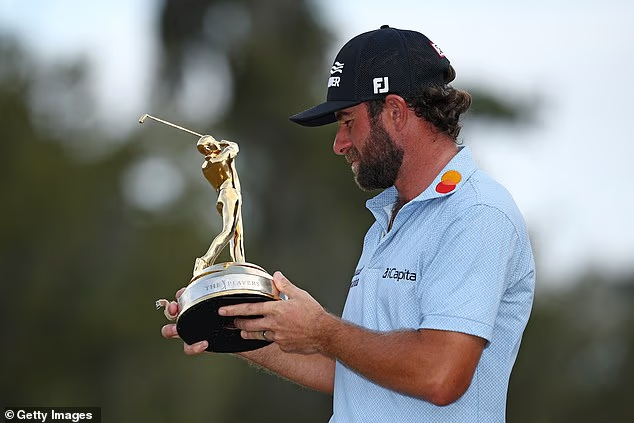

Cameron Young Finally Breaks Through at The Players—And It Couldn’t Come at a Better Time
After 35 years watching this tour, I’ve learned that timing in golf matters almost as much as talent. Cameron Young’s victory at The Players Championship on Sunday proved that lesson in real time. This wasn’t just another PGA Tour win—it was a statement about a player who’s been knocking on the door, and a reminder that perseverance still means something in professional sports.
Let me be direct: Young’s path to this trophy has been brutally humbling. Seven runner-up finishes before winning the Wyndham Championship last summer. Seven. I’ve caddied alongside players who carried that kind of monkey on their backs, and I’ll tell you—it weighs heavy. You start to wonder if something’s missing, if the big moments just aren’t for you. Then suddenly, they are.
When Form Meets Fortune
What strikes me most about Young’s performance wasn’t the final result—it was how he navigated the back nine when the course was eating up the field. Ludvig Aberg, who held a three-shot lead entering Sunday, imploded spectacularly with back-to-back water balls on holes 11 and 12. A 40 on the back nine. That’s not unlucky golf; that’s the kind of unraveling that happens when nerves and wind combine on one of the tour’s most demanding finishing stretches.
Young, meanwhile, played bogey-free on those treacherous holes. In my experience, that’s where champions separate themselves—not with highlight-reel shots, but with the discipline to avoid catastrophe when everything around you is falling apart.
“The nerves kicked in over the 8-inch putt on the last. That hole looked really, really small there from pretty close range. So happy to have finished it off, and just really excited to have played the way I did.”
That quote tells you something important about Young’s mindset. He’s not pretending it was easy. He’s acknowledging the pressure was real, massive even, but he found a way through it. That’s growth. That’s a player learning his craft at the highest level.
The Ryder Cup Effect
Here’s something I don’t think gets enough attention in golf media: Young’s Ryder Cup experience at Bethpage Black last fall clearly stayed with him. Playing in front of a raucous American crowd, delivering when it mattered most in that format—that builds a different kind of confidence than a regular tour event. When Young faced pressure down the stretch at TPC Sawgrass on Sunday, he had evidence from his recent past that he could handle it.
“Definitely some nerves, but also some confidence.”
That balance—nerves tempered by confidence—is the psychological formula for clutch golf. Young had earned that confidence legitimately. It wasn’t blind optimism; it was based on actual performance under fire.
The Collapse Nobody Saw Coming
Now, about Ludvig Aberg. I mention this not to pile on—Aberg is clearly a talented player with a bright future—but because his meltdown illustrates something important about this level of competition. A three-shot lead going into Sunday at The Players should be commanding. Should be. But this course, this wind, these closing holes: they punish indecision and they punish poor execution in ways that most tournaments don’t.
“I would have loved to be standing where Cameron is standing right now. It definitely stings a little bit.”
Aberg’s honesty here is admirable, actually. He knows what happened. Two water balls on consecutive holes didn’t happen because of bad luck—they happened because pressure got inside his head. Having been around this tour long enough, I’ve seen this pattern repeat itself countless times. The player who can learn from a collapse like this—not dwell in it, but genuinely learn—often comes back stronger.
What This Means for the Season Ahead
Young moves to No. 4 in the world rankings and enters The Masters in the kind of form you want heading into Augusta. He’s proven he can win a major-championship-caliber event. His shot-making down the stretch was crisp. His course management was sound. He hit the longest drive ever recorded on the 18th at Sawgrass—375 yards—which set up his winning par.
The $4.5 million paycheck matters financially, sure, but the real prize here is psychological. Young has crossed a threshold. He’s no longer “the guy with all the runner-up finishes.” He’s a Players Championship winner. That changes how opponents view him. That changes how he views himself.
The Bigger Picture
What also intrigues me is what this victory says about the depth of American golf talent right now. Young, Xander Schauffele (who finished third), Robert MacIntyre (fourth)—the field was packed with quality players, and Young was the one who handled the pressure best when it mattered most. That’s not luck. That’s not coincidence.
In three-and-a-half decades covering this tour, I’ve learned that breakthrough moments often announce themselves. You feel them coming. Young’s performance Sunday had that quality—the sense that something fundamental had shifted, that a player had finally internalized all the lessons from those seven runner-up finishes and applied them to an actual victory.
His tap-in par on the 18th—after that devastating double bogey the day before on the same hole—felt like punctuation on a sentence that’s been in progress for months. Sometimes in golf, as in life, timing really is everything.
