


When Golf’s Greatest Stage Becomes Ground Zero: The Players Championship and a Stark Reminder
I’ve walked the grounds at TPC Sawgrass more times than I can count. Thirty-five years of covering this tour will do that to you. I’ve seen Cameron Young drain putts under pressure, watched Matthew Fitzpatrick grind his way to victory, and celebrated the drama that makes the Players Championship one of golf’s crown jewels. But last weekend, the most prestigious tournament outside the majors became the backdrop for something far more serious—a manhunt for an alleged killer playing out mere yards from where 35,000 fans cheered their heroes.
What strikes me about this incident isn’t just the rarity of it—though thank God, violent crime near tour events is extraordinarily rare. It’s what it reveals about the thin line between the bubble we’ve created around professional golf and the reality that surrounds us all. For decades, we’ve insulated tournaments like the Players from the outside world. We’ve built security perimeters, created controlled environments, and told ourselves that golf is a sanctuary from life’s ugliness. Last Friday night reminded us that sanctuaries have walls, and walls can be breached.
The Facts: How Close Is Too Close?
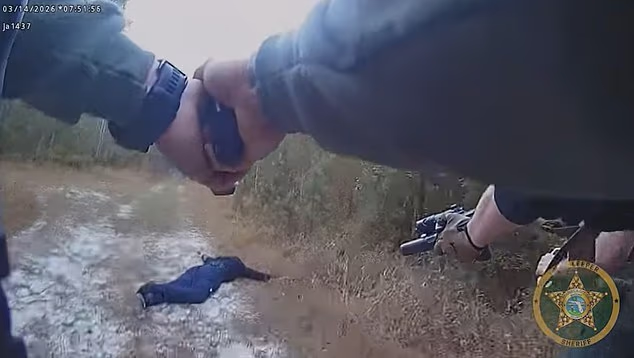
According to reports, Christian Barrios, 32, allegedly shot two people multiple times around 10:30 p.m. Friday in a Walgreens parking lot approximately one mile from the TPC Sawgrass course. Let me put that in perspective for those who haven’t been to Ponte Vedra Beach: one mile is nothing. You can see the tournament grounds from most vantage points in that radius. The story gets more unsettling—Barrios crashed a stolen BMW while fleeing police, then fled into woods that literally border the golf course.
What really caught my attention was this detail: Sheriff Rob Hardwick revealed that Barrios managed to pick up a PGA Tour radio during his escape attempt.
“We know he made contact with some employees in there [TPC Sawgrass],” Hardwick said. “He picked up – we believe it was a radio that belonged to the PGA Tour, not one of our radios and we know he dropped it after that. Our canines used it as a scent when they came in there.”
That radio—a piece of operational infrastructure—became the thread that unraveled his escape plan. Law enforcement used it to track his scent. In a strange twist, the very machinery of professional golf became an instrument of justice.
Saturday Morning’s Delay: A Test of Composure
The third-round delay on Saturday morning was brief—nothing that disrupted the tournament’s narrative arc—but it was significant in ways that go beyond scorecards. Having caddied for Tom Lehman back in the ’90s and covered countless tour events since, I’ve seen how players respond to disruption. Some thrive when normalcy is interrupted; others struggle with the mental reset.
The PGA Tour and Nassau County Sheriff’s Office handled the coordination well. Sheriff Bill Leeper later stated:
“I am proud of the teamwork and collaboration with our partner agencies that led to a swift apprehension of this homicide suspect by our NCSO deputies. This arrest demonstrates the widespread effort and dedication of every unit involved.”
You can measure the success of security by how invisible it is. Most fans probably didn’t even realize there was an active manhunt in progress. That’s actually the gold standard in event management—the machinery working flawlessly in the background.
The Broader Context: Criminal History and System Failures
What Sheriff Hardwick said next is what keeps me thinking about this days later. Barrios had 27 arrests on his record. Twenty-seven. And he was on probation when he allegedly committed this homicide.
“His criminal history is embarrassing. It makes me sick to my stomach. [Barrios] is out of prison again on probation, committing another violent felony. Here we are dumping all these resources and families are gonna mourn two people that were shot and killed in a parking lot of Walgreens over domestic violence situation.”
That’s law enforcement speaking truth that transcends golf. This isn’t a golf story at its core—it’s a story about systemic failures in criminal justice. But it happened to intersect with the Players Championship, which is why we’re discussing it here. In my experience, when major events become news for reasons beyond sport, it’s usually worth examining why.
Golf Carried On—As It Should
Here’s what I want to emphasize: Cameron Young won the Players Championship. He defeated Matthew Fitzpatrick by a shot in compelling fashion. The tournament delivered the drama and excellence it’s supposed to. Players competed at the highest level despite the backdrop of a manhunt. That resilience, that ability to compartmentalize and perform under extraordinary circumstances, says something about both the mental fortitude these athletes possess and the essential normalcy of sport itself.
The security breach didn’t compromise the competition. The delay didn’t derail the narrative. Professional golf’s infrastructure, while tested, held firm. That matters. It means we can continue hosting world-class events in real communities without fundamentally surrendering to fear.
In my three and a half decades around this game, I’ve learned that golf reflects life—sometimes the good parts, sometimes the difficult parts. Last weekend was a reminder that even our cherished sanctuaries exist in the real world, subject to its complexities and dangers. The fact that we can acknowledge that reality and still crown a worthy champion speaks to the enduring strength of this game.
