


When Golf’s Showcase Collides With Harsh Reality: What the Players Championship Arrest Tells Us
Cameron Young’s one-shot victory over Matthew Fitzpatrick at the Players Championship will live on in the record books as a thrilling finish to golf’s so-called “fifth major.” But for those of us who’ve spent decades around this game, this year’s tournament will be remembered for something far more sobering—a moment when the bubble surrounding professional golf got punctured by the real world in a way that’s difficult to ignore.
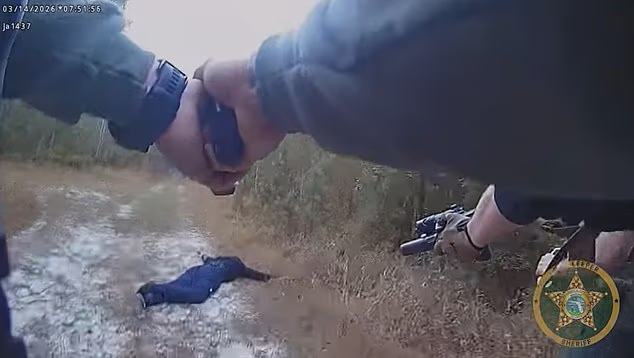
The arrest of Christian Barrios, an alleged killer who fled into the woods bordering TPC Sawgrass just hours after shooting two people at a nearby Walgreens, forces us to confront an uncomfortable truth: no matter how pristine the manicured fairways or how exclusive the membership, golf venues exist in the same communities as everyone else. They’re not sanctuaries from society’s problems.
A Swift Response, But Questions Remain
Let me be clear—law enforcement handled this situation about as well as one could hope. The Nassau County Sheriff’s Office and their partner agencies deserve genuine praise for their coordination and speed. Sheriff Bill Leeper’s statement captured the professionalism of the response:
“I am proud of the teamwork and collaboration with our partner agencies that led to a swift apprehension of this homicide suspect by our NCSO deputies. This arrest demonstrates the widespread effort and dedication of every unit involved.”
That the arrest caused only a brief delay to Saturday’s third round—pushing it back just enough for security protocols to be established—speaks to how well the operation was executed. In my 35 years covering this tour, I’ve seen security evolve dramatically. What once was a gentlemanly sport played in front of mostly well-behaved crowds has required increasingly sophisticated safety measures. This incident, while deeply troubling, showed that infrastructure is in place and personnel know how to use it.
But here’s what strikes me: the fact that Barrios made it into the woods bordering the course at all. He picked up a PGA Tour radio during his escape attempt—a detail that seemed almost absurd until you understand its significance. As Sheriff Rob Hardwick explained, that discarded radio became crucial to the capture:
“Our canines used it as a scent when they came in there… He made contact with some employees in there [TPC Sawgrass]. He picked up – we believe it was a radio that belonged to the PGA Tour, not one of our radios and we know he dropped it after that.”
Think about that for a moment. An armed fugitive, desperate and fleeing arrest, wandered close enough to PGA Tour operations to grab a radio. It’s a reminder that even at golf’s most prestigious events, attended by 35,000 fans on a sellout Saturday, there are limits to what security can control.
The Bigger Picture: Criminal Justice Failure
What troubles me more than the proximity of danger is what Hardwick said about Barrios’s background. The man had 27 arrests. Twenty-seven. And he was on probation after a previous prison sentence when he allegedly committed this violent felony. Hardwick didn’t mince words about his frustration:
“His criminal history is embarrassing. It makes me sick to my stomach… He is out of prison again on probation, committing another violent felony. Here we are dumping all these resources and families are gonna mourn two people that were shot and killed in a parking lot of Walgreens over domestic violence situation.”
That’s not a golf story. That’s a systemic failure story. And it happened to occur near the Players Championship.
In my decades around professional golf, I’ve watched the sport insulate itself from many of society’s rough edges. We talk about “the golf bubble”—the sense that once you’re inside the ropes, the outside world doesn’t intrude. But golf exists in the real world, with real problems. This incident is a stark reminder of that reality.
Golf’s Response: Stability and Normalcy
What I appreciated, frankly, was how the tour and tournament management handled the narrative. There was no panic, no talk of canceling or relocating. Security was enhanced, protocols were observed, and the event continued. Young’s victory—coming against a strong international field—proved that golf could absorb this disruption and deliver compelling competition.
That’s actually important. In a world where fear can drive poor decision-making, the ability to acknowledge a genuine threat, respond appropriately, and continue forward without overreacting speaks to institutional maturity. The PGA Tour isn’t naïve about security. They’re realistic about it.
What This Means Going Forward
Having caddied for Tom Lehman back in the ’90s and watched security evolve from gentlemanly courtesy to sophisticated professionalism, I don’t see this incident derailing the tour’s trajectory or Player Championship’s status. Major sporting events deal with security challenges regularly. That’s the world we inhabit now.
But it’s worth acknowledging: the Players Championship, like all of golf, doesn’t exist in a vacuum. It exists in a community, surrounded by neighborhoods and commerce and, yes, sometimes crime. The fact that we can address that reality calmly and professionally—as both law enforcement and the tour did this past weekend—suggests golf has matured as an institution.
Young earned his victory fair and square. TPC Sawgrass proved once again why it hosts golf’s most important event. And law enforcement proved they could handle a crisis. That’s how you move forward from a weekend like this one.
