


Tiger’s Masters Question Reveals What We Already Know: The Body Says No, But the Competitor Won’t Quit
There’s a moment every year, around this time, when Tiger Woods gets asked about Augusta National. And every year, he gives essentially the same answer: Maybe. Could happen. We’ll see how the body feels.
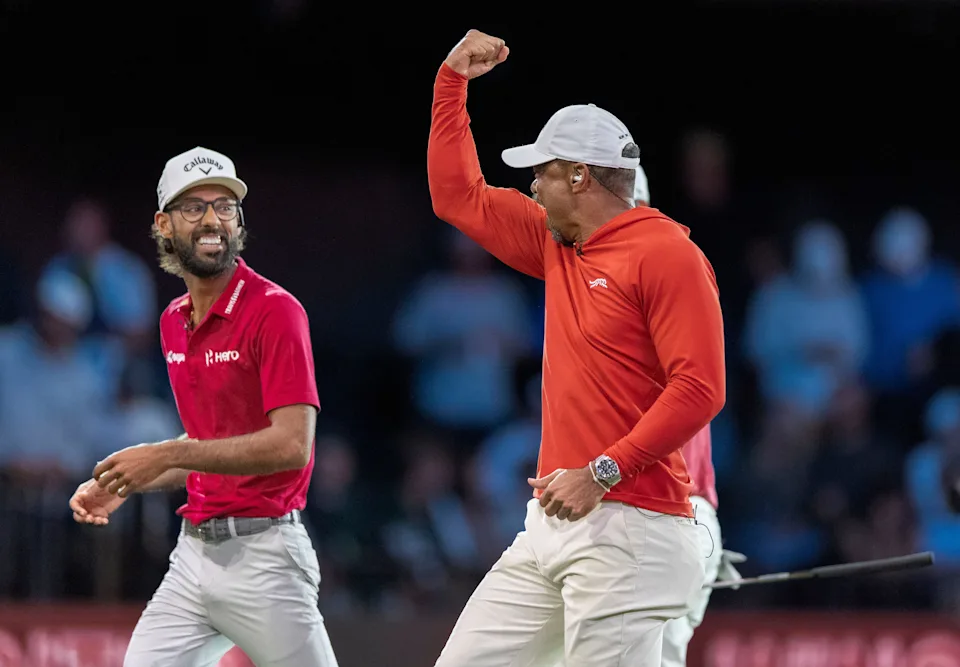
After Jupiter Links’ 9-5 victory over Rory McIlroy’s Boston Common at the SoFi Center on March 17, Tiger was asked again. And he answered again the only way he knows how—with hope dressed up as possibility.
“I said I’ve been working on it. Sometimes I have good days, sometimes I have bad days. Disc replacement is not a lot of fun.”
In 35 years covering professional golf, I’ve learned to read between the lines of what Tiger says. What I’m hearing here isn’t optimism. It’s defiance. There’s a difference, and it matters.
The Mathematics of Decline Don’t Favor Miracles
Let’s look at the timeline because it tells the real story. Tiger had disc replacement surgery on October 10, seven months after a ruptured left Achilles tendon surgery. Before that, two back operations. His last competitive PGA Tour event was the 2024 British Open. His most recent tournament appearance was the PNC Championship with his son Charlie in late 2024.
We’re now looking at a golfer who, in the span of roughly 14 months, has undergone four major surgical procedures. That’s not a rough patch. That’s a significant restructuring of the body.
Having caddied for Tom Lehman back in the ’90s, I watched firsthand how recovery works for elite athletes. You get one, maybe two major procedures and bounce back reasonably well. You get three or four? The mathematics change. The body doesn’t have the same blueprint for healing.
What strikes me most about Tiger’s candid assessment is his honesty about this reality:
“The body doesn’t quite heal like it was when I was 24. Doesn’t quite bounce back. So I have good days when I can pretty much do anything, and other days where it’s hard to just to move around.”
This isn’t Tiger making excuses. This is Tiger being realistic. And frankly, that’s progress.
The Role Change Tells Its Own Story
What’s particularly interesting is how Tiger has repositioned himself within the Jupiter Links organization. He’s attending every match. He’s coaching. He’s invested in the team’s success—and they’re proving worthy of that investment, having advanced to the SoFi Cup Finals with Max Homa, Akshay Bhatia, and Tom Kim carrying the load.
I think there’s wisdom in this pivot that Tiger himself may not fully appreciate. In my decades around professional golf, I’ve seen what happens when champions try to force comebacks beyond their physical capacity. The desperation becomes visible. The body language changes. Sponsors and teammates sense it. It becomes a distraction rather than an asset.
Instead, Tiger has found a different lane. He’s still competing—just not as a player. He’s invested in the TGL concept he co-founded with McIlroy, and Jupiter’s run to the finals validates that the league has found its footing in its second season.
The Masters Question Never Really Goes Away
But let’s be honest: Tiger won’t stop being asked about Augusta. And he won’t stop giving the same answer. That’s not because he’s being coy or keeping options open for marketing purposes. It’s because the Masters represents something uniquely different in professional golf.
It’s Tiger’s tournament in ways that no other event is. He’s won it five times. He’s engineered one of sports’ greatest comebacks there in 2019. The course, the history, the tradition—it all pulls at a competitor of his caliber differently than other events.
“I really don’t want to screw up the lineup. I want these guys to keep playing.”
This quote, I think, is the most revealing. Tiger is genuinely concerned about being a liability to his team. That’s not the statement of someone actively planning a Masters appearance. That’s someone weighing whether his body could handle the mental and physical demands of one of golf’s most grueling tournaments, and whether he’d be helping or hurting Jupiter’s chances in the process.
What Actually Matters Here
The larger story isn’t whether Tiger plays Augusta. It’s that we’re watching a golf legend navigate the most difficult transition any athlete faces: the acknowledgment of limits.
Tiger has never been good at that. His entire career has been built on pushing through, on finding margins of improvement where others saw impossibility. But you can’t will your way past disc replacement surgery and multiple Achilles tendon issues.
The positive development here—and I do think there is one—is that Tiger appears to be finding fulfillment in a different role. He’s still connected to competitive golf at the highest level. He’s still influencing outcomes, mentoring younger players, and building something innovative with the TGL format.
That’s not the fairy tale ending fans hoped for. But it might be the more sustainable one.
Will Tiger play the Masters? Probably not. But he’ll keep saying maybe, because champions don’t fully surrender their armor. They just learn to wear it differently.
