


Tiger’s Masters Mystery: Why His Ryder Cup Decision Matters More Than We Think
Look, I’ve been around this game long enough to know when something doesn’t quite add up. And right now, watching Tiger Woods navigate his comeback timeline while simultaneously being asked to captain the 2025 Ryder Cup team feels like watching someone try to juggle while learning to walk again.
The headline is straightforward enough: Tiger’s recovering from his seventh back surgery, a torn Achilles, and he’s noncommittal about Augusta. We’ve heard this story before—too many times, frankly. But what strikes me after 35 years covering this tour is what’s happening in the spaces between the quotes, and what Tiger’s Ryder Cup decision actually reveals about the state of professional golf right now.
The Honest Assessment
First, let’s acknowledge what Tiger said following Jupiter Links’ semifinal victory:
“I said I’ve been working on it. Sometimes I have good days, sometimes I have bad days. Disk replacement is not a lot of fun.”
That’s not spin. That’s a man being genuinely candid about his situation. In my experience covering tours, when athletes start getting that honest about physical setbacks, it usually means things are harder than the previous rosy updates suggested. A disk replacement at age 50 isn’t a minor procedure—it’s orthopedic real estate. The fact that Tiger’s still experiencing oscillating recovery patterns tells you something important: this isn’t a typical comeback arc.
What I find most revealing, though, is Tiger’s acknowledgment about his TGL participation this season:
“I’ve been trying to play each and every one of these matches. I’ve been trying to come back. But it just hasn’t worked out that way.”
That’s the sound of a man confronting physical reality. Having caddied for Tom Lehman back in the ’90s, I remember watching him navigate similar crossroads. Sometimes the body just doesn’t cooperate with the timeline your mind wants to follow.
The Real Question: Ryder Cup or Recovery?
Now here’s where this gets interesting—and frankly, a bit complicated for everyone involved. The PGA of America has given Tiger a “soft deadline” before the Masters to decide whether he wants to captain the 2027 US Ryder Cup team at Adare Manor in Ireland. According to reporting, sources described it as less of an ultimatum and more of a practical necessity. They need answers.
But here’s what nobody’s really saying out loud: asking Tiger to commit to captaincy right now might be the worst possible timing, and the PGA knows it.
In my three decades covering the tour, I’ve watched the Ryder Cup captaincy evolve from a ceremonial role into something genuinely demanding. It’s not just picking pairings and making speeches anymore. You’re managing egos, coordinating strategy with assistant captains, conducting media obligations, and serving as the emotional spine of a team during one of golf’s most intense pressure cookers. Add that on top of Tiger’s current workload—he’s chairman of the Future Competition Committee overseeing a massive PGA Tour schedule restructuring—and you’ve got a recipe for burnout before the captain even steps foot in Ireland.
Why This Matters Beyond Tiger
What fascinates me here is what this decision reveals about professional golf’s current state. The sport desperately wants Tiger’s involvement and endorsement in virtually every major initiative—the PGA Tour restructuring, LIV integration, TGL credibility, tour leadership. He’s become the de facto ambassador for the sport’s future.
But there’s a tension there, right? Because the one thing Tiger might need most right now is to focus solely on whether his body will allow him to compete at the highest level again. Everything else—captaincies, committees, league management—becomes noise.
I think Tiger’s going to decline the Ryder Cup position, and I think that’s the right call. Not because he lacks the credentials or passion—the man’s won five Masters titles and bled red, white and blue his entire career. But because Tiger seems to understand something many don’t: sometimes saying no is the ultimate act of leadership. Protecting your recovery, protecting your legacy, protecting your ability to compete—that matters more than filling a captaincy slot.
The Masters Remains the Real Timeline
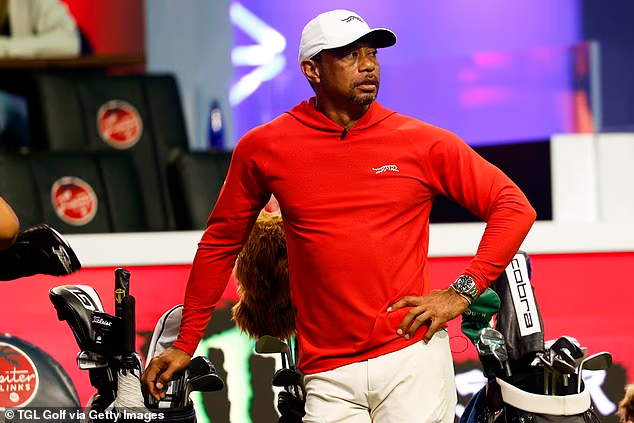
Here’s what I think actually tells us something about Tiger’s true status: Jupiter Links, his TGL team, just made the finals and will face Los Angeles Golf Club starting Monday. Tiger remains in the manager’s chair, not the player’s seat. That’s telling.
If there were any genuine confidence about making the Masters—or any major field—we’d probably see Tiger pushing harder to get back into competitive golf immediately. Instead, he’s managing a team, keeping his competitive edge without the physical demands of full PGA Tour golf, and being refreshingly honest about the up-and-down nature of recovery.
The Masters runs April 9-12. We’ll get our answer then, one way or another. Whether Tiger decides to play will tell us far more about his actual condition than any statement ever could.
My gut says he shows up at Augusta. I’m not sure he plays, but he’ll be there. Because that’s Tiger—always chasing, always believing. Just sometimes believing looks different at 50 than it did at 30.
