

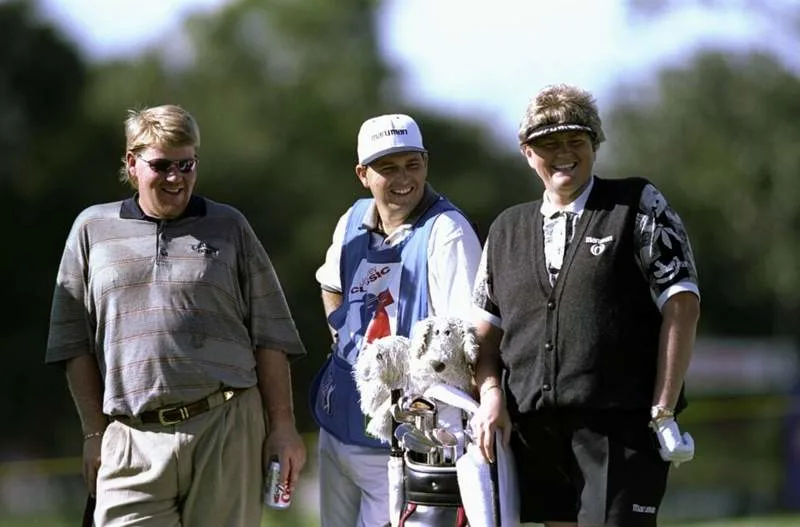

John Daly’s 355-Yard Carry Still Haunts Us—And It Should
I’ve been covering professional golf for 35 years, and I’ve seen a lot of remarkable things on the PGA Tour. But every so often, something surfaces that makes you stop and think: “What if?” Laura Davies’ recent commentary about John Daly’s 1998 JC Penney Classic appearance at Innisbrook Resort did exactly that for me.
What strikes me most about this story isn’t just the raw distance—though 355 yards through the air in 1999 is absolutely staggering. It’s what that number represents: a window into a different era of golf, one where pure athleticism and hand-eye coordination ruled the day, before equipment became the great equalizer. And honestly, it makes me wonder if we’re not romanticizing the distance problem just a bit.
The Day the Water Became Irrelevant
Let’s set the scene. The 16th at Copperhead Course (now home to the Valspar Championship) is no joke. A 439-yard dogleg right with water lurking for any drive that leaks toward the fairway’s right side. Thick trees and pine straw line the left. It’s routinely described as one of the toughest tee shots on the PGA Tour. Even now, in the age of 48-inch drivers and optimized golf balls, players respect that hole.
“John Daly hit driver over the water (on 16). It’s 355 to carry everything, and that was in 1999. I have to finish this story. I had 60 yards left into the green and I fatted it. The crowd actually booed me.”
There’s something beautifully honest about that quote from Davies. Here’s one of the longest hitters in women’s golf history—and I mean that literally and figuratively—standing in the gallery essentially saying, “He just removed an entire hazard from the equation.” That’s not strategy. That’s not club selection. That’s pure, unadulterated power making a course feature irrelevant.
What We Lost (And Gained) in 25 Years
Having caddied for Tom Lehman back in the day, I watched the evolution of equipment firsthand. The difference between a 1999 driver and a 2024 driver isn’t subtle—it’s transformative. Daly’s ball speeds allegedly reached 220 mph in his prime. If he was carrying 355 yards with late-90s technology, the math gets uncomfortable pretty quickly when you apply modern equipment to those numbers.
The article makes a compelling point that bears repeating: Daly averaged over 300 yards off the tee in six out of seven seasons from 1997 to 2003. Given today’s technology improvements, those numbers would likely translate to 340+ yards in the modern era. That’s not speculation—that’s extrapolation based on measurable data.
I think what fascinates me most is this: we’ve spent the last decade debating distance on the PGA Tour, wondering if we’ve let things get out of hand. Meanwhile, we had a guy doing this nearly 30 years ago with equipment that was primitive by today’s standards. John Daly didn’t need a launch monitor to hit it past 350 yards. He just needed his natural ability and a driver that weighed about as much as a grapefruit.
The JC Penney Classic: A Format We Underestimated
Here’s something else that strikes me about this story: the JC Penney Classic itself deserves more reverence than it gets in golf’s historical memory. That tournament ran from 1989 to 1999 and featured mixed teams of PGA and LPGA Tour players. It was format golf at its finest—better-ball and foursomes (alternate shot), which meant course management mattered as much as raw power.
Daly and Davies won a playoff at 24-under-par for four rounds, defeating Paul Azinger and Se Ri Pak. In my three decades covering the tour, I’ve seen plenty of scramble formats that favor distance hitters, but this one was different. You needed the short game. You needed course knowledge. You needed a partner who could bail you out when things went sideways.
Davies’ self-deprecating comment about fatting an approach shot with 60 yards to the pin? That’s real golf. That’s what makes mixed-team events special. The format forced honesty in a way that no individual tournament ever could.
The Hypothetical That Haunts Us
“Wouldn’t it be great to see Daly in his prime hitting a modern driver and golf ball? He may well be even longer than the likes of Bryson DeChambeau, Marco Penga and Aldrich Potgieter.”
Now here’s where I need to pump the brakes a little. I don’t think Daly would necessarily be longer than DeChambeau—Bryson’s a different breed, and his entire physiology has been engineered for distance in ways that go beyond equipment. But the hypothetical is worth entertaining, and it’s worth asking seriously: at what point does distance become less about talent and more about resources?
In my experience, the best players adapt to their era. Daly was long for his time because he was exceptionally talented and exceptionally strong. If you gave him modern equipment, he’d be formidable. If you gave DeChambeau equipment from 1999, he’d still find a way to be competitive. That’s what separates the truly great players from the merely very good ones.
What this story really tells us is that the distance conversation isn’t new. We’ve just been living in denial about it. The PGA Tour didn’t suddenly become a long-drive competition in 2015. It became one gradually, starting with players like Daly who understood that the farther you hit it, the easier the game becomes. Modern equipment just amplified what was always true.
The 16th hole at Copperhead Course got smaller that day in 1999, not because the course changed, but because one man made it irrelevant. That’s not a bug in professional golf—it’s a feature. And until we come to terms with that, we’re going to keep having the same argument about distance that we’ve been having for a quarter-century.
